Social Media Addiction: Signs, Dangers & Breaking Free

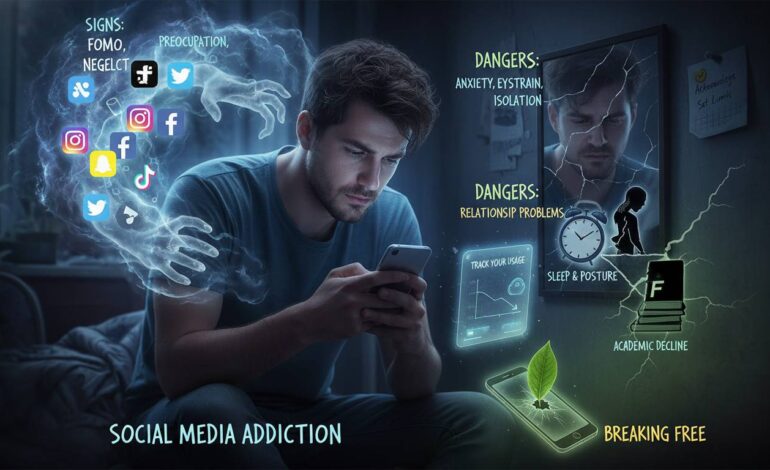
Smartphones have become extensions of ourselves, and millions of Americans find themselves trapped in an endless scroll, checking notifications at all hours, feeling anxious when disconnected. Social media addiction has become one of the biggest mental health concerns of the digital age, affecting users across all age groups—but teenagers and young adults bear the brunt of it.
This guide looks at the signs, the risks, and what actually works for breaking free.
What Is Social Media Addiction?
Social media addiction is a pattern of compulsive behavior around social platforms that interferes with daily life, relationships, and mental well-being. It’s not an official clinical diagnosis yet, but mental health professionals recognize it as a behavioral addiction—with the same hallmarks as substance use disorders: tolerance, withdrawal, and losing control.
“Social media platforms are designed to deliver intermittent variable rewards—likes, comments, shares—that trigger dopamine release in the brain’s reward pathway,” says Dr. Anna Lembke, a professor of psychiatry at Stanford University and author of “Dopamine Nation.” “This creates a powerful reinforcement loop that can hijack our motivation systems.”
Research in the journal Computers in Human Behavior suggests about 5-10% of social media users fall into problematic use. That’s tens of millions of people.
Recognizing the Signs
You don’t have to be addicted to use social media a lot. But when several of these become persistent habits, there’s a problem:
Behavioral signs:
- Losing hours to scrolling without realizing it
- Feeling anxious or restless when you can’t access platforms
- Reaching for social media every time you feel bad
- Neglecting work, school, or responsibilities
- Hiding your usage from others
- Fighting with people you care about over your phone habits
Psychological signs:
- Constant fear of missing out (FOMO)
- Mood swings tied to likes, comments, and engagement
- Can’t focus on anything without checking notifications
- Sleep problems from late-night scrolling
- No interest in hobbies or activities you used to enjoy offline
A 2023 APA survey found nearly 60% of adults and 75% of teenagers check social media multiple times a day. Many described it as automatic—a habit rather than a choice.
Why Do Some People Get Addicted?
Both personal vulnerabilities and platform design play a role.
Individual factors:
- Low self-esteem: Likes and followers can feel like a measure of worth
- Social anxiety: Social media seems safer than face-to-face interaction, but it can also reinforce avoiding real connection
- Depression and loneliness: The irony is that platforms marketed as connection tools often make isolation worse
- Impulsivity: Some people are simply more prone to addictive behaviors
Environmental factors:
- Peer pressure and cultural expectations around being always “on”
- Jobs that require social media presence
- Not much else going on—few offline hobbies or social ties
What platforms do:
This is the uncomfortable part. Social media companies deliberately design their products to be addictive. Variable rewards (sometimes you get engagement, sometimes you don’t), infinite scroll, autoplay, push notifications—these aren’t accidents. Stanford’s Persuasive Technology Lab has studied how these techniques exploit basic human needs for validation and information.
The Real Consequences
The effects go way beyond “wasting time.”
Mental health:
Research consistently links heavy social media use with anxiety and depression. A major study in JAMA Network Open looked at over 500,000 adolescents and found a clear association between time spent on social media and depressive symptoms. Comparing your actual life to everyone else’s highlight reel will do that to you.
The “phantom vibration” effect—imagining your phone buzzing when it hasn’t—shows up in about 90% of smartphone users. That’s how deep this stuff gets.
Sleep and physical health:
Blue light from screens messes with your circadian rhythm. The National Sleep Foundation says 95% of Americans use devices in the hour before bed. Poor sleep makes everything else worse, including mental health. It’s a vicious cycle.
Focus and productivity:
After checking email or social media, it takes workers an average of 23 minutes to get back on task, according to UC Irvine research. That’s a massive drain on productivity.
Relationships:
Here’s the irony: platforms designed for connection often damage real relationships. Research in the Journal of Social and Personal Relationships found that couples who use more social media report lower relationship satisfaction. Family dinners get interrupted. Conversations fragment. You’re physically present but mentally elsewhere.
How to Break Free
There’s no single solution. You need to tackle both the behavior and what’s driving it.
Practical steps that actually help:
- Delete social media apps from your phone. Keep them on a tablet or computer you don’t constantly hold.
- Turn off push notifications for everything except actual calls and texts.
- Designate phone-free times: no devices in the bedroom, no scrolling during meals.
- Use built-in screen time tools (iPhone’s Screen Time, Android’s Digital Wellbeing) to track and limit usage.
- Try a 24-hour break each week. Some people call it a “digital sabbatical.”
Psychological approaches:
Cognitive behavioral therapy (CBT) works well for identifying and changing the thought patterns that drive compulsive use. Mindfulness practices help you notice the urge before you automatically act on it.
“The goal isn’t complete abstinence for most people,” says Dr. Nina Vasan, founder of the Stanford Brainstorm Lab. “It’s developing a healthy relationship. Ask yourself: am I using social media, or is it using me?”
Find real connection:
Social media fills a real need—validation, belonging, connection. But it does it poorly. Join a club, volunteer, take a class, play sports. These provide the real human interaction that likes and comments only pretend to offer.
When to get professional help:
If your social media use is destroying your daily functioning, causing severe distress, or happening alongside depression or anxiety, talk to a therapist. Behavioral addictions are their specialty.
Conclusion
Social media addiction is a real mental health challenge, but it’s treatable. Recognize the signs, understand what’s happening in your brain, and make concrete changes to your digital habits. The goal isn’t to ditch technology—it’s to use it intentionally instead of letting it use you.
Common Questions
Is this a real diagnosis?
Not in the DSM-5 yet. But mental health professionals take it seriously. The APA recognizes it as clinically significant, and many therapists treat it using frameworks from other behavioral addictions.
How much is too much?
Research suggests under 30 minutes a day is probably fine for most adults. But it’s less about the number and more about whether your use is intentional, doesn’t mess with sleep, and doesn’t cause distress when you can’t access it.
Are teenagers more vulnerable?
Yes. Adolescent brains are still developing—specifically the prefrontal cortex, which handles impulse control. Teens also face extra pressure around identity and social comparison. About 15-20% of adolescents report problematic use, and the mental health impact tends to hit harder than for adults.
What apps help reduce usage?
Freedom blocks apps and sites across devices. Moment tracks screen time. Both iPhone and Android have built-in tools now—no download required.
Does social media cause depression, or do depressed people just use it more?
Both. It’s a feedback loop. Heavy use contributes to depression, and depressed people often use more compulsively as a way to cope. Breaking either side of the cycle helps.
Can I use social media for work without getting addicted?
Yes, but you need boundaries. Keep professional and personal accounts separate. Set strict schedules. Define what “success” looks like so you’re not chasing engagement emotionally the way you would personally.