Why Some People Get Invited to Studies Every Week


If you’ve signed up for a consumer research panel, checked your email on a Tuesday morning, and watched a friend boast about completing five paid studies that month while your inbox sits empty, you’ve probably asked yourself what gives. The frustration is real, and it’s not just bad luck. There’s actually a well-engineered system behind every study invitation, and once you understand how it works, you can position yourself to get invited far more often.
Research panels don’t distribute invitations randomly. They’re running businesses that need specific types of respondents to deliver accurate data to their clients—and those clients are willing to pay premium rates for people who match very particular profiles. Understanding this mechanism is the difference between feeling like you’re shouting into a void and actually building a consistent stream of study opportunities.
This article breaks down exactly why some people receive invitations weekly while others stay perpetually invisible to panel algorithms. I’ll explain the factors that drive invitation frequency, show you what you can actually control, and debunk the myths that keep most people from ever maximizing their participation potential.
The Demographic Targeting Machine
Every study that gets launched has a client behind it with very specific requirements. A beverage company launching a new energy drink needs 25-to-34-year-olds who consume energy beverages at least three times weekly. A healthcare system researching patient satisfaction needs recent visitors to emergency departments in specific zip codes. A tech company testing a new app interface needs iPhone users in urban areas who have downloaded at least ten apps in the past month.
This targeting is the main reason invitation frequency varies so dramatically. If your demographic profile happens to align with what clients are actively buying—which changes month to month, quarter to quarter—you’ll get flooded with opportunities. If your characteristics are less commercially valuable during a particular period, you might wait months between invitations.
Panel platforms like Prolific, Respondent, or UserInterviews maintain detailed demographic databases on every participant. When a client submits a study requirement, the algorithm immediately filters through millions of profiles to find matches. The tighter the client specifications, the smaller the eligible pool—and the more invitations those matching participants receive.
Geographic location matters a lot here. Clients frequently restrict studies to specific countries, states, or metropolitan areas based on where they’re launching products or measuring brand awareness. Someone in a major metropolitan area like New York, Los Angeles, or Chicago will almost always receive more invitations than someone in a rural region, simply because more studies target urban populations for market research purposes.
Income level and employment status also play a significant role. Certain product categories—like luxury goods, financial services, or business-to-business software—require participants at specific income brackets. If you fall into a bracket that’s currently in demand, your invitation rate will reflect that demand.
Profile Completeness: The Hidden Multiplier
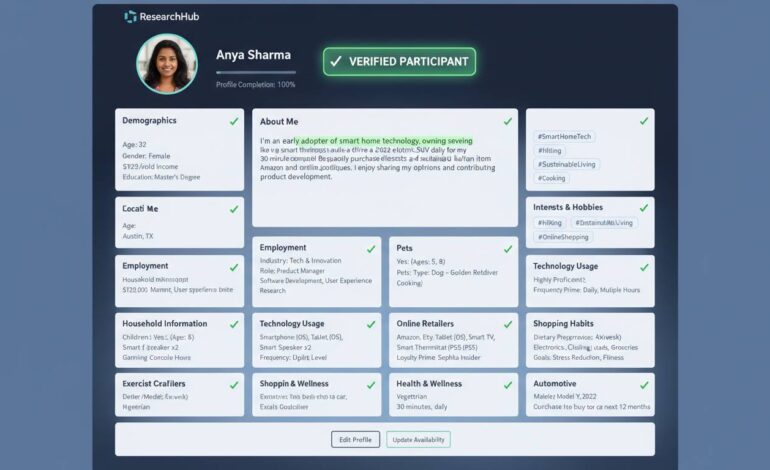
Here’s something most participants don’t realize: your profile completeness score directly affects your invitation priority. Research panels reward thoroughness because it reduces their own risk. A complete profile means the panel can confidently match you to studies, which means fewer screening failures, faster project completion, and happier clients.
Most panels display a profile completion percentage somewhere in your account settings. If you’re sitting at 60 or 70 percent, you’re essentially invisible to the matching algorithm. Panels have thousands of participants with nearly complete profiles, so why would they waste invitation slots on someone who might not qualify?
Completing your profile means filling out every single available field—not just the obvious ones like age and income, but the granular details too. What brands of coffee do you buy? How many vehicles does your household own? What streaming services do you subscribe to? These seemingly irrelevant questions are exactly what clients are paying for, and having them on file makes you exponentially more valuable as a participant.
Set quarterly reminders to log in and update any information that might have changed. Got a new job? Updated your household composition? Started a new medication? These changes can suddenly make you eligible for studies that weren’t available before.
Activity Level and Responsiveness Patterns
Panels track not just whether you qualify for studies, but how you behave once invited. Participants who respond quickly to invitations and maintain high completion rates get preferential treatment in future invitations. It makes business sense—panels want reliable participants who don’t waste their clients’ time with no-shows or partial completions.
If you receive an invitation and either ignore it or decline it repeatedly, the algorithm interprets this as disengagement. Your invitation frequency will gradually decrease. Conversely, participants who accept invitations within hours of receiving them and consistently complete studies in full become “high-value” users who receive priority access to new studies.
This is why you should adjust your notification settings to ensure you actually see invitations when they arrive. If you’re using a panel that offers browser notifications, email alerts, or SMS messages, enable all of them. Studies with tight participant quotas can fill within minutes of going live. Being fast matters.
Some platforms also reward consistent login activity. Logging into your panel account even when you don’t have pending invitations signals to the system that you’re an active user. Some algorithms even send test invitations to active users to gauge responsiveness before rolling out larger campaigns.
The Referral Ecosystem
Many research panels operate referral programs that create network effects. When you refer a friend who then becomes active, both you and your friend often receive bonus invitations or priority access to future studies. Panels do this because referred participants tend to be more engaged—they joined because someone they trusted vouched for the experience.
If you’re consistently getting invited while your friend who signed up the same day never sees anything, check whether you’re in a referral relationship with a highly active user. Your panel might prioritize invites to participants who are part of referral chains that have demonstrated strong retention.
Some panels also have community features or tiers. Top contributors sometimes gain access to exclusive study opportunities that aren’t released to the general pool. Engaging genuinely with the platform—providing thoughtful open-ended responses, participating in beta features, completing feedback surveys about the panel itself—can elevate your status in ways that translate to more invitations.
Common Myths Keeping You From Getting Invited
The internet is full of advice about study invitations, and much of it is either outdated or simply wrong. Let’s address the misconceptions that are probably hurting your invitation count.
Myth: Invitations are completely random. This is perhaps the most damaging myth because it leads to resignation. Nothing about the invitation process is random. Every single invitation goes to a specific profile that matches specific criteria. If you’re not getting invitations, it’s because your profile doesn’t match current client needs—not because of bad luck.
Myth: Once rejected from a study, you’re blacklisted forever. Panels need large pools of qualified participants. Excluding someone permanently for one screening failure would be terrible business logic. What actually happens is that temporary mismatches get noted in your profile, but these expire or get overwritten as your profile updates. Don’t let a single rejection deter you from continuing to participate.
Myth: You need special qualifications for most studies. While some studies genuinely require specialized expertise—healthcare professionals, software developers, business executives—the vast majority of consumer research targets general populations. The qualification that matters most is matching the specific demographic combination a client needs at that moment, not having impressive credentials.
Myth: There’s a cap on how much you can earn. Some platforms do limit total earnings or number of studies per month to prevent professional survey-takers from skewing data, but these limits are typically quite generous. For most people participating legitimately, earnings caps won’t be the reason they’re not receiving invitations.
What Research Panels Actually Want
Understanding the business model behind research panels clarifies why certain behaviors get rewarded. Panels act as intermediaries between researchers (their clients) and participants. Their reputation depends on delivering accurate, high-quality data quickly. Every screening failure, every no-show, every incomplete study reflects poorly on the panel and puts their client relationship at risk.
This is why panels obsess over response rates and completion quality. A panel that consistently delivers participants who show up and finish gets preferred treatment from clients. That panel therefore gets more studies to distribute. The participants on that platform benefit from more opportunities.
Panels also value participants who provide substantive feedback in open-ended questions. Clients pay for insights, not just checkbox answers. If you consistently write detailed, thoughtful responses, you’re demonstrating exactly the quality that makes a panel’s clients happy. Some panels even have quality-control mechanisms that flag participants who rush through open-ended questions with minimal effort.
Finally, panels need participants who represent rare or difficult-to-reach demographics. If you’re a left-handed vegetarian who owns a small business and lives in a specific region, you might receive invitations at dramatically higher rates than average—because your combination of characteristics is uncommon, and clients specifically need people like you to ensure their data represents all segments of the population.
Practical Strategies to Increase Your Invitation Frequency
Now for the actionable part. If you’ve read this far, you already understand why invitations vary. Here’s exactly what to do about it.
First, join multiple research panels. Don’t limit yourself to one platform. Prolific, Respondent, UserInterviews, Respondent.io, and dozens of smaller panels each serve different client bases. A study that requires participants in your demographic might be running on one platform but not another. Having accounts on five panels instead of one multiplies your exposure by five.
Second, complete every profile field on every platform. That obscure question about your annual grocery spending? That’s probably exactly what a food company client is filtering for. The time you spend updating profiles pays dividends in invitation frequency for months or years afterward.
Third, check your panels daily, multiple times per day. Set specific times—morning, lunch, evening—and make checking for new studies part of your routine. Studies with limited quotas can disappear within minutes. Being first matters.
Fourth, respond to invitations immediately, even if you’re unsure about your qualifications. The screening process happens after you click, not before. If you think you might qualify, take the chance. Panels prefer participants who demonstrate enthusiasm.
Fifth, if a platform offers mobile apps, install them and enable notifications. Being able to respond to invitations when you’re away from your computer dramatically increases your capture rate for time-sensitive opportunities.
Sixth, maintain high completion rates on every study you start. This seems obvious, but the data shows that participants who start studies and abandon them without finishing receive fewer future invitations. Always complete what you begin, or decline politely before starting if you know you won’t have time.
Frequently Asked Questions
Why do I never get surveys? The most likely reason is that your profile doesn’t match current client needs, or your profile is incomplete. Update every field, check daily, and consider joining additional platforms. Also verify that your email notifications aren’t being filtered into spam folders.
How do study invitations work? Research panels maintain databases of participant demographics. When clients submit study requirements, the panel’s algorithm identifies matching participants and sends invitations, typically prioritizing participants with high activity scores and complete profiles.
Can I get invited to more studies? Yes. Increase your profile completeness, join multiple panels, check for new studies frequently, and maintain high completion rates. Each of these actions improves your algorithmic priority.
Are survey sites fair? The invitation system is designed to match client needs, not to distribute opportunities equally. This means some demographics receive more opportunities than others based on commercial demand. The system isn’t designed to be unfair—it’s designed to be accurate for research purposes.
What if I’ve been rejected from many studies? Rejection is normal and doesn’t permanently affect your standing. Focus on updating your profile to match studies you’re more likely to qualify for, and continue participating. Screening failures are part of the process for everyone.
The Bottom Line
Getting invited to studies consistently isn’t about luck—it’s about understanding the matching system and positioning yourself favorably within it. Your demographic profile, your activity patterns, your profile completeness, and your platform presence all combine to determine how often you’ll see opportunities land in your inbox.
The participants who get invited weekly aren’t necessarily more qualified than you. They’re usually just more visible to the algorithm, more responsive to invitations, and more thorough in their profile maintenance. These are all things you can control starting today.
If you’ve been frustrated by the invite-or-not experience, treat this as an opportunity to audit your approach. Update every profile field. Check your platforms daily. Join a few more panels. The difference in invitation frequency isn’t minor—it’s often the difference between a few studies a year and a steady stream of opportunities.