Which Smartwatch Should You Buy for Fitness in 2025?

Picking a fitness smartwatch in 2025 really comes down to what you’re actually going to use. If you need the most accurate tracking, better battery life, and sports-specific features, Garmin owns the fitness-focused market. Apple Watch wins on ecosystem integration if you’re already in the Apple world, and Samsung Galaxy Watch gives Android users solid health monitoring without compatibility headaches. There’s no single “best” watch—it depends on your main sport, how much you want to spend, and which phone you carry. This guide lays out everything you need to decide.
What Actually Matters in a Fitness Smartwatch
Before getting into specific models, you need to know which features will actually help your training and which are just marketing fluff.
GPS accuracy is probably the most important feature for runners, cyclists, and anyone exercising outdoors. Without built-in GPS, your watch has to rely on your phone’s location, which kills battery and often gives you less accurate distance data. Every major fitness smartwatch in 2025 has built-in GPS, but the precision varies quite a bit. Garmin and Apple tend to be the most reliable here, while some cheaper options struggle in cities with tall buildings blocking signals.
Battery life is where things get interesting. Some watches give you 18 hours of active use, others push past 10 days. If you want to track multi-hour runs or back-to-back workouts, or just don’t want to charge every day, this matters a lot. Usually it comes down to picking between a full smartwatch experience or a device that’s mainly for fitness.
Heart rate monitoring has gotten much better. Optical sensors now use multiple LEDs and improved software, but they still have problems with certain skin tones, tattoos on the wrist, and activities with a lot of arm movement. Chest straps are more accurate for serious athletes, though most people find optical sensors work fine for regular training.
Water resistance matters more than people think. A 5ATM rating means you can swim and shower with it, but it’s not the same as a dive computer. If you swim laps, look for watches with pool swim tracking and open-water modes specifically.
Top Fitness Smartwatches for Different Needs
Best Overall Fitness Watch: Garmin Forerunner 965
Garmin keeps dominating fitness watches with the Forerunner 965. It’s a solid mix of serious training features and something you’d actually wear every day. Battery goes up to 23 days in smartwatch mode and about 31 hours with GPS on—plenty for even ultramarathons.
The training readiness score is what makes this stand out. It looks at your sleep, recovery, and recent workout load, then tells you whether you’re ready to push hard or should take it easy. This has genuinely changed how a lot of athletes train, giving them actual data instead of just going by feel.
The Forerunner 965 has topographic maps, course navigation, and multi-band GPS for better accuracy in tough spots. It tracks over 30 activity profiles—running, cycling, strength training, HIIT, yoga, you name it. The touchscreen works well, and physical buttons are there when you need them, which matters when your hands are sweaty.
The price is the main drawback. Around $600, it’s not cheap. You also don’t get as many smartwatch features as Apple or Samsung—no app store, limited music storage. But if you’re focused on fitness, these trade-offs are usually worth it.
Best for iPhone Users: Apple Watch Series 9
The Apple Watch Series 9 isn’t really a fitness-first device, but it’s become one of the most popular fitness trackers anyway because it does both things well. If you have an iPhone, the tight integration makes it the obvious choice—you get fitness tracking without giving up smartphone features.
The Series 9 added double-tap gesture control, so you can use the watch during workouts without breaking your stride. The S9 chip lets Siri process requests on the device, which feels noticeably faster. Health features include blood oxygen monitoring, ECG, and temperature sensing for cycle tracking.
Battery life is the weak spot. You’ll charge it every day or every other day depending on how hard you work out. The always-on display is bright and easy to read outside, but it uses a lot of power. If you’re coming from a Garmin, this is the hardest adjustment.
GPS tracking works fine for running and cycling, though some testers notice a small distance difference compared to dedicated GPS watches. The Workout app has grown a lot, with guided sessions for strength, yoga, and HIIT. Apple Fitness+ has video workouts too, but it costs extra.
The aluminum case keeps it light at about 38 grams, comfortable for all-day wear. The third-party fitness app selection is huge—you can find specialized apps for just about any sport or training method.
Best for Android Users: Samsung Galaxy Watch 6 Classic
Samsung’s Galaxy Watch 6 Classic is a good middle ground between fitness features and smartwatch stuff, making it the top pick for Android users who don’t want to compromise.
The rotating bezel is nice for navigation—it’s way easier to scroll through workout data or menus with wet or sweaty fingers compared to touchscreen-only watches. The Super AMOLED display is easy to see in direct sunlight, which is a common complaint about some other watches.
Health tracking includes body composition analysis that measures skeletal muscle mass, body water, and body fat percentage. That’s more than standard fitness metrics and gives you a fuller picture of your physical condition. Blood pressure monitoring and ECG are available where Samsung has regulatory approval.
Workout tracking covers over 100 exercises, with automatic detection for common activities like running, swimming, and cycling. The running coach feature gives real-time guidance on pace and form, helpful if you’re training for a specific time goal.
Battery life sits between Apple and Garmin—roughly two days with normal use, less if you leave the always-on display on and do GPS workouts. The Galaxy Watch 7 is out now, but the 6 Classic is still a good deal at lower prices, and the newer version only has small improvements.
Best Budget Fitness Watch: Fitbit Charge 6
Fitbit has had some changes—Google bought the company and is slowly folding it into the Google ecosystem. But the Fitbit Charge 6 is still a great value for fitness-focused users who don’t need full smartwatch features.
At around $160, it’s a fraction of the price of premium options while still delivering solid fitness tracking. Battery lasts about seven days, so you charge it once a week instead of daily. Heart rate tracking works comparably to more expensive devices for moderate activities, though high-intensity interval training can cause some variation.
The Charge 6 adds Google integration—Google Maps for navigation and YouTube Music controls. These feel a bit added-on given Fitbit’s fitness-first design, but they’re useful extras without the high price. Google Photos lets you use photos as watch faces, which is a fun personalization option.
Workout tracking covers about 40 exercise modes, with automatic recognition for walking, running, cycling, and swimming. Sleep tracking is still a Fitbit strength, giving detailed sleep stages and a daily sleep score that helps you understand how well you’re recovering.
The trade-off is the smaller screen and limited apps. You can’t respond to messages, download third-party apps, or make contactless payments (though NFC is there for Google Pay). For a lot of people, this simplicity is actually nice—a fitness tracker that tells time, not a mini computer on your wrist.
Best for Outdoor Athletes: Garmin Fenix 7 Pro
The Garmin Fenix series has been the pick for serious outdoor adventurers for years, and the Fenix 7 Pro keeps that going with real improvements. This is a tool for mountaineers, ultra-runners, and anyone whose training takes them far from civilization.
The multi-band GPS with multiple LEDs gives you excellent accuracy in tough conditions—deep canyons, thick forest, or cities where signals bounce around and cause problems. Maps come preloaded with topo maps for most regions, with turn-by-turn navigation for trails and roads. The flashlight, first added in earlier Fenix models, is surprisingly useful for early morning runs or camping.
Training features match the Forerunner line—training readiness, performance conditions, recovery recommendations. But the Fenix adds climbpro, which shows real-time gradient information during ascents, essential for cyclists and trail runners dealing with changing terrain.
The build quality matches the price. The titanium bezel and fiber-reinforced polymer case can take a beating. Water rating goes to 10ATM, fine for diving and high-pressure water sports. Solar charging significantly extends battery life in bright conditions—Garmin says up to 22 days in smartwatch mode with solar.
The size might be too much for casual fitness users. The 47mm case is big, and some people think it’s too large for daily wear. If you mostly run on treadmills or lift weights at the gym, the Fenix is overkill. But for outdoor enthusiasts, nothing else comes close.
How to Choose Based on Your Primary Activity
Running
For serious runners, the choice usually comes down to Garmin Forerunner 965 or Apple Watch Series 9. The Forerunner has better battery life, more advanced pacing features, and training load analysis built specifically for runners. The Apple Watch is better if you want your watch to do more than just track runs.
Garmin’s Running Power metrics, which need a compatible foot pod, give you real-time power output similar to cycling power meters. This helps runners keep steady effort across different terrain—serious runners are starting to care about this more.
Swimming
Pool swimmers should care most about stroke detection and length counting accuracy. Apple Watch and Garmin devices both do this well, while Fitbit’s swimming tracking is more basic. Open water swimmers need GPS tracking and compass features, which makes Garmin the clear choice.
Samsung’s Galaxy Watch tracks swimming okay but doesn’t quite match the dedicated swim features of Garmin or Apple. If swimming is your main sport, try the watch in a pool before you buy.
Strength Training and HIIT
Regular fitness trackers aren’t great for activities without GPS, but modern smartwatches handle weights and gym work much better now. What matters most is automatic exercise detection, rep counting (available on some models), and heart rate tracking during movements with lots of arm motion.
Apple Watch is ahead on rep counting for strength workouts, automatically detecting when you’re doing reps and tracking volume. Garmin’s strength profile records specific exercises, though you often need to enter things manually. Samsung’s Galaxy Watch has similar features and lets you use Bixby voice to log exercises.
Cycling
Cycling-specific smartwatches exist, but most cyclists prefer dedicated bike computers. If you want one device for running and cycling, check that it can pair with external sensors (speed, cadence, power meters). Garmin devices have the most complete cycling ecosystem, including bike radar and smart light integration.
Apple Watch works fine for cycling with the Workout app, though you might need to carry your phone for navigation. Samsung’s Galaxy Watch has cycling modes but doesn’t support as many advanced sensors as Garmin.
Emerging Trends to Consider
AI-powered coaching is showing up more and more. Garmin’s adaptive training plans and Apple’s training load analysis look at your past data to give personalized recommendations—basically virtual coaching without paying someone. It’s not the same as a real coach, but it’s useful.
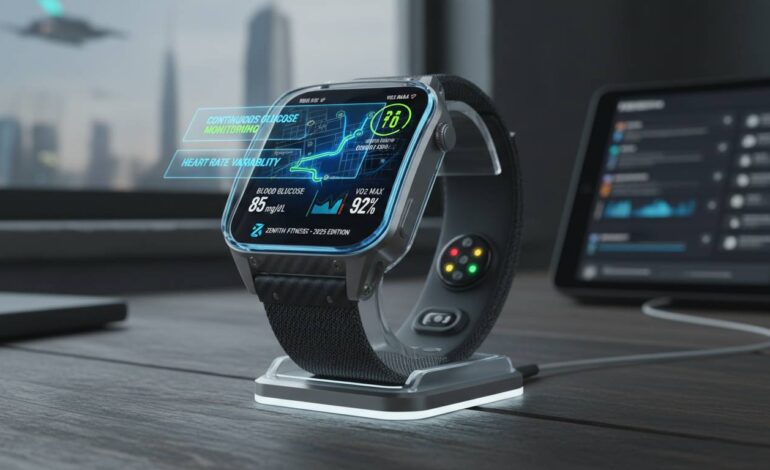
Blood glucose monitoring is the next frontier. Samsung has gotten regulatory approval for blood glucose estimation using infrared spectroscopy, a way to measure blood sugar without needles. This could be huge for diabetes management. The tech is still developing, but expect big things in 2025 and beyond.
Satellite connectivity for emergency features is expanding beyond Apple’s Emergency SOS via satellite. This could become standard on premium devices, giving safety features for people who go where there’s no cell service.
Integration with continuous glucose monitors is growing. Fitbit and Garmin both work with Dexcom and similar devices. This helps users see how diet and exercise affect blood sugar, useful for people managing diabetes and anyone interested in metabolic health.
Making Your Final Decision
Your ideal fitness smartwatch depends less on which device is objectively “best” and more on which features match what you’ll actually use.
If you’re a serious athlete doing structured training, Garmin devices give you better analysis and battery life. If you want something versatile that handles fitness tracking but also works well as a smartwatch, Apple Watch or Samsung Galaxy Watch are better picks. If money matters most, the Fitbit Charge 6 gives you great value without cutting the core fitness features.
Think about how often you upgrade too. Apple Watch users usually replace every 2-3 years, while Garmin users often keep devices for 4-5 years. That affects the real cost over time, not just the purchase price.
Try devices in person if you can. Wrist size, weight, and button layout are things you won’t know until you wear them. A lot of people find out they prefer physical buttons over touchscreens after trying both during workouts.
Conclusion
The fitness smartwatch market in 2025 has great options at every price point and for every use case. Garmin stays the pick for serious athletes who want the most advanced training metrics and excellent battery life. Apple Watch is the best all-around choice for iPhone users who care about ecosystem integration. Samsung makes the most complete Android-compatible device, and Fitbit offers amazing value for people who want simplicity and long battery life.
Start with an honest look at how you’ll actually use the watch. A feature-packed Garmin doesn’t matter if you never charge it. Apple Watch’s apps don’t help if you want five days between charges. Match the technology to your habits, not to what marketing tells you to want.
However you decide, modern fitness smartwatches have capabilities that would have seemed impossible just a few years ago. The data they collect helps you train smarter, recover better, and understand your body in ways that used to require expensive lab equipment.
FAQs
Which smartwatch has the best battery life for fitness tracking?
Garmin watches have the best battery life by far. The Fenix 7 Pro can go over 20 days in smartwatch mode, while the Forerunner 965 handles ultramarathons with 30+ hours of GPS tracking. Apple Watch and Samsung Galaxy Watch usually need charging every day or two.
Is Apple Watch good for serious fitness training?
Apple Watch Series 9 is great for most fitness users. It has comprehensive health tracking, tons of apps, and reliable workout detection. But serious athletes often prefer Garmin for its advanced training metrics, better battery life, and sports-specific analysis tools.
Do I need ECG and blood oxygen features?
ECG monitors your heart rhythm and can detect atrial fibrillation—potentially life-saving if you’re at risk. Blood oxygen monitoring gives you insights into respiratory health and sleep quality. These matter more if you have specific health concerns, though many people find the data interesting but don’t really do much with it.
Can I swim with any fitness smartwatch?
Most modern fitness watches are at least 5ATM water resistant, meaning they’re fine for swimming and showering. But water resistance wears down over time, and hot tubs or saunas can damage the seals. Check your specific model’s rating, and don’t press buttons underwater unless the maker says it’s safe.
Should I get a chest strap heart rate monitor?
Chest straps give more accurate heart rate data than optical wrist sensors, especially during high-intensity activities with lots of arm movement. They’re worth it if you’re training for specific heart rate zones or want to compare metrics across activities. Most fitness watches can connect to external chest straps via Bluetooth or ANT+.
How often should I replace my fitness smartwatch?
Most people replace fitness smartwatches every 3-5 years. Batteries eventually degrade and become less usable, and newer models have meaningful improvements in sensor accuracy and software. Premium Garmin devices often last longer than Apple Watches because they have simpler battery demands and don’t depend as much on cellular technology advances.