What Dinosaur Has 500 Teeth? Facts About the Nigersaurus

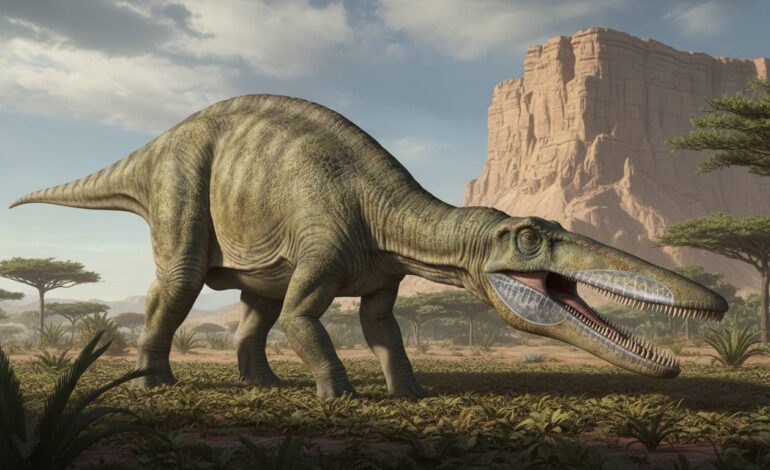
The dinosaur with 500 teeth is Nigersaurus taqueti, a bizarre sauropod famous for its vacuum-like, square muzzle packed with more than 500 teeth—including both active and replacement teeth—continuously renewed approximately every 14 days .
Why Nigersaurus Had So Many Teeth
Nigersaurus stood out in a crowd of colossal dinosaurs—not for its size, but for its dental design. This sauropod’s wide, squared-off snout served like a built-in mower. It grazed low-growing vegetation, like ferns and horsetails, by sweeping its jaw side‑to‑side. That grinding action, along with abrasive grit and silica in its diet, caused rapid tooth wear—so it evolved a conveyor‑belt system of teeth to stay effective .
Its unique “dental batteries” were arranged in vertical columns—about 60 in the upper jaw and 68 in the lower—each with up to nine replacement teeth. That amounts to over 500 teeth either in use or queued beneath .
Interestingly, these teeth were asymmetrical, with enamel ten times thicker on the outer side—likely an adaptation to resist wear from constant grazing .
Anatomy That Made It Unique
Lightweight, Yet Sturdy
- The skull and bones of Nigersaurus were exceptionally light—thin enough that light could pass through some fossils .
- The skeleton was highly pneumatized, meaning it had internal air spaces, a trait shared with modern birds .
Mouth Designed for Grazing
- All its teeth were aligned at the very front of its jaws—a rare trait among tetrapods .
- The muzzle likely had a keratinous sheath, a horny covering similar to a beak, which may have helped in cropping plants .
Posture and Senses
- Inner-ear anatomy and skull orientation suggest Nigersaurus habitually held its head downward, optimizing ground-level feeding .
- Despite large nostrils, its olfactory brain region was underdeveloped, indicating a poor sense of smell—not a priority for a low-level grazer .
Discovery & Research
- Fossils were first noted mid‑20th century by Philippe Taquet in Niger, but the full significance only emerged when Paul Sereno’s team rediscovered the site in 1997 and formally described the dinosaur in 1999 .
- In 2007, researchers used CT scans to digitally reconstruct its fragile skull—the first time such technology was applied in this way for a dinosaur .
A “Mesozoic Cow” in Context
Nigersaurus is often nicknamed the “Mesozoic cow.” Not because of its size—but because, like grazing cows, it ate low grasses and foliage all day using a wide, sweeping mouth . This unique niche contrasts with most sauropods, which reached high into trees for leaves. Nigersaurus reminds us that ancient ecosystems supported a wide range of feeding strategies—even among titanic herbivores .
Why It Still Matters
This dinosaur demonstrates how evolution can produce extreme specializations. Its unique skull, rapid tooth replacement system, and light build were finely tuned to its environment and diet. Studying Nigersaurus helps clarify how dinosaurs diversified their feeding strategies and adapted to avoid competition. It stands as a powerful example of form following function—even among the giants that once roamed Earth .
“Nigersaurus evolved a body plan that allowed it to dominate a feeding zone closer to the ground… It was a sauropod equipped with its own built‑in conveyor belt for teeth.”
Summary: What Makes Nigersaurus So Special
- Held over 500 teeth arranged in front‑of‑jaws dental batteries.
- Replaced its teeth approximately every 14 days.
- Possessed a light, air‑filled skeleton and a broad, keratin-sheathed muzzle.
- Had poor smell but specialized inner-ear anatomy for grazing posture.
- Offered a fresh perspective on sauropod diversity—feeding low like a “Mesozoic cow.”
Nigersaurus remains a vivid illustration of how unusual adaptations emerge in response to ecological demand—and how discovering one bonebed in the Sahara changed our view of dinosaur feeding strategies.
FAQs
Q: Is Nigersaurus the only dinosaur known with 500+ teeth?
A: Yes. Its dental system—over 500 teeth including replacements—is unique among known dinosaurs. Other herbivores, like hadrosaurs, also had dental batteries, but with far fewer teeth .
Q: How fast did Nigersaurus replace its teeth?
A: Around every 14 days, scientists count daily growth lines in the teeth to estimate this rapid replacement rate, the fastest known among dinosaurs .
Q: What did Nigersaurus eat?
A: It grazed on soft, low-lying plants like ferns, horsetails, and early flowering plants. Grass hadn’t evolved yet during its time (~110 million years ago) .
Q: Why did Nigersaurus evolve such an unusual mouth and jaw?
A: Its environment and abrasive, low-level diet selected for a wide, front‑loaded mouth and continuous tooth replacement. This allowed efficient grazing and minimized competition with high-feeding sauropods .
Q: When was Nigersaurus first described?
A: Fossils were noted mid‑20th century, but the species was formally described in 1999 by Paul Sereno and colleagues. Digital reconstructions came in 2007 .
Q: What does its skeleton tell us about its lifestyle?
A: Its light, hollow bones and downward-facing head show adaptation for low grazing—not tall browsing. It was efficient and specialized to its niche .