What Desirability Studies Measure That Usability Tests Miss

Most product teams operate with a fundamental blind spot. They pour resources into usability testing—watching users complete tasks, measuring time-on-task, counting errors—and walk away confident they’ve understood their audience. Then a product launches with pristine usability scores and catastrophic adoption rates. The interface works. Nobody wants to use it.
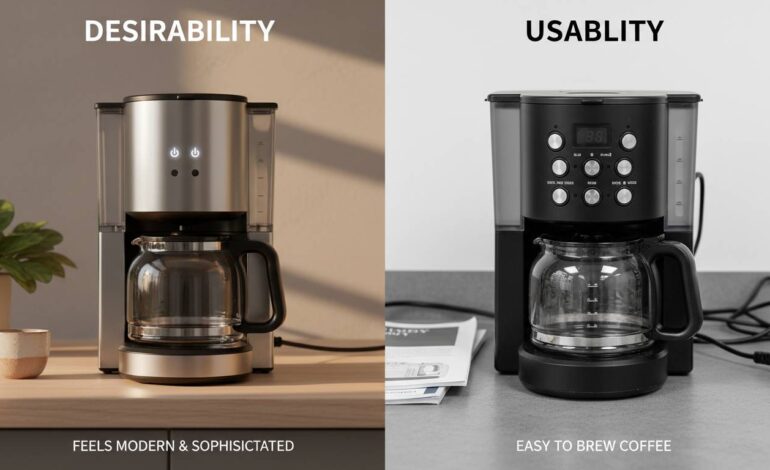
This isn’t a failure of usability testing. It’s a misunderstanding of what usability testing was designed to measure. There’s an entire dimension of user experience that most teams never examine until it’s too late: desirability. The emotional, psychological, and attitudinal layer that determines whether someone actually wants a product—not just whether they can figure out how to use it.
Desirability studies and usability tests answer fundamentally different questions. One asks: “Can users accomplish their goals?” The other asks: “Do users want this product in the first place?” Treating them as interchangeable is why so many technically sound products fail in the market.
A desirability study captures users’ emotional responses, attitudes, and perceived value toward a product or concept. Unlike usability testing, which measures task performance, desirability studies measure how a product makes users feel and whether it aligns with their self-image, values, and aspirations.
The most common format involves presenting users with a product or concept, then asking them to select adjectives from a standardized list that describe their reaction. The Microsoft Desirability Toolkit, released in 2003 and still widely used, provides 118 adjectives spanning dimensions like trustworthiness, excitement, sophistication, and warmth. Users select five to ten words that best capture their impression, and researchers analyze the distribution to identify gaps between the intended brand positioning and actual user perception.
Other methodologies include open-ended emotional response interviews, forced-choice comparative studies where users select between multiple concepts, and more sophisticated approaches like the PrEmo emotional response instrument developed by Pieter Desmet, which measures both positive and negative emotions across specific categories.
The critical insight is that desirability studies operate at the attribution level. They’re measuring what users project onto a product—what it says about them, what it makes them feel about the company behind it, and whether it fits into their mental model of what they want to use. This is fundamentally different from behavioral data about task completion.
Understanding Usability Studies
Usability testing, by contrast, is a behavioral research methodology focused on measuring how effectively users can complete specific tasks. The standard approach involves giving users task scenarios—”Find the pricing page,” “Complete a purchase,” “Set up your profile”—and then observing whether they succeed, how long it takes, and where they encounter friction.
The field was formalized in the 1980s, with Jakob Nielsen’s work at Bell Labs and later at Nielsen Norman Group establishing the now-standard metrics: task completion rate, time on task, error rate, and satisfaction scores (typically measured through the System Usability Scale or SUS). These metrics provide quantifiable, comparable data about interface efficiency.
Modern usability testing spans a spectrum from moderated in-lab sessions to unmoderated remote studies using tools like UserTesting, UserInterviews, or Lookback. Between-subjects designs compare different interface versions. Within-subjects designs test the same users across multiple iterations. Quantitative usability testing applies statistical analysis to larger sample sizes, while qualitative testing prioritizes understanding the “why” behind user behavior.
The strength of usability testing is its objectivity. You’re watching what users actually do, not what they say they do. The limitation is equally fundamental: usability testing tells you nothing about whether users want to be there in the first place. A user can complete every task flawlessly and still leave thinking your product is embarrassing, cheap, or wrong for them.
Key Differences Between Desirability and Usability Studies
The distinction becomes clearer when you examine what each methodology explicitly does and does not measure:
| Dimension | Usability Study | Desirability Study |
|---|---|---|
| Primary focus | Task performance | Emotional response |
| Data type | Behavioral | Attitudinal |
| Typical metrics | Completion rate, time-on-task, errors | Attribute ratings, emotional valence |
| Question answered | “Can users complete this task?” | “How do users feel about this product?” |
| Best timing | During iterative development | At concept stage and post-launch |
| Sample requirements | 5-15 users for qualitative | 15-30 users for reliable attribution data |
| What it misses | User motivation, emotional connection | Task efficiency, error patterns |
A product can score excellently on usability and poorly on desirability. This isn’t hypothetical—it’s why usability professionals push so hard for organizations to invest in both. The classic example is Microsoft’s 2009 launch of Kin, a phone designed for social media enthusiasts that was technically sound but positioned so awkwardly that users felt embarrassed to be seen with it. The usability was fine. The desirability was fatal.
What Desirability Studies Capture That Usability Studies Miss
The gap between these methodologies isn’t academic—it directly impacts business outcomes. Here’s what desirability studies reveal that usability testing simply cannot:
Emotional Response and First Impressions
Usability studies typically begin after users have agreed to participate in research. They’ve already made a micro-commitment. They’re in a testing mindset. The first impression data you get from usability testing is contaminated by the research context itself.
Desirability studies are designed to capture the initial, visceral reaction. When you ask users to select adjectives after first exposure to a product—before they’ve started troubleshooting—you’re measuring what psychologists call the “affective tag.” This is the emotional watermark that shapes all subsequent interaction. If a product feels “corporate” or “unfriendly” in that first moment, users will interpret every subsequent interaction through that lens.
Research by Tobler et al. (2008) on first impressions and website credibility found that aesthetic appeal accounts for up to 75% of credibility assessment in the first 50 milliseconds. No usability test captures this because by the time you’re measuring task performance, users have already formed an impression you’re no longer measuring.
Perceived Value and Willingness to Pay
Usability testing measures whether a product works. Desirability testing measures whether a product is worth paying for. These seem related but are surprisingly independent.
Consider a SaaS product with excellent usability—fast, intuitive, error-free. If users perceive it as “overpriced” or “not worth it,” they won’t convert regardless of how smooth the interface is. Desirability studies can capture this perception before you’ve built the entire product.
Maximum Difference Scaling, often used in desirability research, asks users to choose between different feature sets and pricing scenarios. This reveals not just what users say they want, but what they’re actually willing to sacrifice for—a fundamentally different insight than usability data.
This is where desirability studies become strategically invaluable. You can optimize a product to within an inch of its life for task efficiency and still fail because you never validated whether the value proposition resonated. Airbnb’s early research famously included desirability dimensions—they wanted to understand not just whether users could book a stay, but whether the experience felt like “belonging” and “trust.” That emotional positioning turned out to be the actual product, not the interface.
Brand Perception and Self-Image Alignment
Here’s something most product teams discover too late: users choose products that say something about them. A user who thinks your product is “for beginners” or “for enterprise” or “not for someone like me” will not use it, regardless of usability.
Desirability studies with attribute-based methodologies capture this alignment. When users select adjectives like “professional,” “creative,” “trustworthy,” or “innovative,” they’re describing not just the product but their own identity in relation to it. If your target audience selects attributes that conflict with their self-image, you have a desirability problem, not a usability problem.
The gap between self-image and product perception explains why technically superior products lose to inferior competitors. Apple’s iPod wasn’t the first MP3 player with better battery life or storage—it was the first one that made users feel cool. That feeling is pure desirability.
Attitudes Toward Change and Competitors
Usability studies measure performance with your product. Desirability studies can measure attitudes toward your category overall. When you ask users how they feel about your product versus competitors—not which is easier to use, but which they’d prefer—you get insight into preference formation that task-based testing cannot provide.
This matters because switching costs are rarely purely functional. Users stick with products they feel attached to, even when better options exist. Understanding the emotional component of loyalty lets you design for retention, not just acquisition.
When to Use Each Method
The timing of desirability versus usability research matters as much as the methodology itself.
Desirability studies are essential at three points:
-
Concept validation — Before building anything, desirability testing reveals whether the proposed value proposition resonates. If users don’t find the concept desirable, no amount of usability iteration will save it.
-
Rebranding or repositioning — When your product or company is trying to shift perception, desirability studies measure whether the shift landed. You can have perfect usability and still be perceived as “the old version.”
-
Post-launch diagnostics — When adoption lags but usability metrics look fine, desirability studies identify the perception gap. This is where you discover users think you’re “too complicated” or “not for them” despite easy task completion.
Usability studies are essential during:
-
Iterative development — Once a concept has desirability validation, usability testing guides interface refinement. Each iteration should be more usable than the last.
-
Competitive analysis — Usability benchmarking reveals where your interface falls short against specific competitors on specific tasks.
-
Accessibility validation — Ensuring users with disabilities can complete tasks is a usability concern, not a desirability concern.
The mistake most teams make is treating usability as the default investigation method. They usability test everything—concepts, redesigns, new features—because it’s familiar, because leadership understands it, because it produces clean numbers. Desirability remains unmeasured until something goes wrong.
A Framework for Choosing the Right Method
Rather than thinking about which study is “better,” think about which question you need answered:
If you’re asking “Can users figure this out?”—run usability testing.
- Will this workflow work for target users?
- Where are the friction points in the current design?
- How does this compare to the previous version?
- Are there accessibility barriers?
If you’re asking “Do users want this?”—run desirability testing.
- Does this concept appeal to our target audience?
- How do users perceive our brand relative to competitors?
- What emotional response does this design trigger?
- Is there a gap between our intended positioning and actual perception?
If you’re asking both questions—which is most projects—you need both methods, in that order. Validate desirability first. If the concept fails that test, saving it through usability optimization is a fool’s errand. Only after desirability is confirmed should you invest in making the product usable.
This sequence protects against the most expensive product development mistake: building something technically excellent that nobody wants.
Combining Both Methods for Complete User Insights
The most effective research programs integrate desirability and usability data rather than treating them as separate silos. This integration reveals insights neither method captures alone.
Consider a scenario: usability testing shows users complete a checkout flow in 45 seconds with a 98% completion rate. Strong numbers. But desirability data reveals users describe the experience as “stressful,” “suspicious,” and “impersonal.” The product works. It makes users feel uncomfortable. Unless you measure both, you don’t know there’s a problem.
Integration also enables prioritization. When desirability research identifies that users perceive your product as “complicated,” and usability research shows they struggle most with the onboarding flow, you’ve identified a specific problem with a specific location. The desirability insight gives you the “why” behind the usability data.
Practical integration approaches include:
-
Sequential studies: Run desirability research on concepts, then usability testing on refined designs. Compare emotional response data with behavioral data at each stage.
-
Concurrent mixed methods: In moderated sessions, combine task completion observation with post-task emotional response questions. Ask not just “did you complete this?” but “how did you feel doing it?”
-
Longitudinal tracking: Measure both desirability and usability at multiple points in the user journey. This reveals whether emotional response changes as users gain experience—and whether usability improvements actually improve perception.
This integrated approach is what separates mature research programs from those still treating usability as a synonym for user experience.
The Honest Limitation
I want to be clear about what desirability studies cannot do. They cannot predict market success with certainty. They capture stated attitudes, which correlate with but do not guarantee behavior. A user can say your product feels “innovative” and still choose a competitor for reasons that have nothing to do with emotion—price, availability, habit.
Desirability is also vulnerable to social desirability bias. Users in research contexts may give answers they think you want, or may not have the self-awareness to articulate their true reactions. This is less of a problem in usability testing, where behavior is observed directly.
The most honest framing is this: desirability studies measure one critical component of product success. They don’t replace usability data—they complement it. Ignoring either dimension means operating with half the picture.
The teams that get this right don’t choose between desirability and usability. They build both into their research cadence, in the right sequence, asking the right questions at the right time. That’s what separates products that work from products people actually want.