Volume of Hemisphere: Formula, Calculation & Example

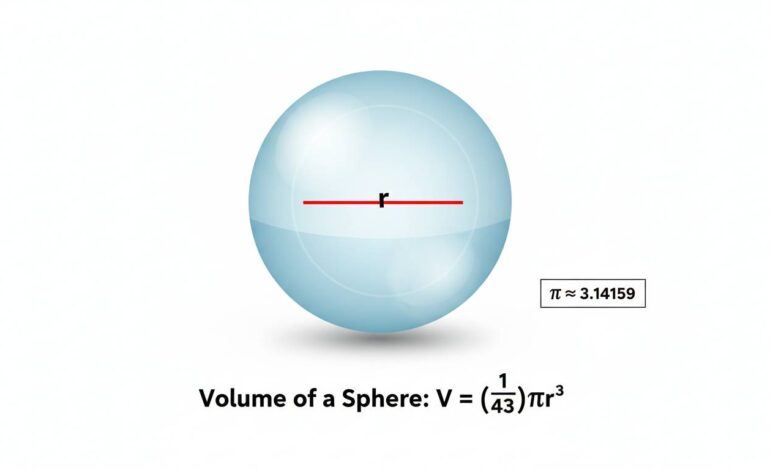
The volume of a hemisphere (half of a sphere) is calculated using the formula V = (2/3) × π × r³, where r is the radius. In plain terms: take two-thirds of the volume of a full sphere (which is (4/3)πr³), and you get the hemisphere’s volume immediately.
What Exactly Is a Hemisphere’s Volume?
A hemisphere is simply half of a sphere. In everyday cases, you might imagine something like a dome on top of a building or a bowl sliced in two. That shape is our hemisphere.
- A sphere has volume:
V_sphere = (4/3) × π × r³ - A hemisphere cuts that in half:
V_hemisphere = ½ × V_sphere = ½ × (4/3)πr³ = (2/3)πr³
That’s your straightforward formula: V = (2/3) × π × r³.
Why It Works: Breaking Down the Math
1. Deriving It from a Full Sphere
Start with the full-sphere formula, (4/3)πr³. Splitting that in two gives (2/3)πr³ exactly—done and dusted.
2. Geometric Reasoning
There’s also a more visual way to see why it’s two-thirds. If you slice a sphere down the middle, each half contains two-thirds of the original volume’s “weight” in a uniform sense. It checks out with calculus too, but that’s a bit more involved.
3. A Bit of History and Context
The full sphere formula is famously tied to Archimedes. His clever methods laid the groundwork. Later, mathematicians applied similar logic or calculus to carve out that clean two-thirds proportion for hemispheres.
Step-by-Step: How to Use the Formula in Practice
Here’s a simple walkthrough:
Step-by-Step Calculation Example
Say you have a hemisphere with a radius of 5 units. Here’s how you do it:
-
Cube the radius:
r³ = 5³ = 125 -
Multiply by π:
125 × π ≈ 125 × 3.1416 ≈ 392.7 -
Take two-thirds:
(2/3) × 392.7 ≈ 261.8
So the hemisphere’s volume is about 261.8 cubic units.
It’s that easy. You cube, multiply by π, then scale by two-thirds.
Why It Matters—Real-World Uses
In Architecture
Dome builders need to calculate volume for materials. If you’re making a half-dome structure, you need to know how much concrete or space that half form will require.
In Manufacturing
Think of things like hemispheric storage tanks or domed components. Knowing the volume tells you about capacity or how much material is needed.
In Nature & Science
Hemispherical geometry shows up in nature—think raindrops (almost spheres) or half-globe patterns. In labs, scientists might measure properties of hemispherical droplets or lenses. Quick volume formulas can be surprisingly handy there.
Practical Examples
1. Big Dome, Light Materials
Imagine designing an acoustic dome in a concert hall with r = 10 meters.
– r³ = 1,000
– Full sphere volume ≈ 4,188.8 m³
– Hemisphere (two-thirds) ≈ 2,792.5 m³
That tells you how much air space there is, which directly affects acoustics and material choice.
2. Small Sports Bowl
Say you’ve got a half-spherical bowl with r = 0.2 meters.
– r³ = 0.008 m³
– Hemisphere volume ≈ (2/3) × π × 0.008 ≈ 0.0168 m³ (about 16.8 liters)
Neat and simple, right?
Diving a Bit Deeper: Limits, Tips, and Variations
Units Matter
Make sure r is in the right units. If that’s in centimeters, your volume comes out in cubic centimeters. Always keep units consistent.
Pi Accuracy
You don’t need π to many decimals for normal work. 3.1416 is fine for most everyday tasks. Save 3.14159265+ for high-precision science.
Hemisphere vs. Hemispheroid
Heads-up: a hemisphere isn’t the same as a stretched or squashed half-globe (a hemispheroid). That has a different formula entirely. Keep the radius uniform if you’re using (2/3)πr³.
Quick Comparison Table (Skimmable)
Here’s a fast glance of the key parts:
- Shape | Radius (r) | Volume Formula | Units
- Hemisphere | r | (2/3)πr³ | cubic units
- Full Sphere | r | (4/3)πr³ | cubic units
- Example r = 5 | – | ≈ 261.8 | cubic units
Why It Feels So Clean (A Bit of Intuition)
- Halving a sphere isn’t the same as getting half the volume in some cases—but here, because of symmetry, it really is exactly half.
- The two-thirds emerges because (4/3)×½ simplifies neatly.
- Humans have messed with this for centuries—from geodesic domes to modern CAD software—and the formula stays solid.
“The beauty lies in its simplicity: half a sphere, two-thirds of the volume. A neat outcome from fundamental geometry.”
When You Might Need More Than Just the Volume
Sometimes volume isn’t the end of the story. You might want:
- Surface area of the hemisphere (needs 3πr² including the flat face)
- Center of mass (different for hemispheres vs. full spheres)
- Moment of inertia (relevant in physics/engineering)
Again, don’t confuse those needs—they’re separate formulas.
Should You Ever Use Integrals?
If you’re in calculus class, you might derive the volume via integration (stacking infinitely thin discs). It’s neat but overkill for casual use. Use (2/3)πr³ unless you need the process for learning or proof purposes.
Quick Recap Table
| Task | Formula / Value |
|————————————–|———————————–|
| Volume of hemisphere | (2/3) × π × r³ |
| Example (r=5) | ≈ 261.8 cubic units |
| Compare full sphere | (4/3)πr³ (twice the volume) |
| Surface area (hemisphere) | 3πr² (including base) |
| Use case | Domes, bowls, tanks, scientific models |
Putting It All Together
The volume of a hemisphere is neat, reliable, and absolutely vital across fields. Use the formula V = (2/3)πr³ whenever you’re working with half-spherical shapes.
Whether you’re in architecture, engineering, manufacturing, school projects, or just curious—you’ve got a clean, intuitive formula ready to go.
FAQs
How do I find the volume of a hemisphere?
Use V = (2/3) × π × r³, where r is the radius. It’s simply half the volume of a full sphere.
What if I know the diameter instead of the radius?
Divide the diameter by two to get the radius, then plug into the formula: (2/3)π(r³).
How accurate is π in this formula?
You typically use 3.1416 for everyday tasks. You only need more decimals for high-precision projects.
Do I need calculus to find hemisphere volume?
No. Calculus offers the derivation via integration, but it’s not needed for everyday use of the formula.
Is the surface area different?
Yes. The total surface area (including the base) is 3πr², not the same as the volume calculation.
Why (2/3) and not (1/2)?
Because the full sphere is (4/3)πr³, and half of that simplifies to (2/3)πr³. It’s exact and clean by design.
Final Thoughts
Grasping the volume of a hemisphere isn’t rocket science—it’s a simple, elegant piece of geometry that packs real-world punch. Clear formula, practical use, and easy to remember. Next time you see a dome or half-globe shape, you’ll know exactly how to tackle it.