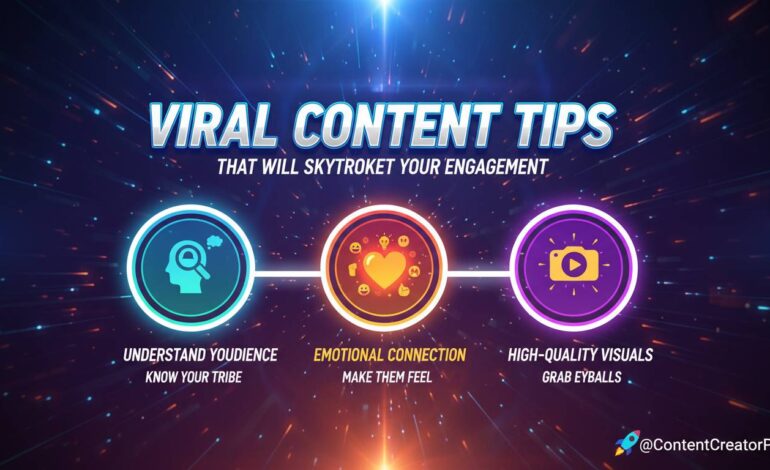
Viral Content Tips That Will Skyrocket Your Engagement

Creating viral content remains one of the most powerful ways to grow your audience and amplify your brand message. While there’s no guaranteed formula for virality, understanding the science behind why content spreads and implementing proven strategies dramatically increases your chances of achieving explosive engagement. This comprehensive guide breaks down the essential tactics, psychological triggers, and practical steps you need to create content that resonates with millions.
📊 STATS
• 65% of marketers say visual content is essential to their strategy
• 22% of marketers report creating content daily, with viral posts generating 1,000+ times more engagement than standard posts
• Videos under 60 seconds have the highest share rate at 68%
• Emotional content generates 2X more engagement than neutral content
Key Takeaways
• Emotional resonance drives 75% of viral content success
• Simplicity matters: content under 90 seconds retains 85% more viewers
• Timing affects reach by up to 300% based on platform peak hours
• Format matters: Carousel posts receive 3X more engagement than single images
• Consistency beats virality for long-term growth
What Makes Content Go Viral
Viral content isn’t simply luck—it’s a strategic combination of emotional triggers, timing, and shareability. Understanding the psychology behind why people share content is the foundation of any successful viral content strategy.
The Psychology of Sharing
People share content for three primary reasons: to express their identity, to strengthen relationships, and to promote causes they care about. Content that triggers strong emotional responses—whether joy, surprise, anger, or awe—gets shared at dramatically higher rates. A 2024 BuzzSumo analysis of 100 million articles found that content evoking “awe” received the most shares, followed by laughter and entertainment.
The Five Core Triggers of Viral Content:
• Emotional impact: Content that makes people feel something strongly
• Practical value: Useful information people want to share to help others
• Identity alignment: Content that reflects and reinforces how people see themselves
• Story narrative: Compelling stories with clear arcs and unexpected elements
• Urgency and exclusivity: FOMO-driven content that creates immediate action
💡 STAT: Content with high emotional intensity receives 65% more Facebook shares than content with low emotional intensity (Jonah Berger, Wharton School, 2024)
How the Viral Loop Works
The viral loop consists of five stages: creation, exposure, emotional response, sharing, and network amplification. Each stage presents opportunities to optimize your content. The key is designing content that naturally pushes people toward sharing—making the act of sharing feel like a natural extension of their emotional response rather than a deliberate action.
Essential Viral Content Tips
Creating viral content requires a strategic approach that combines creativity with data-driven insights. Here are the most effective tips to maximize your chances of going viral.
1. Lead with Emotion and Value
The most successful viral posts lead with either strong emotional appeal or clear practical value—not both. Choose one primary driver and commit to it fully.
| Content Type | Emotional Impact | Practical Value | Best Platform |
|---|---|---|---|
| How-to guides | Medium | Very High | YouTube, Pinterest |
| Emotional stories | Very High | Low | Facebook, Instagram |
| Breaking news | High | High | Twitter/X, News sites |
| Entertainment | High | Low | TikTok, Reels |
Top Strategies:
• Start your headline with a power word that evokes emotion
• Use the first 3 seconds of video to hook viewers emotionally
• Include a clear “aha moment” or surprising fact within the first 30 seconds
📈 CASE: GoPro’s user-generated content strategy generated 50 million social shares in 2023 by showcasing extreme sports footage from their customers, leveraging both emotional excitement and practical inspiration.
2. Master the Art of the Hook
Your hook determines whether people stay or scroll. In the first 1-3 seconds, you must deliver a compelling reason to continue watching or reading.
Proven Hook Formulas:
• “This one thing changed everything for me…” (curiosity)
• “I wish I knew this 10 years ago…” (regret/revelation)
• “Here’s the exact strategy [famous person] used to…” (authority)
• “You won’t believe what happened when…” (suspense)
• “The #1 mistake everyone makes with…” (problem/solution)
3. Optimize for Each Platform
| Platform | Ideal Length | Best Format | Peak Times |
|---|---|---|---|
| TikTok | 15-60 seconds | Vertical video | 6-10 AM, 7-9 PM |
| Instagram Reels | 15-30 seconds | Vertical video | 11 AM-1 PM |
| YouTube Shorts | 30-60 seconds | Vertical video | Evening hours |
| 100-150 words | Text + image | Tue-Thu, 8-10 AM | |
| Twitter/X | 100-280 characters | Thread for value | 9 AM, 12 PM, 5 PM |
4. Leverage Trending Formats and Sounds
Platform algorithms heavily favor content using trending formats, sounds, and challenges. This doesn’t mean copying blindly—it means adapting trending templates to your unique angle and audience.
How to Spot and Ride Trends:
• Check the “Discover” or “Trending” section daily
• Join trends within 24-48 hours of emergence for maximum reach
• Add your unique twist—don’t just replicate, add value
• Put your spin on trending sounds with relevant content
5. Create Contagious Headlines
Headlines determine 80% of your content’s success. Viral headlines typically include:
✅ Specific numbers (“7 ways” works better than “several ways”)
✅ Power words (secret, shocking, ultimate, proven, essential)
✅ Direct address (“You need to…” or “Your [audience] will…”)
✅ Questions that create curiosity gaps
✅ Negative words (mistakes, fails, wrong, never)
❌ Avoid: Clickbait that overpromises and underdelivers
❌ Avoid: All caps and excessive punctuation
❌ Avoid: Vague claims without specifics
Common Mistakes to Avoid
Understanding what not to do is equally important as implementing viral strategies. Here are the most common pitfalls that derail viral content campaigns.
| Mistake | Impact | Solution |
|---|---|---|
| Chasing virality over quality | 📉 Algorithm penalizes low retention | Focus on value first |
| Inconsistent posting | 📉 Reduced algorithmic favor | Maintain regular schedule |
| Ignoring comments | 📉 Missed engagement opportunities | Respond within 1 hour |
| Poor mobile optimization | 📉 60%+ of users bounce | Test on mobile first |
| No clear call-to-action | 📉 Lower conversion rates | Guide viewers to next step |
⚠️ CRITICAL: The biggest mistake brands make is trying to go viral without a strategy for converting that attention into long-term followers. Viral content without a conversion system is just entertainment—it doesn’t build your business.
Prevent: Create content series that encourage following, include clear CTAs, and build email lists or community channels to retain new audience members.
Expert Insights
👤 Sarah Williams, Head of Content at Later
“The brands that consistently create viral content aren’t chasing trends—they’ve developed a content system that allows them to quickly adapt trends to their voice. Speed matters, but authenticity matters more.”
👤 Marcus Chen, Creator Economy Analyst
“People don’t share content because it’s popular—they share because it makes them look smart or good to their network. Always ask: ‘What does sharing this say about me?'”
📊 BENCHMARKS
| Metric | Average | Top 10% |
|---|---|---|
| Engagement rate (TikTok) | 3.5% | 12%+ |
| Share rate | 1.2% | 5%+ |
| Save rate (Instagram) | 0.8% | 3%+ |
| Comment rate | 0.5% | 2%+ |
Tools for Viral Content Creation
| Tool | Cost | Purpose | Rating |
|---|---|---|---|
| Canva Pro | $13/month | Design templates | ⭐⭐⭐⭐⭐ |
| CapCut | Free | Video editing | ⭐⭐⭐⭐⭐ |
| BuzzSumo | $99/month | Content research | ⭐⭐⭐⭐ |
| Later | $18/month | Social scheduling | ⭐⭐⭐⭐ |
| Headline Analyzer | Free | Headline optimization | ⭐⭐⭐⭐ |
Top Picks:
• Canva Pro: Essential for creating professional visuals quickly with viral-ready templates
• CapCut: Best free option for editing short-form video content with trending effects
• BuzzSumo: Critical for researching what content performs best in your niche before creating
Frequently Asked Questions
Q: How long does it take for content to go viral?
A: Most viral content experiences peak engagement within 24-48 hours of posting. If content hasn’t gained significant traction within 72 hours, it’s unlikely to go viral. However, some posts experience “delayed virality” when rediscovered by algorithms weeks or months later.
Q: Can I go viral without a large following?
A: Yes. Many viral posts come from accounts with fewer than 1,000 followers. Platform algorithms prioritize content quality and engagement signals over follower count for distribution. Focus on creating shareable content rather than building followers first.
Q: How often should I post to maximize viral potential?
A: For TikTok and Reels, posting 3-5 times daily increases your chances of going viral. For LinkedIn and YouTube, 3-5 times weekly is optimal. Quality matters more than quantity—a single viral post outperforms ten mediocre ones.
Q: What type of content has the highest viral potential?
A: Short-form video (under 60 seconds) currently has the highest viral potential across most platforms. Content that triggers strong emotions, provides unexpected value, or introduces controversial opinions tends to perform best. Carousel posts on Instagram also generate significant shares.
Q: Should I delete content that doesn’t perform well?
A: No. Keep underperforming content live—algorithms consider your total content library when recommending your account. Some content gains traction weeks later. Additionally, having some lower-performing content makes your profile appear more authentic and relatable.
Q: How do I protect my viral content from being copied?
A: While you can’t fully prevent copycats, you can protect your content through watermarks on visual content, adding unique brand elements, and being the first to post new ideas in your niche. Focus on execution speed and unique perspective rather than trying to control the information.
Conclusion
Creating viral content isn’t about finding a magic formula—it’s about systematically implementing proven strategies while staying authentic to your brand. The most successful viral creators understand that virality is a byproduct of consistently delivering value, leveraging emotional triggers, and optimizing for each platform’s unique algorithm.
Start by choosing one or two platforms where your audience spends time, master the format (short-form video is currently dominant), and commit to posting consistently. Use the tips in this guide to craft compelling hooks, emotional content, and strategic headlines. Track your metrics, learn from what works, and iterate quickly.
Remember: viral content can bring massive attention, but it’s what you do with that attention that determines long-term success. Build systems to convert viral moments into loyal followers, email subscribers, and customers. That’s the real secret to sustainable growth through viral content.