TCS Salary Hike: Everything Employees Need to Know

TCS is India’s largest IT services company and one of the biggest private sector employers in the country. Every year, thousands of employees wait for the company’s annual salary revision announcements, which usually come out between April and October. The hike percentages, performance-based increments, and band-wise distributions make TCS compensation one of the most talked-about topics in India’s IT corridor. Whether you’re a fresh recruit wondering what to expect or a seasoned employee analyzing your increment, understanding how TCS structures its salary revisions can help you navigate your career decisions more effectively.
TCS Salary Hike 2025: Latest Update
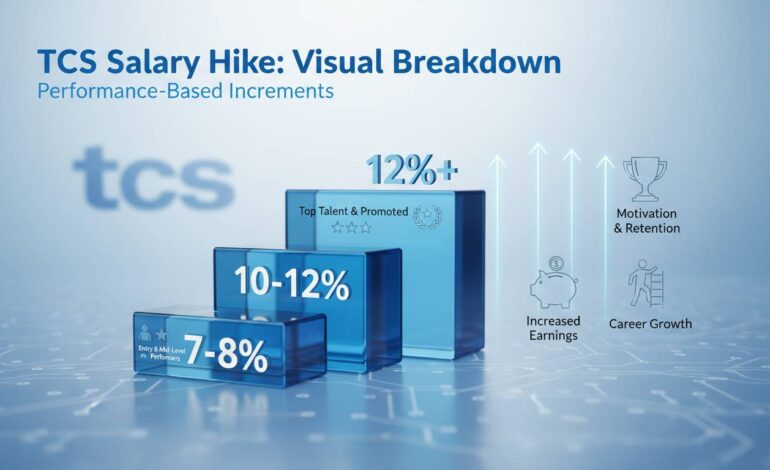
TCS announced its annual salary revision for fiscal year 2025. The company implemented increments ranging from 4% to 8% for eligible employees, with top performers in the upper bands receiving higher percentage increases. The revisions were effective from April 1, 2025.
The salary hike was rolled out in two phases to handle the logistics across TCS’s workforce of over 600,000 employees. Performance ratings play a crucial role in determining the increment percentage. Employees are rated between 1 and 5 on the company’s internal performance scale, and those with higher ratings receive more substantial increases.
Employees confirmed receiving official communication through the company’s internal portal, with detailed breakdowns of their revised salaries visible in the HR system. The hike applies to both on-site and remote workers.
Which TCS Employees Will Get the Increment
TCS categorizes its employees into performance bands, each carrying different increment percentages. The band system ranges from B1 to B5, with B1 representing the highest performers and B5 indicating those meeting expectations. Employees in the higher bands (B1 and B2) receive increments that can go up to 10-15%, while those in middle bands (B3) see increases around 6-8%. The lower bands receive more modest increments, typically in the 3-5% range.
Not all employees receive increments simultaneously. TCS follows a structured approach where the salary revision process considers multiple factors including joining date, previous ratings, and role-specific requirements. New joiners who completed their probation period before the announcement are eligible for the full hike, while those who joined recently might receive prorated increments.
The company also factors in industry experience and educational background when determining final compensation packages. Employees working in niche technology domains or those with specialized certifications often negotiate better increments during the revision cycle.
TCS Salary Hike History: A Five-Year Overview
Looking at the historical context of TCS salary revisions helps employees set realistic expectations and benchmark their growth against past trends. Over the past five years, TCS has maintained a consistent approach to annual increments, though the percentages have varied in response to market conditions and company performance.
In fiscal year 2024, TCS announced salary hikes ranging from 6% to 9% for eligible employees, with an average increment of approximately 7%. The 2023 revision saw slightly higher percentages, averaging around 8%, during the post-pandemic recovery period when talent was in high demand. The 2022 hike was more modest at 5-7%, while 2021 saw reduced increments of 3-6% due to pandemic-related business uncertainties. The 2020 revision was minimal, with most employees receiving 2-4% increases as the industry navigated unprecedented challenges.
This historical pattern shows that TCS typically maintains incremental growth even during challenging periods, though the exact percentages fluctuate based on broader economic conditions and the company’s financial performance. Employees who have been with TCS for three or more years tend to receive higher cumulative increases compared to their junior counterparts.
TCS vs Other IT Companies: Salary Comparison
The Indian IT services sector operates in a competitive talent market where salary hikes by major players directly impact each other. When comparing TCS with industry peers like Infosys, Wipro, and HCL Technologies, the compensation packages show interesting variations despite similar business models.
Infosys, TCS’s closest competitor, has historically offered slightly higher increments to counter attrition and attract top talent. In recent years, Infosys announced hikes ranging from 6.5% to 9%, marginally outpacing TCS in some bands. Wipro’s salary revision has been comparable to TCS, typically within the 5-8% range. HCL Technologies has taken a more conservative approach, with increments averaging 4-7% over the past two years.
Despite these differences, TCS remains the largest employer in the sector. Many professionals value the job security, learning opportunities, and brand name that TCS offers. The total compensation package at TCS often includes performance bonuses, stock options for senior employees, and healthcare benefits that supplement the base salary hike.
What TCS Employees Are Saying
Employee sentiment around salary hikes provides valuable insights into how the revisions translate to actual take-home compensation. Platforms like Glassdoor, Indeed, and various professional forums feature mixed reactions from TCS employees regarding the annual revisions.
Many employees appreciate the transparency of the band-based system and the predictability it offers. Those who consistently perform well report satisfaction with their increment percentages, noting that TCS rewards sustained high performance. Junior employees often express that the hikes are adequate for their career stage, though some feel the increments don’t fully match inflation rates.
Critics point out that the variable pay component can significantly impact total earnings, and the distinction between promised hikes and actual in-hand salary variations sometimes causes confusion. The company’s promotion cycle, which operates separately from annual salary revisions, also influences overall compensation growth for employees aspiring to move up the hierarchy.
Long-serving employees highlight that cumulative increments over multiple years have helped them achieve comfortable salaries, particularly when combined with promotions and internal role changes. The general consensus suggests that while TCS offers stable, predictable compensation growth, employees seeking rapid salary appreciation might need to leverage external opportunities or pursue internal promotions aggressively.
Understanding TCS Compensation Structure
Beyond the annual salary hike, TCS employees should understand the complete compensation architecture that determines their total earnings. The salary package consists of multiple components including basic pay, house rent allowance (HRA), special allowance, conveyance allowance, and variable pay.
The variable pay component, typically ranging from 10-20% of the total CTC (Cost to Company), gets disbursed quarterly or annually based on company and individual performance. This variable component can significantly fluctuate, meaning that two employees with identical fixed salaries might take home different amounts depending on their variable pay ratings.
TCS also offers additional benefits including medical insurance for employees and their families, provident fund contributions, gratuity payments, and learning opportunities through internal programs. Senior employees gain access to stock appreciation rights and restricted stock units, adding another dimension to their total compensation beyond monthly salary.
Conclusion
TCS salary hikes remain a critical factor for thousands of IT professionals building their careers in India’s tech sector. The 2025 revision continues the company’s tradition of performance-linked increments, with eligible employees receiving increases ranging from 4% to 8% based on their band ratings and contributions. While the percentages might seem modest compared to some industry peers, TCS compensates through job stability, benefits, and learning opportunities that support long-term career growth. Employees should focus on consistently delivering high performance to secure better increments and explore internal mobility options to maximize their compensation trajectory within the organization.