Social Media Privacy Concerns: How to Protect Your Data

Every click, like, and location check-in creates a digital trail that social media companies harvest, analyze, and monetize. With over 4.9 billion social media users worldwide, the scale of data collection has reached unprecedented levels, leaving millions wondering: just how much does Big Tech know about you, and what can you do about it?
The reality is stark—your personal information has become the most valuable commodity in the digital economy. Understanding the depth of social media privacy concerns and learning concrete protection strategies isn’t just wise; it’s essential for anyone who uses these platforms.
What Social Media Platforms Actually Collect About You
Social media companies gather far more data than most users realize. Beyond the obvious—your name, email, and birthday—these platforms construct intricate profiles using behavioral, contextual, and inferred data.
Explicit Data includes information you consciously provide: profile details, posts, photos, messages, and contact lists. This forms the foundation of your digital identity on each platform.
Behavioral Data tracks your every interaction: which posts you view and for how long, what you click, how long you scroll, your search queries, and even the device you’re using. A 2023 study by the Norwegian Consumer Council found that TikTok collects data on user interactions every 39 milliseconds during active sessions.
Inferred Data is even more concerning—algorithms analyze your behavior to predict your interests, political views, health conditions, personality traits, and future behaviors. Meta’s internal documents revealed that the company classified users into categories including “junk food lover,” “conservative,” “liberal,” “tennis enthusiast,” and even “easily influenced.”
According to a 2024 report by Surfshark, the average social media user generates approximately 1.7 MB of data per minute of active use. Over a year, that accumulates to nearly 900 MB—data that gets shared, sold, and leveraged in ways users never consent to explicitly.
The Data Broker Connection
Your social media data doesn’t stay on the platform. A 2023 investigation by The Markup revealed that Meta shares user data with over 1,900 third-party apps and services, many of whom resell this information to data brokers. These brokers compile detailed profiles that can include your income level, shopping habits, medical interests, and daily routines—information that insurance companies, employers, and advertisers can potentially access.
Real-World Consequences of Privacy Breaches
The risks aren’t theoretical—they manifest in concrete harms affecting real people’s lives.
Identity theft remains the most prevalent consequence. The Federal Trade Commission reported 1.4 million identity theft cases in 2023, with social media platforms serving as primary attack vectors. Criminals use publicly available information to answer security questions, hijack accounts, and open fraudulent lines of credit.
Employment discrimination has emerged as a serious concern. A 2023 CareerBuilder survey found that 70% of employers screen candidates on social media, with many making hiring decisions based on information unrelated to job qualifications—such as political beliefs, religious affiliation, or personal life details shared privately.
Targeted scams have grown exponentially more sophisticated. The FBI’s Internet Crime Report documented $10.3 billion in losses to internet fraud in 2022, with social media platforms facilitating the majority of romance scams and investment fraud. Attackers now use AI to clone voices and create convincing deepfake videos, making traditional verification methods obsolete.
Geolocation risks present particular danger. Research by The Guardian revealed that fitness apps like Strava inadvertently exposed the locations of military bases and secret facilities through user activity maps. Individual users have been stalked, robbed, or worse after sharing location data that revealed their daily routines.
Dr. Shady Wood, cybersecurity researcher at Johns Hopkins University, warns: “The拼接拼接danger with social media privacy isn’t just about ads following you—it’s about the irreversible nature of digital footprints. Once your data is harvested, you can’t unring that bell.”
How to Protect Your Data: A Step-by-Step Privacy Guide
Taking control of your social media privacy requires deliberate action. Here’s a comprehensive approach:
Audit Your Digital Footprint
Before tightening settings, understand what information is already public. Google yourself using variations of your name, check image reverse searches, and review what appears in search results. This baseline assessment reveals what others can see.
Master Platform Privacy Settings
Each platform offers granular controls, but they’re often buried in menus:
Facebook: Review the “Off-Facebook Activity” tool to clear history and disconnect future tracking. Restrict past posts to “Friends” only, and disable facial recognition in Settings > Face Recognition.
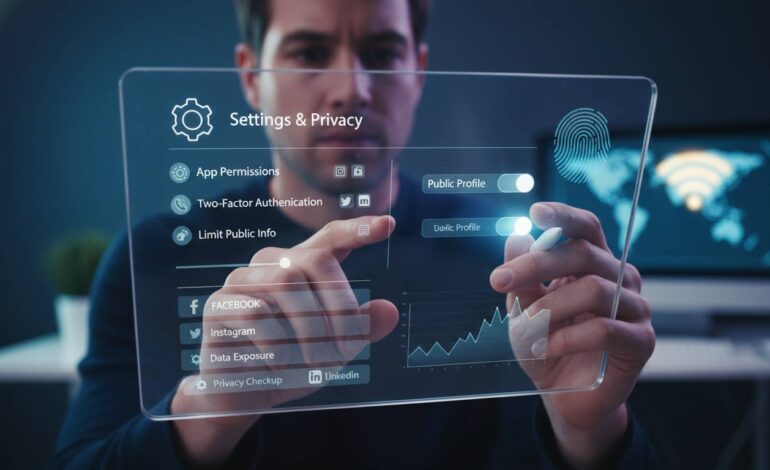
Instagram: Switch to a private account, disable activity status, and review which third-party apps have access through Settings > Apps and Websites.
TikTok: Disable personalized ads in Settings > Privacy, turn off “Suggest your account to others,” and restrict download settings to prevent others from saving your content.
Twitter/X: Protect your tweets if you want them seen only by followers, disable location tagging, and review connected apps regularly.
Limit What You Share
Ask yourself these questions before posting:
- Could this information help someone steal my identity?
- Would I be comfortable with this being public forever?
- Does this reveal my location or daily routine?
- Could this harm my professional reputation?
Professor Alessandro Acquisti, who studies privacy at Carnegie Mellon University, advises: “The most effective privacy protection is still not sharing in the first place. Once data leaves your device, you lose control of it permanently.”
Use Strong, Unique Passwords and Two-Factor Authentication
Each social media account should have a distinct, complex password of at least 16 characters. Enable two-factor authentication using an authenticator app rather than SMS, as SIM-swapping attacks increasingly target text-message codes.
Essential Privacy Tools and Settings
Several tools can significantly enhance your social media privacy:
| Tool/Feature | Function | Best For |
|---|---|---|
| VPN | Encrypts internet traffic, hides IP address | Public WiFi users, location masking |
| Privacy-focused browsers | Blocks trackers, prevents fingerprinting | Comprehensive protection |
| Password managers | Generates/stores unique passwords | Account security |
| Temporary phone numbers | Verifies accounts without real numbers | Reducing identity exposure |
| Data deletion requests | Forces platforms to remove your data | GDPR/CCPA compliance |
Requesting Your Data
Under the California Consumer Privacy Act (CCPA) and similar laws, you can request that platforms delete your data. Meta, Google, and TikTok all offer data download and deletion tools, though the process can be convoluted. Use these links:
- Facebook/Meta: Settings > Your Facebook Information > Download Your Information
- Google: myaccount.google.com > Data and Privacy
- TikTok: Settings > Account > Download your data
Common Privacy Mistakes to Avoid
Even privacy-conscious users make these errors:
Mistake #1: Using the same credentials across platforms
When one service suffers a breach, attackers try those credentials everywhere. Use unique passwords for every account.
Mistake #3: Accepting all app permissions
Flashlight apps requesting camera access, simple games asking for contact lists—these permissions often exceed what’s necessary. Review and revoke unnecessary access regularly.
Mistake #4: Posting while traveling
Sharing vacation photos in real-time announces that your home is empty. Wait until returning to post travel content.
Mistake #5: Ignoring platform policy updates
Social media companies routinely change privacy policies, often making them less protective. Review notifications when platforms update their terms.
The Future of Social Media Privacy
The privacy landscape continues evolving rapidly. Several trends will shape user protection in coming years:
Regulatory pressure is intensifying. The proposed American Privacy Rights Act would establish federal data protection standards, potentially giving users greater control over their information. The European Union’s Digital Services Act has already forced significant changes in how platforms handle user data.
Privacy-focused alternatives are gaining traction. Platforms like Mastodon, Lemmy, and BlueSky offer decentralized or alternative models that prioritize user control. While still niche, these platforms attract users disillusioned with Big Tech’s data practices.
AI-powered privacy tools are emerging. Services using artificial intelligence to detect doxxing attempts, identify oversharing risks, and automate privacy settings are entering the market, potentially making protection more accessible.
Browser fingerprinting advances mean traditional cookie-based tracking is being supplemented—or replaced—by methods that identify users based on device characteristics, making incognito modes less effective than many assume.
Katherine Lee, privacy researcher at Stanford’s Center for Internet Security, observes: “We’re at an inflection point. Users increasingly understand the trade they’re making, but they need better tools and stronger regulations to reclaim their digital autonomy.”
Frequently Asked Questions
Can I make my social media accounts completely private?
While you can restrict who sees your posts by adjusting privacy settings to “Friends Only” or “Private,” no platform guarantees complete privacy. Platforms still collect data about your activity, and determined actors can potentially access information through social engineering or legal requests. Complete anonymity on social media is essentially impossible.
Does deleting my social media account remove my data?
Not automatically. Most platforms retain some data even after account deletion, and information you shared with others—such as photos or messages—remains on their recipients’ accounts. You must explicitly request data deletion through the platform’s privacy tools, and even then, complete removal isn’t guaranteed.
Should I use my real name on social media?
Using a pseudonym provides some protection against doxxing and identity theft, but many platforms require real names for verification. Consider using your actual name for professional networking (LinkedIn) while using pseudonyms for personal expression. Never use your full legal name if you’re concerned about being found by abusive ex-partners, stalkers, or others who might harm you.
How do I know if my data has been compromised in a breach?
Monitor HaveIBeenPwned.com for email addresses associated with your accounts. Enable breach notifications from your password manager if it offers this feature. Watch for unexpected password reset emails, unfamiliar login alerts, or sudden changes in your account settings—these often indicate compromise.
Is it safe to use social media login for other apps?
Using “Login with Facebook” or similar options is convenient but creates security risks. If the third-party app suffers a breach, attackers gain access to your social account. Additionally, these logins often grant broader permissions than necessary. Use platform-specific passwords or dedicated single-sign-on solutions instead.
What information should I never share on social media?
Never share: your full birthdate (especially the year), home address, phone number, Social Security number, financial information, vacation plans, photos of children with identifiable information, answers to common security questions, or real-time location while at home. Even seemingly innocent details can be combined to create convincing phishing attacks or identity theft attempts.
Protecting Your Digital Future
Social media privacy concerns aren’t going away—they’re intensifying as platforms develop more sophisticated tracking methods and AI makes data analysis more powerful. The good news is that you have agency.
Every privacy setting adjusted, every unnecessary permission revoked, every thoughtful decision about what to share adds up. While you can’t eliminate all digital exposure, you can dramatically reduce it.
Start with one action today: review one platform’s privacy settings, or audit what information you’ve made public. Then gradually build stronger habits. Your digital identity belongs to you—protect it accordingly.
The companies that profit from your data aren’t going to protect your privacy for you. But informed, proactive users can reclaim significant control over their digital lives. The first step is understanding what you’re up against—and now you do.