Remote Research Study Payments: Timing, Methods & Taxes

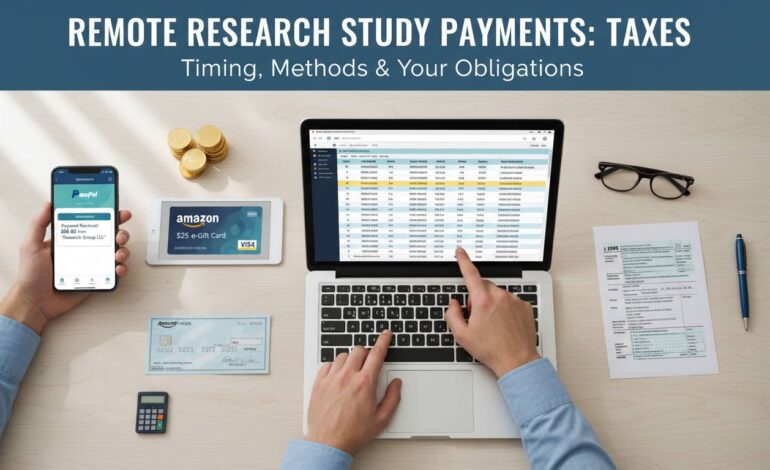
Research participation has moved firmly into the digital age, with companies and academic institutions now routinely recruiting remote participants for studies that once required in-person attendance. What hasn’t moved as smoothly is the payment infrastructure that supports these arrangements. If you’ve ever completed a remote study and wondered when you’d actually get paid, why you’re being offered Amazon gift cards instead of cash, or whether the IRS is going to come after that $50 you earned testing a new app, you’re not alone. The payment side of remote research is genuinely confusing, and the lack of standardized practices across platforms makes it worse.
This guide walks through exactly how payment works for remote research studies in 2025. I’ll cover the timing frameworks you’re likely to encounter, the payment methods platforms actually use, and the tax considerations that apply to your earnings. I’ve drawn on specific platform policies and actual payout structures to give you something you can use, not just general advice that sounds helpful but falls apart when you try to apply it.
Payment Timing: When to Expect Your Money
The single most common frustration participants report is not knowing when they’ll actually receive payment. The answer is more complicated than it should be, because different platforms operate on fundamentally different schedules, and “processing” can mean anything from a few hours to several weeks.
Most research platforms fall into one of three timing categories. The fastest group — platforms like Prolific and CloudResearch — typically process payments within 24 to 48 hours of study completion. Prolific holds payments in escrow until participants confirm completion, which actually protects you from studies where the researcher disappears without approving your work. This escrow system is worth understanding because it means your money exists in the platform’s system immediately after you finish, even if it takes a day or two to become available in your account.
The middle group includes platforms like MTurk and UserInterviews, where payment processing commonly takes 5 to 10 business days. MTurk’s system requires requesters to approve work before funds are released, and some requesters sit on approvals for days or weeks. UserInterviews uses a similar model but has tightened its policies recently — as of late 2024, the platform now requires researchers to approve completed studies within 14 days or automatically release payment. That policy change was a direct response to participant complaints about extended delays.
The slowest category involves academic institutions running their own remote studies, sometimes through university-affiliated platforms. These payments can take 4 to 8 weeks because they often require processing through institutional accounts payable systems, which operate on monthly or bi-weekly cycles. If you’re participating in a study run by a university research lab, ask about the payment timeline upfront. Don’t assume it’ll be fast.
One thing to understand: “payment pending” doesn’t mean your money is at risk. Most legitimate platforms hold funds in escrow or maintain balances with payment processors. What it does mean is that patience is often required, and the timeline can vary significantly depending on where you’re participating.
Payment Methods: What You’ll Actually Receive
The payment methods available to remote research participants have expanded considerably over the past few years, but availability still varies widely by platform. Understanding your options before you commit to a study prevents unpleasant surprises when it’s time to get paid.
PayPal remains the most widely accepted method across platforms. Prolific, MTurk, Respondent.io, and most commercial platforms support PayPal transfers. The key advantage is speed — PayPal transfers typically clear within 24 to 48 hours. The disadvantage is that PayPal takes a transaction fee from the sender, which some platforms pass along by reducing your stated payment by a small percentage (usually 2% to 5%). Prolific notably does not pass this fee along to participants, which is one reason their pay rates sometimes appear slightly lower than MTurk — the actual take-home amount often works out similarly.
Amazon gift cards are the second most common option, particularly for shorter studies and demographic-specific recruitment. Several platforms — including CloudResearch and various smaller research marketplaces — default to gift cards because they avoid transaction fees entirely. The practical benefit for participants is that Amazon gift cards feel like instant credit, but they’re less flexible than cash. If you don’t shop on Amazon, this option loses significant value.
Direct bank transfer / ACH is growing in availability. Prolific added direct bank transfer options in 2023, and it’s now available to participants in the US, UK, and EU. This method typically takes 2 to 5 business days and avoids the PayPal fee issue entirely. The catch is that you need to provide bank account details, which some participants are understandably hesitant to do with smaller platforms.
Virtual cards and prepaid debit represent an emerging category. Some platforms issue virtual Visa or Mastercard codes that you can add to digital wallets immediately. This gives participants more flexibility than platform-specific gift cards but requires a few extra steps to activate.
Check payments are increasingly rare but still appear in academic research contexts. If a university lab is running the study, check payments may be your only option, and these can take 6 to 10 weeks to arrive by mail.
The practical takeaway: check what payment methods a platform offers before starting a study. If gift cards are the only option and you don’t use Amazon, factor that limitation into whether the stated pay rate is actually worth your time.
Minimum Payment Thresholds
Almost every platform enforces a minimum balance before you can initiate a payout. These thresholds exist because payment processing costs would eat up small transactions entirely.
MTurk requires a $1 balance minimum for Amazon gift card redemptions and $10 for Amazon payments transferred to your bank. Prolific has no minimum — you can withdraw any amount at any time, which is notably participant-friendly. UserInterviews sets a $10 minimum for most payout methods. Respondent.io, which focuses on higher-paying professional studies, requires a $50 minimum.
If you’re doing short studies that pay $2 to $5 each, the threshold matters. A platform with a $1 minimum on a $3 study means you can cash out after two or three studies. A $10 minimum on the same payment amounts means you need to complete three or four studies before you see any money. Factor this into your platform selection if you’re planning to do many small studies.
Payment Processing Fees: Who’s Eating the Cost
This is where platform policies diverge significantly, and it’s worth understanding because it affects your actual take-home pay.
Some platforms — Prolific is the most prominent example — absorb all payment processing fees themselves. You see exactly the amount stated for each study in your account. Other platforms pass the cost along to participants, typically reducing payouts by 2% to 5% to cover PayPal or payment processor fees. A $10 study might show as $9.50 in your account after fees.
Academic platforms run through universities sometimes have more complex arrangements. A study advertised as paying $50 might actually result in a $50 check, but the university processes it through accounts payable, which can take weeks and may require you to complete additional tax documentation before the check is issued.
The fee structures aren’t always transparent. When you’re evaluating a study’s pay rate, mentally account for 2% to 5% if you’re unsure how the platform handles processing fees. It’s better to be pleasantly surprised than disappointed.
Payment Disputes and Missing Compensation
Things go wrong. A researcher forgets to approve your work. A platform experiences a processing error. You complete a study and never see payment. Understanding how disputes work matters.
Prolific has a dedicated participant support system where you can flag unreleased payments. Their policy states that participants should be paid within 7 days of study completion, and unreleased payments after that window can be escalated through their support team. Their response times have improved significantly since 2023, with most disputes resolved within 5 business days.
MTurk has a more complicated dispute process. You can requester bonuses from the researcher directly, but there’s no formal dispute resolution for missed payments. If a researcher completes a study and never approves it, your only recourse is requesting a bonus directly from them, which relies entirely on their willingness to respond. This is a genuine limitation of MTurk’s model, and it’s why many experienced MTurk workers screen requesters carefully before accepting work.
UserInterviews implemented a more structured approach in 2024. Their participant dashboard now includes a clear payment status for each completed study, and there’s a built-in dispute button that triggers platform mediation. This is a meaningful improvement over the older model where participants had to email support and hope for a response.
For academic studies, your best protection is documenting everything before you start. Take screenshots of the study description, the stated payment, and the completion confirmation. If payment doesn’t arrive within the timeline you were told, contact the lab administrator with this documentation. Most university labs care about their reputation with the IRB and will resolve payment issues to avoid complications with ethics oversight.
Tax Implications: What the IRS Actually Requires
Here’s where I need to be direct: the tax treatment of remote research payments is genuinely ambiguous in certain situations, and no article can replace professional tax advice for your specific situation. What I can do is explain what the platforms themselves are required to do and what you should plan for.
The $600 threshold is the most important number to know. As of tax year 2022, platforms like MTurk, Prolific, and Respondent.io are required to send participants a Form 1099-K if they earn $600 or more in a calendar year. This threshold applies to gross payment amounts before any fees. For MTurk workers who do high volumes of HITs, this threshold is commonly reached.
However, there’s a critical distinction: receiving a 1099-K doesn’t automatically mean your earnings are taxable income. The IRS position is that payments for participation in research studies are generally considered taxable income if the participant is not a genuine volunteer. Most remote research participants are compensated for their time, which means the payments are taxable.
Self-employment considerations apply if research participation becomes a significant income source. If you’re earning thousands of dollars per year through research platforms, the IRS may consider you self-employed, which means you’d owe self-employment tax (the Social Security and Medicare taxes that employers normally split with employees) in addition to income tax. At income levels above $400 in net self-employment earnings, you’re required to file Schedule C and Schedule SE with your tax return.
Academic research exemptions can apply in specific situations. If you’re participating in a study run by a university and the payment is classified as a reimbursement for expenses (rather than compensation for your time), it may not be taxable. University labs are supposed to structure payments appropriately, but the classification isn’t always clear. Keep any documentation the university provides about how your payment is characterized.
Platform 1099 policies vary. MTurk will issue a 1099-K if you cross the $600 threshold and have provided your taxpayer identification number. Prolific issues 1099 forms to US participants who earn $600 or more and have submitted their tax information. Respondent.io, which deals with higher-value studies, has similar requirements.
The practical recommendation: if you’re earning more than a few hundred dollars per year from research participation, set aside 20% to 25% of your earnings for taxes. Track your earnings by platform and save any 1099 forms you receive. If your research earnings become substantial, consult a tax professional about whether you should be filing as self-employed.
The Counterintuitive Reality About Pay Rates
Now for something that most articles on this topic get wrong. Everyone tells you to calculate your hourly rate by dividing the stated payment by the estimated completion time. This is useful, but it’s incomplete, because the stated pay rate and your actual effective hourly rate often diverge significantly in ways that hurt participants.
Platforms that post higher stated payments (like Respondent.io, which frequently lists studies paying $100 to $300) tend to have much lower acceptance rates. You might apply to 15 studies at $150 each and get accepted to one. Your effective hourly rate — total earnings divided by total time spent (including applying, screening, and waiting) — ends up far lower than the stated rate suggests.
Conversely, platforms with lower stated rates but high acceptance rates (like Prolific, where acceptance rates often exceed 90% for active participants) can yield higher effective hourly earnings because you’re actually completing work consistently.
The commonly repeated advice to “always calculate your hourly rate” is sound, but it needs a modifier: calculate your effective hourly rate based on your actual completion rate, not the advertised rate. If a study pays $50 and takes 30 minutes but you only get accepted to one in ten studies at that rate, your effective hourly rate is $10, not $100.
International Considerations
If you’re participating in remote research studies from outside the United States, additional complexity applies. Tax treaties between your country and the US may affect how your earnings are taxed. Payment processor availability varies — PayPal works in most countries, but direct bank transfers are often limited to specific regions.
Prolific explicitly supports participants in the UK, US, EU, Canada, and Australia, with payment processing calibrated to each region’s banking systems. MTurk restricts participation to specific countries and requires verified payment accounts in those countries.
Research platforms that focus on professional participants (like Respondent.io) often have stricter geographic requirements because their studies involve specialized expertise. If you’re outside the major English-speaking markets, your platform options may be significantly narrower.
The takeaway: verify that a platform supports your country and preferred payment method before investing time in the application process. This is especially important for participants in countries with limited banking partnerships with US payment processors.
Conclusion: What Actually Matters
The payment infrastructure for remote research studies is improving but remains fragmented. If you’re planning to participate in these studies regularly, the practical moves that matter most are straightforward: choose platforms with transparent fee structures and reasonable payment timelines, track your earnings meticulously if you’re earning meaningful amounts, and set aside money for taxes if your annual earnings cross a few hundred dollars.
The biggest risk most participants face isn’t complicated — it’s simply not understanding when and how they’ll get paid, which leads to frustration and wasted time on platforms that don’t align with their needs. The platforms worth your time are the ones that make payment timing clear, support flexible withdrawal methods, and have responsive support when things go wrong.
If you’re serious about research participation as a side activity, Prolific and UserInterviews currently offer the best combination of transparency, fee policies, and payment reliability for most participants. MTurk remains valuable for high-volume workers who understand its quirks. Respondent.io is worth exploring if you have specialized professional expertise and can navigate its competitive application process.
What remains genuinely unresolved in this space is whether standardization will ever emerge. Different platforms continue to operate on different models, and participants are left to navigate the differences. The IRS guidance on research participation income remains vague enough that professional tax advice is often warranted for serious participants. These are problems that won’t solve themselves, and they’re worth keeping an eye on as the remote research industry continues to mature.