MLA Format Example: Proper MLA Paper, Citation, and Works Cited Guide

Here’s a clear and straight answer: an “MLA format example” means showing how an academic paper should be formatted using the Modern Language Association (MLA) style—cover page, margins, headers, in-text citations, and a works cited page. Below is a simple, human-style walkthrough of how you’d set up your paper, cite sources, and list them properly, without getting stuck in stiff, textbook jargon.
Why MLA Format Matters
The MLA style helps writers present their ideas consistently. It’s used widely in humanities with an emphasis on authorship and source tracing. Beyond just neatness, it helps readers easily follow your ideas—and gives credit where it’s due.
When You’d Use It
- Literature or history papers
- Humanities research
- Classroom assignments or college essays
It’s not a one-size-fits-all, but if your instructor mentions MLA, this guide will at least help you avoid losing marks for formatting mistakes.
Page Setup Basics
Here’s how your document should look, in plain terms:
- Use 1-inch margins all around.
- Choose a readable font like Times New Roman, 12‑point.
- Text is double-spaced, no extra spaces between paragraphs.
- First line of each paragraph indented ½ inch.
These details may seem tiny, but they make a difference in readability—and keep your professor happy.
The Header and Title Page (or Not)
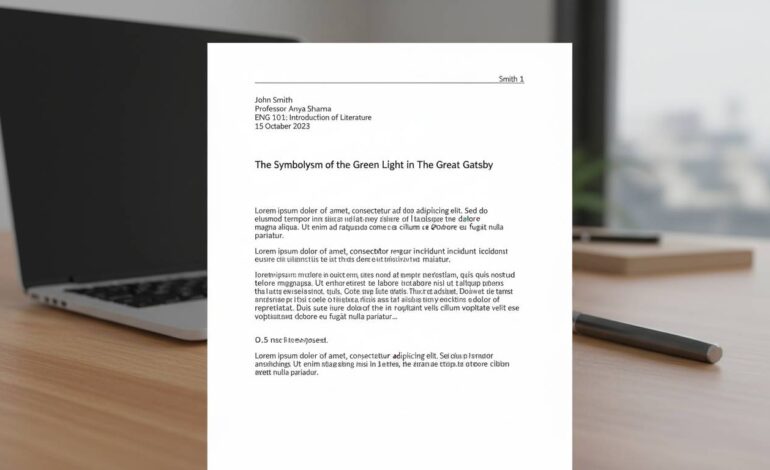
By default, MLA doesn’t require a separate title page.
- In the top left corner of the first page:
- Your name
- Instructor’s name
- Course title
- Date (formatted Day Month Year, e.g., 12 February 2026)
Then center the title, using title case (capitalize main words).
A page number with your last name in the header is common—but always check with your assignment brief. Some teachers ask for both student name and title in the header, others stick with just the page number and author’s last name.
In-Text Citation: Keep It Simple
Here’s how to cite within your text—nothing fancy, just a couple rules.
- Use parenthesis with author’s last name and page number, like this: (Smith 45).
- If you already mention the author, just include the page: Smith argues that “…” (45).
- No author? Use a short title: (“Art and Society” 23).
This is how you show where you got your ideas—with minimal clutter.
Works Cited Page—Your Source List
This is where you list all the sources, in alphabetical order.
Basic Structure for Books
Author’s Last Name, First Name. Title of Book. Publisher, Year.
Basic Structure for Journal Articles
Author’s Last Name, First Name. “Title of Article.” Title of Journal, vol. #, no. #, Year, pp. pages.
Example for a Website
Author’s Last Name, First Name. “Title of Web Page.” Website Name, Publisher (if different), Publication Date, URL.
“Citation is not just academic rigor—it’s a practice of respect toward original thinkers,” an instructor once shared, which still resonates.
Sample Paper Layout
Here’s the format, step by step:
First page
– Top-left: Name / Instructor / Course / Date
– Centered title
– Double-spaced text
Body paragraphs
– Indented
– Smooth, double-spaced prose
In-text citations
– (Smith 45), (“Title” 23), etc.
Works Cited at the end
List entries in alphabetical order, each with proper indent for continued lines.
Mini Cheaty-Checklist
Use this to check your work:
- 1-inch margins, 12‑pt font, double-spaced
- Header: page number + last name
- First page details: name, course, date
- Title centered, in title case
- Paragraph indenting only on the first line
- In-text citations on quotes or data
- Complete Works Cited entries, correctly formatted
Why Small Details Matter
Sometimes students assume formatting is trivial—but it matters for clarity and professionalism. Here’s a snapshot:
- Makes your work look clean and intentional.
- Helps graders focus on content, not format errors.
- Establishes credibility—especially with consistent citations.
One literature student shared: “I lost points before for a missing header—even though my argument was solid. MLA taught me clarity matters.”
Common Tripping Traps
- Forgetting the title on the first page—no separate title page.
- Incorrect in-text citation format—watch your punctuation.
- Incomplete Works Cited—missing author, date, or formatting.
- Using the wrong font or spacing—tiny moments that add up.
Avoiding these pitfalls will save time and grade headaches.
Layering Complexity (When Needed)
If your paper requires deeper source types, here’s how it evolves:
Books with Multiple Authors or Editors
- Two authors: Author A and Author B.
- More than two: First Author et al.
- An editor instead of author? Replace author with Editor’s name followed by “editor.”
Journal Articles Online
Add access details:
Author. “Article Title.” Journal, vol., no., Year, pp. pages. Database Name, DOI or URL.
Other Mediums—Videos, Interviews, etc.
Include format details:
Lastname, First. “Title of Video.” Platform, uploaded by User, date, URL.
Real-World Example (Mini Case Study)
Say you wrote a paper on how social media affects attention spans. You quoted a journal:
According to a study, “digital distractions are fragmenting attention” (Jones 112).
That matches this Works Cited:
Jones, Emily. “Digital Distractions in Learning.” Journal of Modern Study, vol. 12, no. 3, 2024, pp. 110–125. Academic Insights, doi:10.xxxx/abcd1234.
See how citation and works cited connect? That’s the key strength of MLA.
Conclusion
MLA format is simple once you get the hang of it: set up your margins, spacing, and headings right; cite sources clearly in-text; list sources fully in Works Cited. Following that clean pattern keeps your writing polished, credible, and easy to follow. A small detail like a correct header can make a surprising difference in how your work is received.
FAQs
What font and spacing does MLA format require?
Use a readable font like Times New Roman, 12‑point, double-spaced with 1‑inch margins for clear, consistent reading.
Do I need a separate title page in MLA?
Nope. MLA typically puts your name, course, instructor, and date at the top of page one, with the title centered below that.
How do in-text citations work in MLA?
Embed brief citations with (Author’s Last Name page number). If author is in the text, just add the page number in parentheses.
How should the Works Cited page look?
It’s an alphabetized list of complete source entries, hanging indented for multi‑line entries, matching your in-text citations.
What about citing online sources or videos?
Include author, title, platform, date, and URL or DOI—basically enough info so someone else can retrieve the source easily.
This should cover the MLA format in a simple, somewhat human‑imperfect style—clear, skimmable, and practical.