Market Research vs UX Research: What’s the Difference?

Most companies treat market research and UX research as interchangeable buzzwords, and that’s an expensive mistake. I’ve watched startups burn through $50,000 on focus groups to validate a product nobody wanted to use, while other companies ship features that technically work but completely miss what their users actually need. The confusion isn’t semantic—it costs real money and creates real products that fail in fundamentally different ways.
Understanding the distinction between these two research disciplines isn’t academic. It’s a strategic decision that determines whether you build the right thing and whether anyone cares.
What Is Market Research?
Market research answers the question: Is there a market for what we’re building, and how do we reach it?
This discipline examines the external environment—your customers, competitors, and broader industry dynamics. Market research tells you whether people will pay for your product, what price points make sense, which segments to target, and how your brand compares to alternatives. It informs business decisions before product development begins and continues to guide marketing and expansion strategies long after launch.
The primary methods are quantitative by nature. Surveys with large sample sizes establish market sizing and segment preferences. Focus groups reveal attitudinal insights and emotional drivers. Competitive analysis maps the landscape and identifies gaps. Secondary research pulls existing industry data to build context.
What market research explicitly does not do is tell you whether your product actually works for the people using it. A market might love the idea of your fitness app, but that tells you nothing about whether users will stick with a 14-day onboarding flow. That’s a different question entirely—one that market research isn’t equipped to answer.
Tools like Qualtrics, SurveyMonkey, and Datumbox handle the quantitative heavy lifting, while NVivo assists with qualitative coding. Companies like Nielsen and Ipsos operate at the enterprise scale, but smaller teams can accomplish plenty with SurveyGizmo and internal recruitment through platforms like UserInterviews.
What Is UX Research?
UX research answers a fundamentally different question: How do people actually use our product, and does it work for them?
Where market research looks outward at the market, UX research looks inward at user behavior. This discipline observes what people do rather than what they say they’ll do—because there’s a well-documented gap between intention and action. UX researchers conduct usability testing, run card sorting exercises, perform user interviews, and run A/B tests to understand interaction patterns.
The methods break into two categories: evaluative and generative. Evaluative methods test whether an existing design works—usability testing, heuristic evaluations, task analysis. Generative methods discover what users need before any design exists—contextual inquiry, diary studies, jobs-to-be-done interviews.
A crucial distinction: UX research happens throughout the product development lifecycle, not just at the beginning. You research before building to understand needs, during development to test prototypes, and after launch to identify friction points. This ongoing iteration is what separates functional products from ones people actually want to use.
Tools like Maze, Optimal Workshop, and UserTesting facilitate remote usability studies. Hotjar and FullStory provide behavioral analytics. For moderated sessions, companies use Lookback or UserInterviews to recruit participants. Figma and Miro support the synthesis and visualization of findings.
Market Research vs UX Research
The differences become clearest when you look at what each discipline actually does.
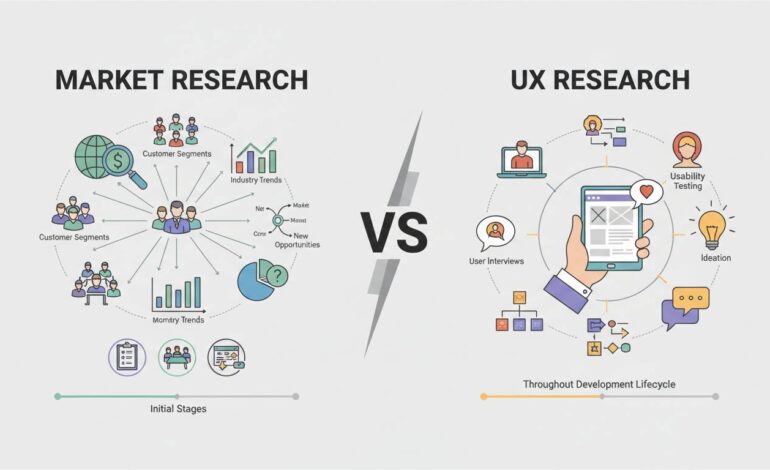
Primary focus: Market research examines external market conditions. UX research examines internal user behavior.
Core question: Market research asks “should we build this?” UX research asks “does this work for users?”
Timing: Market research happens before product development and guides ongoing strategy. UX research runs throughout the development lifecycle.
Methods: Market research uses surveys, focus groups, and competitive analysis. UX research uses usability testing, user interviews, and A/B testing.
Audience: Market research serves stakeholders, executives, and marketing teams. UX research serves designers, product managers, and engineers.
Sample size: Market research typically needs 100+ respondents for statistical significance. UX research often needs only 5-15 users to find most usability problems.
Success metrics: Market research measures market share, revenue, and brand perception. UX research measures task completion, error rates, and time-on-task.
Output: Market research delivers strategic recommendations. UX research delivers design recommendations.
The most important difference is when these disciplines deploy their methods and what decisions they inform. Market research answers whether a business opportunity exists. UX research answers whether a specific solution actually works for the people using it. Confusing these two produces the classic “built it but nobody came” scenario—or its equally damaging opposite, “built exactly what they asked for but it’s impossible to use.”
A concrete example: Dropbox pre-launched with a video demonstrating the concept. That was market research—testing demand for an idea before investing in development. When they built the actual product, they ran usability tests on the onboarding flow. That’s UX research—ensuring the execution matches user expectations. Same product, two entirely different research questions.
When to Use Market Research
Market research becomes essential at specific inflection points in business growth.
Before launching any new product or service, you need to validate that sufficient demand exists. This means understanding market size, identifying your target segments, and confirming that your value proposition resonates. Skip this step and you’re essentially gambling with development resources.
When entering a new market or geography, market research reveals competitive dynamics, regulatory considerations, and cultural factors that affect positioning. A SaaS company expanding from the US to Japan faces fundamentally different market conditions—pricing sensitivity, sales cycle length, and feature expectations all shift.
When considering major strategic pivots, market research provides the external context for informed decision-making. If your current product line is stagnating, research tells you whether the problem is market-wide or specific to your execution.
For pricing optimization, market research through conjoint analysis and Van Westendorp studies establishes what customers actually value and what they’ll pay. This data directly informs revenue models.
The honest caveat: market research has a shelf life. Industry conditions shift, competitor positions change, and customer preferences evolve. Research conducted three years ago may no longer reflect current reality. Schedule regular refreshes—annually for stable markets, quarterly for fast-moving ones.
When to Use UX Research
UX research should be constant throughout product development, not a one-time checkbox.
During discovery phases, generative research uncovers unmet user needs and validates assumptions before anyone writes code. Jobs-to-be-done interviews, contextually observed in users’ actual environments, reveal the real problems worth solving.
When evaluating prototypes, usability testing with clickable mockups catches interaction problems before engineering investment. Finding a navigation issue in Figma costs hours; finding it after development costs sprints.
After shipping features, behavioral analytics and session recordings surface where users struggle. Hotjar and FullStory make it easy to identify rage clicks, dead ends, and drop-off points. This is where most companies under-invest—they ship and move on instead of validating that their work actually landed.
When optimizing conversion funnels, A/B testing provides statistical evidence about what changes behavior. Optimizely and VWO support these experiments, but the research question must be precise: “Does simplifying the checkout form reduce cart abandonment?” Not “does anything change?”
For accessibility compliance, UX research with users who has disabilities isn’t optional under WCAG guidelines—it’s required. Including assistive technology users in your research pool isn’t just ethical; it’s legally mandated in many contexts.
The counterintuitive truth: UX research with just five users can identify 85% of usability problems, according to research from Nielsen Norman Group. You don’t need massive sample sizes to get actionable insights. You need the right methodology and someone willing to watch users struggle with your designs.
How They Work Together
The most effective organizations don’t choose between market research and UX research—they integrate both into a coherent research strategy.
Consider a company building a project management tool for creative teams. Market research identifies the segment (in-house creative agencies, 10-50 employees), validates willingness to pay ($15-30/user/month), and confirms that existing tools feel “too corporate” for creative workflows. That’s the strategic foundation.
UX research then takes over: observing how creative professionals actually organize visual work, testing different information architecture approaches through card sorting, and validating that the onboarding flow doesn’t alienate non-technical users. The market research says what to build; the UX research says how.
A real-world case: Airbnb’s continued growth came from integrating both. Market research identified that travelers valued authentic, local experiences over standardized hotels. UX research then built the interface around that insight—developing the map-based search, the host communication tools, and the review system that makes authenticity visible. Neither research type alone would have produced that product.
The integration point is research operations—the systematic coordination of who conducts research, how findings get stored and shared, and when each discipline gets consulted. Without this infrastructure, market and UX research operate in silos, often duplicating effort or, worse, contradicting each other.
Common Mistakes Companies Make
The most expensive error is treating these as either/or choices. Companies that invest exclusively in market research ship products that technically meet stated requirements but frustrate users. Companies that invest exclusively in UX research build elegant solutions to problems nobody actually has.
Another frequent failure: confusing what people say with what people do. Market research captures stated preferences through surveys and focus groups. UX research observes actual behavior. These diverge more often than you’d expect—people tell researchers they’d pay for premium features they never actually use in practice.
Timing mistakes are equally costly. Conducting market research after development is useless for strategic decisions. Running usability tests before you have a prototype wastes everyone’s time. Each discipline has an optimal moment in the product lifecycle.
Finally, many companies treat research as an event rather than a practice. One study per year isn’t research ops; it’s a checkbox that produces outdated findings. Effective research integrates continuously, feeding insights into iterative development cycles.
Conclusion
The distinction between market research and UX research isn’t academic hair-splitting—it’s a fundamental difference in what questions each discipline answers and when they deliver value. Market research tells you whether a business opportunity exists and how to position yourself competitively. UX research tells you whether your execution actually serves the people using your product.
The companies that get this right don’t treat research as a luxury or a single phase. They build ongoing capabilities in both disciplines, integrate findings across organizational functions, and resist the temptation to substitute one type of research for the other.
Your next step isn’t to hire more researchers—it’s to ask yourself which question you’re actually trying to answer. If you’re asking “should this exist?” that’s market research. If you’re asking “does this work?” that’s UX research. The answer changes everything you do next.