Less Than Sign: Meaning, Uses, and Examples in Math

? Right away: it’s the “<” symbol, used in math to show that the number on the left is strictly smaller than the number on the right. (For example, 3 < 5 means exactly that—3 is less than 5.)
A Quick Breakdown: Meaning and Basic Use
The < symbol indicates that one number is strictly less than another. It’s a strict inequality, which means the two values are not equal. For example, writing a < b means a is smaller than b and definitely not equal.
Visually, the “open” side of the sign always faces the larger number, while the pointed tip points toward the smaller number. On a number line, this aligns with the idea that smaller values lie to the left of bigger ones.
Here’s a quick real-world example: If you write 1 < 3, you’re saying “one is less than three.” That’s clear, simple, and immediate.
Learning Tricks and Visualization
Because < and > look pretty similar, people often mix them up. Here are two human-spoken tricks that actually work:
- The “L” trick: The
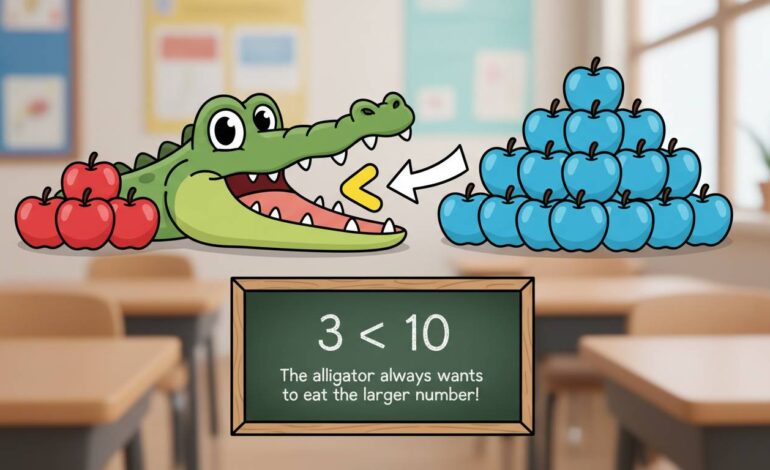
<sign looks like the letter “L”—so “L” stands for “Less than.” - Alligator jaws: Picture an alligator always trying to eat the bigger number. The wide open end of
<faces the bigger number—that’s the closed-off jaw.
Use in Math and Beyond
In Mathematics
- You use
<when stating that one value is strictly smaller than another. - It’s fundamental in expressing inequalities like
2x + 5 < 7clearly: the expression on the left is strictly less. - It’s part of a broader family of relational symbols:
>,=,≤,≥,≠, etc.
On a Number Line
- We mark a solution like
x < 3with an open circle at 3, shading everything to the left—indicating numbers less than 3 but not including 3.
In Programming and Tech
- In coding,
<works as a comparison operator. In languages like C, Java, Python, etc.,if (a < b)checks if a is less than b. - It’s also part of markup languages like HTML:
<tag>shows a start tag. There,<begins and>ends the tag.
Other Relational Symbols and Variants
Mathematics is full of similar symbols. Here’s how < fits into the broader set:
- Strict inequalities:
<means strictly less,>means strictly greater. - Inclusive inequalities:
≤means “less than or equal to” and includes the value on the right. - Other notations:
≪means “much smaller than”—often used when the difference is huge and one value can be almost ignored for an estimate.
Why It Matters
Short answer: it’s simple but powerful. < helps us:
– Compare ages, weights, amounts—anything real-world.
– Write precise algebra and equations.
– Code conditional logic cleanly.
– Structure HTML and markup languages.
Without <, a ton of math, coding, and markup would be more confusing or verbose.
Expert Insight
“The less-than symbol is deceptively simple. It’s one of the first signs students learn, yet it underpins everything from basic inequalities to programming logic and markup languages. Its simplicity is its strength.”
Real-Life Mini Case Study
Imagine comparing the ages of Alice (10), Bob (12), and Charlie (10). You could say:
Alice < Bobbecause 10 is less than 12.Charlie < Boblikewise.- But
Alice < Charlieis false because they’re equal, not less.
That helps someone (say, a parent or teacher) quickly decide that Bob is the oldest and the others are the same age—all with tiny little symbols.
What’s the Origin?
Symbols < and > go way back—Thomas Harriot used them in the 1600s in algebra texts to show inequalities. So they’re centuries old, not some modern invention.
Summary of Key Points
<means strictly less than—that’s it.- The open side points to the larger number.
- The “L” trick and alligator visual help avoid confusion with
>. - It’s essential across math, coding, markup, and everyday logic.
- Related symbols like
≤and≪offer nuance. - It has deep historical roots going back to early algebra.
FAQs
What exactly does the less than sign mean?
It shows that the number or expression on the left side is strictly smaller than the right side. They’re not equal—one’s simply less.
Can we flip < to mean something else?
Yes—a < b means the same as b > a. They’re mirror relations but say the same comparison from opposite sides.
How do I visualize a “less than” inequality?
On a number line, use an open circle at the boundary value and shade to the left. For equations like x < 5, you’d circle 5 and shade left.
What’s the difference between < and ≤?
< means strictly smaller. ≤ means smaller or equal—it includes the boundary value.
Why do coders use < so much?
In code, < is a quick way to compare values, control logic, and decide whether one thing happens or not based on that comparison.
Where else is < used outside math?
In HTML and markup, < opens a tag like <div>. In other contexts it’s also called an angle bracket or chevron.