Is Water Wet? Exploring the Science Behind a Popular Question

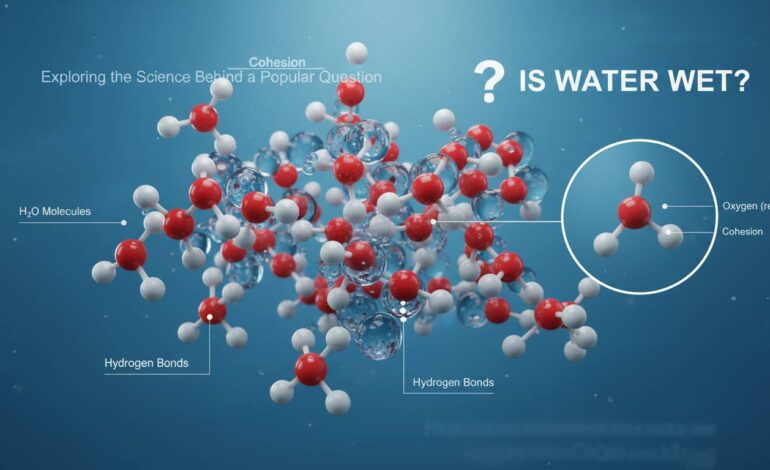
Water isn’t wet—at least not by the strictest scientific definition. Wetness only applies when a liquid adheres to a solid surface. Since water is a liquid and doesn’t cling to itself in that way, scientists say water doesn’t qualify as being wet, though it certainly can make other things wet. That’s the short, clear answer.
What Do Experts Say? Definitions Matter
Most scientists define wetness as a condition where a liquid sticks to a solid surface. Under this definition, water can’t be wet because it doesn’t apply to itself—it only makes solid objects wet. On the other hand, if you define “wet” casually as “consisting of liquid,” then yes, water is wet—but that’s more linguistic than scientific.
So the debate isn’t so much about science anymore—it’s about how you want to interpret a word.
The Science of Wetness: Cohesion vs. Adhesion
To really understand, we need to dive into two key forces:
- Cohesion: the attraction between water molecules, thanks to hydrogen bonds.
- Adhesion: the attraction between water molecules and molecules of another substance.
If adhesion (water-to-surface) is stronger than cohesion, water spreads out and wets the surface. But if cohesion dominates, water beads up, minimizing contact.
This balance is measured by something called the contact angle—the sharper the angle, the less the surface is wetted.
Everyday Examples to Make Sense of It
- On a glass surface, water spreads easily—it wets the surface because adhesive forces are strong.
- On a waxed car, water beading up reveals stronger cohesion and weaker adhesion—the surface remains unwet.
- Add soap or detergent, and you lower surface tension. This weakens cohesion so water spreads more—“wetting” surfaces better.
This demonstrates that water itself isn’t wet—it’s the way it interacts that creates wetness.
Autophobic Behavior: Water Doesn’t Wet Itself
Interesting fact: Water exhibits something called autophobia, meaning it resists wetting itself. Pure water won’t form a uniform layer across itself—that’s just… itself. Not wetness.
You need a solid surface for wetness to exist. Water as a standalone liquid fails to meet that requirement.
The Sensory Illusion: Why It Feels Wet
Wetness feels real. Our skin has nerve endings that sense pressure and temperature changes. When water touches your skin, it cools it and forms a clinging film—your brain registers that as wet. But that sensation is all about perception and context—not an inherent property of water itself.
A Broader Perspective: Liquids That Wet Even More
Not all liquids are equal in wetting power. Liquids with lower surface tension—like alcohol or soapy water—spread more easily and are “wetter.” Even wild examples like superfluid helium are considered “ultra-wet” because it climbs over surfaces due to zero viscosity. So, in some sense, there are liquids “wetter than water.”
Why This Simple Question Matters
On the surface, “Is water wet?” seems like a trivial question. But it opens up deeper insights into:
- Surface chemistry: adhesion, cohesion, tension.
- Material science: designing hydrophobic or hydrophilic surfaces.
- Perception: how we interpret sensory information.
- Practical applications: from fabrics to coatings to agriculture.
So, a childlike question ends up brushing against real scientific complexity and technological innovation.
Expert’s Insight
“Scientists define wetness as a liquid’s ability to stick to a surface—water itself doesn’t satisfy that, so it isn’t technically wet.”
— Dr. Emma Davies, science writer and editor
This sums it up nicely: water doesn’t meet the scientific criteria to be wet—but it sure can make everything else wet.
Conclusion
Water isn’t wet in itself—in scientific terms. Wetness depends on water interacting with a solid surface, not being water itself. Still, in everyday language, saying “water is wet” feels perfectly fine because the phrase captures the essence of what we experience. Understanding the science behind wetness deepens how we view material behavior, sensory perception, and even design innovation—proving that even the simplest questions can spark rich conversations.
FAQs
Why do people still say “water is wet”?
Because in everyday talk, saying water is wet feels natural and captures the experience of moisture—even if it’s not technically accurate by scientific standards.
Can water ever be described as wet scientifically?
Only if you stretch the meaning of wet to include “made of liquid.” But that’s not how wetness is defined in physics or chemistry.
Does temperature affect wetness?
Temperature influences wetness perception. Cooler surfaces slow evaporation, so they feel wetter—though the scientific definition of wetness still relies on adhesion, not temperature.
What’s the “contact angle” and why does it matter?
The contact angle measures how much a liquid spreads on a surface. A low angle means the surface becomes wet; a high angle means the liquid beads up and doesn’t wet well.