How to Answer “Tell Me About a Failure” Without Being Defensive

Most people approach the failure question all wrong. They spend weeks crafting the perfect story about a minor setback they’ve transformed into a learning opportunity, and they miss the point entirely. Interviewers asking about failure aren’t looking for your best recovery narrative. They’re looking for self-awareness, accountability, and whether you’ll blame others or own your mistakes when things go wrong. The defensive answers all sound the same—the polished, pre-packaged responses that candidates have rehearsed from career blogs. That’s what makes the genuine answer so powerful.
The difference between an answer that lands and one that makes recruiters mentally check out comes down to three things: what you choose to disclose, how you narrate the outcome, and whether you can discuss failure without flinching. This isn’t about having the perfect failure story. It’s about understanding why the question exists and approaching it with honesty rather than performance.
The worst mistake candidates make is choosing a failure that’s not actually a failure. “I worked too hard and missed my team’s happy hour” doesn’t fool anyone. Interviewers have heard every version of the “I care too much” failure, and it reads as evasion.
What you need is a failure with real stakes. I’m not suggesting you walk in and describe your biggest career catastrophe. But the failure you choose should have enough weight that it actually mattered. Maybe you missed a deadline that affected a client relationship. Perhaps you pushed back on a project and it launched with critical bugs. Maybe you made a hiring mistake that cost the team months of productivity.
Here’s the test: if your friends in the industry would hear your failure story and think “that’s rough” rather than “wow, that’s barely a hiccup,” you’re probably in the right territory.
A real example: one candidate I worked with described launching a product feature without adequate testing because she’d overridden her team’s concerns about the timeline. The feature failed publicly, and the client relationship suffered. That’s a failure with scope. It showed she understood that her decision had real consequences, not just that she “learned a valuable lesson.”
Lead with Accountability, Not Explanation
This is where most candidates derail their answers. After describing what went wrong, they immediately pivot to explaining why it wasn’t really their fault. The marketing team didn’t give them enough time. The client kept changing requirements. The technology failed at the worst moment. These explanations might be true, but leading with them signals defensiveness before you’ve finished your first sentence.
The interviewers who ask about failure are specifically listening for the moment you explain rather than own. It’s a test, whether they articulate it that way or not. When you catch yourself saying “but” after describing what went wrong, that’s the exact moment you’re losing them.
Instead, lead with the ownership. “I made a decision to rush the timeline, and that decision caused the outcome we predicted.” That’s a complete sentence that owns the failure. The explanation of why you made that decision can come later, but it should sound like context, not excuse.
I coached a candidate last year who had genuinely been set up to fail by a micromanaging boss. Her instinct was to explain the context before describing the failure. We worked on letting the failure stand on its own first. When she finally answered the question by saying, “I missed the deliverable, and I own that,” the interviewer actually leaned forward. Contextualizing the failure came after, and it landed completely differently because she’d established that she wasn’t looking for sympathy first.
Use the STAR Method, But Don’t Worship It
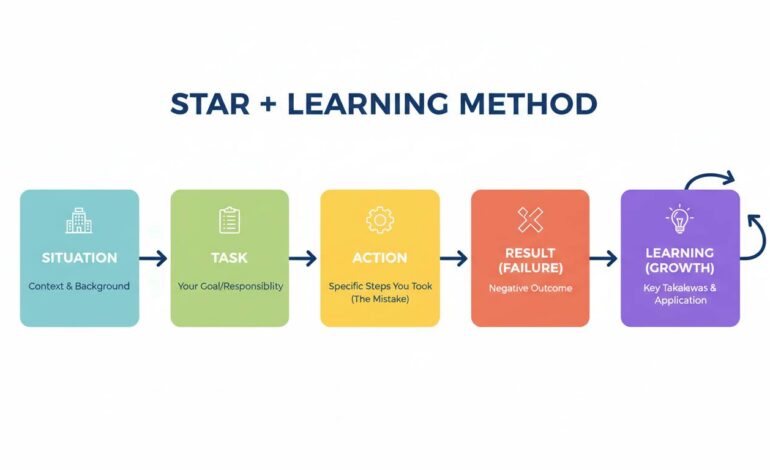
The STAR method (Situation, Task, Action, Result) is the standard framework for behavioral interview questions, and it works well here. Structure your answer so the interviewer can follow the story. But here’s what most articles get wrong: STAR is a skeleton, not the meal. Following STAR mechanically produces answers that sound rehearsed and flat.
What makes STAR work is what you put inside each section. The Situation should be brief—two or three sentences maximum. The Task clarifies your responsibility. The Action is where you describe what you did, including the decision that led to failure. The Result is the outcome, and crucially, the Result should include what happened after the failure, not just the failure itself.
The problem with most STAR answers to the failure question is that they stop at the failure. The candidate describes what went wrong, the interviewer nods, and then there’s silence. You’ve told them about a time you failed, but you haven’t completed the story. The Result section is where you describe what you did after you failed. Did you fix it? Did you tell your manager before they found out on their own? Did you implement changes so it wouldn’t happen again?
A complete failure story includes the aftermath. That’s what turns a failure anecdote into evidence of your professional maturity.
Describe What You Learned, But Skip the Platitudes
Interviewers expect you to say you learned something. It’s become so formulaic that you can almost see them bracing for it. “I learned the importance of communication” or “I learned to trust my team more” are essentially empty phrases at this point. They don’t tell the interviewer anything meaningful about you.
What actually lands is specificity. What did you learn that you didn’t know before? What would you do differently, and why? How did that failure change your approach to similar situations?
Instead of “I learned to communicate better,” try “I learned that saying ‘I’m concerned about the timeline’ in a meeting and actually getting buy-in on a revised deadline are two completely different things. Now I document timeline commitments in writing and check for understanding before moving forward.”
See the difference? One is a platitude that applies to every failure. The other is specific to that situation and reveals something about how you think.
This is also where you can demonstrate growth without sounding like you’re reading from a self-help book. The interviewer doesn’t need you to prove that failure made you stronger. They need to see that you extracted something usable from the experience. Specificity does that work.
Address What You Would Do Differently Without Hedging
Here’s where candidates get defensive again, often without realizing it. When asked what they would do differently, they qualify their answer into meaninglessness. “Well, I might have done X, but it’s hard to say because the situation was complex.” That hedging tells the interviewer you’re not confident in your own judgment.
If you’ve genuinely reflected on the failure, you should be able to say what you would do differently with some certainty. Not in a way that suggests you have all the answers now, but in a way that shows you’ve thought it through.
The strongest answers in this section name the specific decision point and describe the alternative. “I would have pushed back harder on the timeline, even if it meant disappointing the client in that moment.” That’s a take. It shows you’ve thought about the failure as a decision you made, not just something that happened to you.
Being willing to say “I would have done X” is what separates candidates who have actually reflected from those who’ve just practiced the formula.
Watch Your Language for Subtle Defensiveness
The words you use matter more than you think. Certain phrases immediately signal defensiveness, even when you’re trying to sound reasonable. Watch for “but” when it precedes an excuse. Watch for “in my defense” or “to be fair”—these might as well be flashing red lights.
Also pay attention to passive voice. “Mistakes were made” sounds like political non-apology language. “I made a mistake” is what you’re going for. Passive voice in failure stories almost always reads as attempting to soften accountability.
Another pattern: comparing your failure to worse failures. “Well, it wasn’t as bad as when the whole system went down, but…” Stop. The interviewer asked about your failure, not a competition. Minimizing your failure in comparison to others signals that you’re not fully comfortable owning it.
Watch for absolutes in your self-criticism too. “I completely failed” or “It was a total disaster” can sound performative. Specific, measured language is more credible than dramatic language. “The launch had critical bugs that affected 15% of users” is more believable than “it was an absolute disaster.”
Don’t Traumatize the Interviewer with Details
Here’s something nobody talks about: you can over-share in a failure answer. Some candidates get so caught up in demonstrating accountability that they provide far more detail than necessary. The interviewer doesn’t need to know every person who was affected or every anxious night you spent. Excessive detail can actually make them uncomfortable and can read as seeking sympathy rather than demonstrating self-awareness.
There’s a middle ground between “I failed” with no context and a full confessional. Provide enough detail to make the failure concrete and real, but know when to stop. If you find yourself describing your emotional response in detail, you’ve probably gone too far.
A good rule of thumb: if your answer is taking more than three minutes, you’re oversharing. The failure story should be complete, but it shouldn’t feel like a therapy session.
Show What Happened After the Failure
This is the section that most candidates forget, and it’s the most important part of the answer. What did you do after you failed? Did you fix the problem? Did you take initiative to make things right? Did you communicate transparently with stakeholders?
The aftermath is where interviewers see your real response to adversity. Anyone can describe a failure. What separates candidates is whether they disappeared after failing or stepped up to manage the damage.
One of the strongest failure answers I ever heard included this: “I told my director before our standup meeting that we’d need to roll back the release. I’d already drafted the communication to the client and had a revised timeline ready. I didn’t wait for someone to ask.” That answer showed initiative in the aftermath, which is exactly what interviewers want to see.
Sample Answer That Works
Here’s an example that brings these principles together, using the STAR framework without sounding formulaic:
“Situation: Three years ago, I was leading a website redesign for a retail client. We were three weeks from launch and the client requested additional features.
Task: I was the project lead and responsible for managing scope against the timeline.
Action: I agreed to add the features without pushing back on the deadline, because I didn’t want to disappoint the client. I didn’t escalate to my director or flag the risk.
Result: We launched with bugs because we compressed testing. The client complained, and we had to do an emergency fix sprint that ate into our next project’s budget.
After: I told my director what happened and we implemented a scope-change process for future projects. I also started documenting timeline risks in writing rather than flagging them verbally. The client stayed with us, and we’ve never had a similar situation since.”
This answer owns the failure, explains the decision, describes the aftermath, and names specific changes. It’s specific, accountable, and doesn’t flinch from the reality of what happened.
Common Mistakes That Undermine Your Answer
Let me name a few patterns that always hurt candidates. First, choosing a failure that’s clearly not a failure. If your “failure” story ends with you getting praised for your response, it’s not a failure story. It’s a humble-brag in disguise.
Second, using the same failure as everyone else in your industry. If you’re in sales and you say “I didn’t hit my quota one quarter,” that answer is too common to be interesting. Think about what failure is specific to your role and your experiences.
Third, failing to prepare for follow-up questions. If you describe a failure and the interviewer asks, “What would you do if that situation came up today?” and you’re not ready with a thoughtful answer, you look unprepared. Reflect on your failure stories enough to anticipate where the conversation might go.
Fourth, being negative about others involved. Even if someone else contributed to the failure, speaking negatively about them makes you look like someone who shifts blame. If you must mention others’ roles, describe their perspective as understandable given the information they had at the time.
Why the Defensive Instinct Undermines You
The reason defensiveness fails in this question is that it’s so easily detected. Interviewers have heard every version of the excuse, the qualification, the comparison to worse failures. When you do these things, you’re not fooling anyone—you’re just marking yourself as someone who doesn’t fully own their professional history.
The candidates who stand out are the ones who can discuss failure without flinching. They don’t perform accountability; they demonstrate it through the specific choices they make in their answer. They pick real failures. They own them without excessive explanation. They show what happened afterward. They speak specifically about what they learned and what they’d do differently.
That kind of answer is rare. Most candidates are so focused on not looking bad that they forget to look good. The question is an opportunity to demonstrate self-awareness, accountability, and growth—three qualities that matter far more than avoiding every professional mistake. The best failure answers aren’t the ones where nothing went wrong. They’re the ones where something went wrong, and the candidate handled it with maturity.
This is what makes the difference between an answer that gets you the job and one that gets you politely nodded at. It’s not about having a perfect failure story. It’s about being willing to be honest about your imperfections and showing that you’ve grown because of them.