How Many Steps in a Mile? Average Step Count Explained

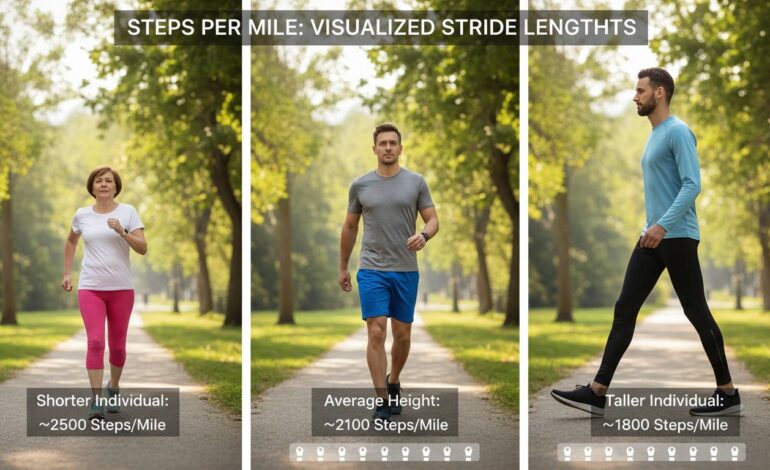
On average, walking one mile takes about 2,000 steps for most adults. That’s the simplest way to grasp the connection between steps and miles. Let’s dig deeper—how stride, pace, and personal factors swing that number, why it matters, and how to make it more useful in daily life.
Why the “2,000 Steps per Mile” Rule Exists
The old “2,000 steps in a mile” idea comes from average stride lengths of 2.1 to 2.5 feet. Since a mile is 5,280 feet, dividing that by the average step length lands you around 2,000 steps.
But that’s only a rough guideline. People’s height, pace, terrain, and even gender can shift things. It’s a starting point—helpful, but far from perfect.
Stride, Height & Gender: When One Size Doesn’t Fit All
Your stride length matters. It’s typically 41–45% of your height. Taller folks have longer strides, which means fewer steps per mile.
Here’s how step counts vary by height:
– 5’0″: ~2,514 steps/mile
– 5’8″: ~2,218 steps/mile
– 6’0″: ~2,112 steps/mile
Men often take fewer steps than women at the same pace due to longer average stride lengths. For example, at a 3 mph walking pace:
– Men: ~2,152 steps/mile
– Women: ~2,315 steps/mile
Pace and Terrain: Faster Doesn’t Always Mean More Steps
Walking slower increases steps per mile. Here’s a breakdown:
– Walking (20 min/mile): ~2,252 steps
– Brisk walking (15 min/mile): ~1,935 steps
Running speeds change things quite a bit:
– Jogging (12 min/mile): ~1,951 steps
– Running (10 min/mile): ~1,672 steps
– Fast run (8 min/mile): ~1,400 steps
In short: walk slower = more steps; run faster = fewer steps.
Measuring Your Unique Steps-per-Mile
Want accuracy beyond averages? Here’s how:
1. Walk a known distance (track or measured path).
2. Count your steps.
3. Divide the distance by your step count to get stride length.
4. Divide one mile (5,280 ft) by your stride length to get your steps-per-mile.
You can also use fitness trackers—Fitbit, Garmin, etc.—to estimate your stride length based on height and gender, or even manually enter your measured stride.
Why Knowing This Helps
- Visualize steps as distance. If your step rate is 2,200 per mile, then 5,000 steps ≈ 2.3 miles.
- Plan workouts without GPS. Just count steps to know you’ve done distance goals.
- Compare fitness over time. As stride and pace improve, steps per mile could shift.
- Track health progress. Understand exactly how movement translates to real miles walked.
Real-World Context & Health Impact
A brisk 10,000-step goal might sound big—but what does it mean in miles? If you’re walking, it usually translates to 4–5 miles daily. Runners might hit that distance sooner, depending on stride.
But not everyone hits 10,000 steps. The average American logs about 4,000–5,000 steps daily—around 2 to 2.5 miles.
And studies show even modest amounts—like 4,400 or 7,000 steps daily—can reduce mortality risk, with benefits plateauing beyond certain points. Some older adults see meaningful gains with just 2,500 steps/day.
In cognitive health, older adults at heightened Alzheimer’s risk slowed cognitive decline by walking 3,000–7,000 steps per day.
Mini Case: Two Walkers, Same Mile, Different Steps
- Jamie, height 5’2″, casual walk: about 2,433 steps/mile.
- Alex, height 6’1″, brisk pace: about 2,067 steps/mile.
Same distance, different effort. Goals must be personalized.
Expert Insight
“Understanding your personal steps-per-mile helps turn abstract step goals into real, actionable distances.”
This sums up the value—it brings clarity to fitness tracking, making goals meaningful and achievable in everyday life.
Conclusion
Most people walk a mile in around 2,000 steps. But that’s just a ballpark. Your real number depends on height, stride length, pace, terrain—even gender. Measuring it directly or using a tracker for calibration gives precise insight. Then your daily step goals become more tangible. Walking miles—not just steps—adds clarity to fitness and health. Strap on your tracker, test your stride, and get personalized.
## FAQs
How many steps are in a mile for most people?
Most adults take roughly 2,000 steps to walk a mile, though it can range from 1,800 to 2,500 depending on stride and pace.
Does running change steps per mile compared to walking?
Yes. Running usually reduces step count per mile because of longer strides—about 1,400 to 2,000 steps depending on speed.
What’s the best way to find my personal steps-per-mile?
Walk a known distance, count your steps, calculate stride length, and then divide 5,280 feet (one mile) by your stride length.
Do fitness trackers give accurate distance from steps?
They can estimate well using stride length from your profile, but manual calibration using measured strides improves accuracy.
Can walking fewer than 10,000 steps still be healthy?
Absolutely. Studies show significant health benefits with just 4,000 to 7,000 steps per day, and even older adults benefit from as few as 2,500 steps.
Why does stride and pace matter for step count?
Because shorter strides—due to slower pace or height—mean more steps to cover the same distance, while longer strides cut the count.