How Many Sentences Are in a Paragraph? Explained Clearly

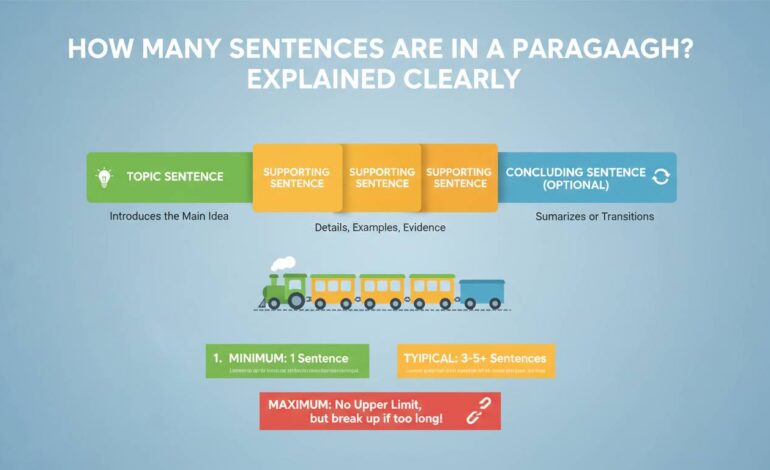
When you wonder “how many sentences are in a paragraph?”, the direct answer: there’s no fixed number—typically a paragraph contains three to five sentences, but context, purpose, and writing style play a major role. This is the simplest scoop. Now, let’s dig into why that range exists, when you might see more or fewer sentences, and how to adapt it in different contexts.
Why “three to five sentences” is a good general rule
Three to five sentences works because it gives a clear topic, a bit of detail, and wraps up or transitions. That balance helps the reader follow your point without getting overwhelmed or needing more. It’s not ironclad though—just a go-to guideline for clarity and flow.
Consistency and readability
Shorter paragraphs help people scan and understand quickly. That’s why many online articles stick with that sweet spot. In traditional academic writing, paragraphs often run longer—six to eight sentences—and that’s okay too. It’s just less scannable and demands more from the reader.
Flexibility across formats
Newspapers, blogs, emails, and marketing copy often favor shorter paragraphs—sometimes just one or two sentences when they want punch or pace. In novels or technical papers, paragraphs can stretch to a dozen or more sentences, especially when explaining complex ideas or weaving narrative.
What influences paragraph length in sentences
Purpose of writing
• For clarity: short paragraphs work best.
• For description or reflection: longer paragraphs give room.
• For impact: one-sentence paragraphs can pack a punch.
Audience expectations
A business report reader expects shorter, to-the-point chunks. A novelist-reader expects more narrative depth in each paragraph. Knowing who you’re writing for shapes how you chunk ideas.
Genre and medium
- Online content = shorter paragraphs, under five sentences.
- Print journalism often uses shorter paragraphs to aid layout.
- Academic contexts lean longer with evidence or argument.
- Creative prose leans into flow and imagery, so lengths vary.
When paragraphs get shorter than three sentences
Dramatic emphasis
One or two short sentences can create rhythm or drama. For example:
“It hit him. All at once.”
That’s intentional. It shifts pace, grabs attention, mirrors emotion.
Visual formatting
Online and marketing content use short paragraphs for skimming.
Bullets, lists, and tight intros pull focus. Some intros or outros might be only one sentence.
When paragraphs go longer than five sentences
Developing complexity
When explaining a technical concept or weaving narrative, you may need space. Suppose you’re describing a process. You might need several sentences to unpack steps, cause and effect, or background. Going past five is fine when the idea is complex enough.
Academic and legal contexts
In scholarly articles or contracts, one paragraph may include an idea, supporting evidence, implications—sprawling across eight to twelve sentences. Readers expect that dense setup and structure.
Human-like nuance and unpredictability
Humans don’t always stick to a formula. Sometimes we write a four-sentence paragraph, then a ten-sentence one, then a quick two-sentence punch. That variation can keep tone organic. Trying to sound “just right” can make writing feel robotic. A little unpredictability helps.
Think about your own writing: scribbled notes, rough drafts—they often bounce between lengths. That’s because our brains chunk ideas differently. Embrace that when writing or editing.
Structure: When to break or combine sentences
Tools for clarity
Ask yourself: does each paragraph express one idea or idea-group? If yes, that’s your unit. If the next sentence hikes to a new subpoint, start a new paragraph. It keeps focus sharp.
Transitional flow
Small sentences at the start or end can guide readers:
- “Let’s unpack this.”
- “Here’s what matters.”
They prime the transition. That counts as a paragraph, even if just one or two sentences.
Combining sentences for rhythm
Sometimes shorter sentences feel choppy. You can blend one or two into a longer compound or complex sentence:
- Short: “It’s too long. Readers get lost.”
- Combined: “It’s too long, and readers get lost.”
That smooths flow but still keeps clarity. Balance matters.
Practical examples across contexts
Blog post (web readability)
- Intro (3 sentences) to set stage.
- Body, each paragraph 2–4 sentences, focusing narrow.
- One-sentence transitions: “Let’s look next at how this applies.”
- Conclusion, 3–4 sentences wrapping up and call to action.
Academic essay
- Topic paragraph (~6 sentences) stating thesis and outline.
- Middle paragraphs (~8–10 sentences) with evidence and analysis.
- Transitional paragraphs (~4–6 sentences) bridging sections.
- Final paragraph (~6 sentences) summarizing and pointing readers forward.
Short story or novel
- Descriptive or emotional depth may run 10–20 sentences in reflective scenes.
- Dialogue often broken into one-character, one-sentence lines, mixing short and longer to sync with pacing.
- Action scenes sometimes use very short paragraphs to quicken the beat.
Expert perspective
“Paragraph length isn’t about arbitrary sentence counts. It’s about grouping ideas naturally and guiding the reader’s attention.”
That sentiment comes from writing coaches and editors who emphasize reader experience over rigid rules. It’s not “three sentences always,” but “does this section feel cohesive, clear, and paced?”
Summary of sentence counts by context
| Context | Typical sentence count |
|————————|————————|
| Web / blog content | 3–5 (often 2–4) |
| Newspaper / journalism | 2–6 |
| Academic / formal | 6–12+ |
| Creative / narrative | Varies widely (1–20+) |
These are guidelines, not mandates. The key is clarity and flow, not hitting a number.
Quick checklist for paragraph crafting
- Is there a clear main idea or purpose?
- Does it stay focused on that idea?
- Do I transition smoothly to the next thought?
- Are the sentences varied to keep rhythm human?
- Would shifting length improve emphasis or readability?
Use this filter through editing—don’t overthink it in the draft stage.
Conclusion
There’s no strict rule for how many sentences belong in a paragraph. A good guideline is three to five sentences for clarity and readability—especially online—but it’s flexible. Shorter bits can pack punch; longer ones can unpack complexity. The goal is cohesive thought, smooth pacing, and reader-friendliness, not a fixed number. Let your idea, audience, and voice guide the flow—and don’t be afraid to mix it up for that natural, human feel.
FAQs
How many sentences should a paragraph have in academic writing?
In academic writing, paragraphs often run longer—around six to twelve sentences—as they include a main idea, evidence, analysis, and a transition.
Is it okay to have one-sentence paragraphs?
Yes, especially online or in creative writing. One-sentence paragraphs can emphasize a point, pace a scene, or act as a visual break. It’s a stylistic choice when used intentionally.
Why are shorter paragraphs preferred on the web?
They’re easier to scan on screens. Readers browsing on phones or desktops can digest short chunks faster and stay engaged.
Can paragraphs in creative writing be very long?
Absolutely. Narrative and descriptive scenes often use longer paragraphs to build atmosphere or dive deep into character’s thoughts, sometimes spanning many sentences.
How do I know when to break a long paragraph?
If a paragraph spans multiple ideas or makes readers pause, it might be time to split. Look for shifts in topic, tone, or argument—those are natural breakpoints.
Does paragraph length affect SEO?
Indirectly. Readable, well-structured content helps with user engagement. Search engines may favor content that keeps readers on the page, and shorter, clear paragraphs aid that.