How Long to Boil Eggs for Perfect Hard or Soft Yolks

Introduction
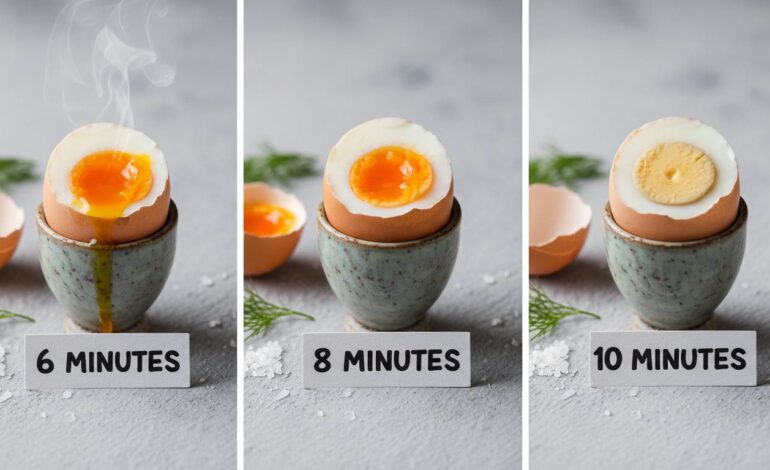
If you want perfectly boiled eggs—with soft, jammy, or hard yolks—boil large eggs for approximately 6 minutes for a runny yolk, around 8 minutes for a jammy center, and up to 12 minutes for a fully hard-boiled result. These timings give you consistent texture whether you’re topping salads, crafting deviled eggs, or just craving a snack.
Why Timing Matters and What Affects It
Getting egg doneness just right is about thermal science, not guesswork. The white and yolk set at different temperatures, so even a minute’s shift changes the texture. One expert, Rosemary Trout from Drexel, explains fat content slows yolk coagulation, meaning slight time changes—say from 10 to 12 minutes—can shift it from creamy to chalky .
Beyond this, factors like egg size, starting temperature, altitude, and how you transfer the eggs into water all influence outcome. Recognizing these variables sets a foundation for better eggs every time.
Simple Timing Guide for Various Yolks
Here’s a quick breakdown for large eggs at sea level:
- Soft‑boiled (runny yolk): about 6 minutes
- Jammy‑center (medium): roughly 7–9 minutes
- Hard‑boiled (firm yolk): around 10–12 minutes
Variations exist: tests range from 4 to 6 minutes for softer styles and stretch to 14 minutes for ultra‑firm yolks .
Expert Views and Practical Notes
Lisa Steele, a seasoned chicken keeper, says 10–12 minutes is her go‑to for large eggs—and you tweak time by a minute per size shift . Martha Stewart’s tip: boil large eggs for up to 12 minutes as a reliable maximum .
Healthline recommends:
– 6 min for runny yolk
– 8 min for jammy
– 12–13 min for hard yolk, especially aiming to avoid over‑cooked texture .
Mastering Variables
Egg Size
Adjust by 1 minute per step: medium (–1 min), extra‑large (+1 min) .
Starting Temperature
Cold-from‑fridge eggs take longer and risk cracking—room temperature smooths it out .
Altitude Effect
At higher altitudes (above 3,000 ft), water boils at lower temps, so add 1 extra minute for each 1,000 ft .
Post‑Boil Cooling
Ice baths or cold running water stop cooking instantly, prevent that green ring around yolks, and make peeling way easier .
Alternative Cooking Methods to Fit Your Way
Steaming
Uses less water, gentle heat, and yields similar results: 5–6 minutes for soft, about 12 for hard yolks .
Pressure Cooking
Soft: 2–4 minutes low pressure
Hard: 7–8 minutes
Quick and handy, though times may vary by model .
Baking
350°F oven, eggs in muffin tin: around 22 minutes for soft yolk; 30 minutes for fully firm .
Periodic Cooking—A Scientific Twist
This niche method alternates eggs between boiling (100 °C) and warm (30 °C) water every two minutes, for a total of 32 minutes. It achieves a firm white with creamy, gel‑like yolk, and may preserve nutrients like polyphenols .
“Of course, it takes time. But I think it’s good to dedicate some time for the people you love.”
– Dr. Ernesto Di Maio, on why he adopted periodic cooking
This isn’t practical daily, but it’s a fascinating insight for cooking nerds.
Mini Case: Finding Your Jammy Sweet Spot
A home cook tested 100+ batches and found 4–6 min produced runny yolks, 7–9 min the jammiest centers, and 10–12 delivered reliably hard yolks . With practice, personal preference emerges—mine? 8 min for toast‑topping.
Another user shared on Reddit:
- Soft: 5–6 min
- Medium: 7–8 min
- Hard: 9–12 min
They stressed starting with boiling water, easing eggs in gently, and ice bathing—made a real difference.
Wrapping It Up
Here’s the main takeaway:
– Soft yolk → ~6 minutes
– Jammy yolk → ~8 minutes
– Hard yolk → ~10–12 minutes
Adjust for egg size, temperature, and elevation. Cool fast, peel smart, and feel free to experiment with steaming, baking, pressure cooking—or even the fancier periodic method if you’re feeling adventurous.
FAQs
How long should I boil eggs if they’re extra‑large?
With extra‑large eggs, add about 1 minute to the timings—e.g., 9–10 minutes for a firm yolk .
Does starting from cold water change boiling times?
Yes—cold eggs take longer and are prone to cracking. Warming to room temp speeds things up and reduces shell cracks .
Why do yolks turn green, and how to avoid that?
Overcooking causes iron and sulfur to react, creating a green ring. Ice baths or quick cooling prevent that and keep the yolk bright .
My house is at high altitude—what then?
Above ~3,000 ft, water boils cooler. Add about 1 extra minute per 1,000 ft to compensate .
Is periodic cooking worth trying?
It makes color and texture amazing—and may preserve more nutrients—but it takes 32 minutes and careful temperature shifts. Fun experiment, not everyday method .
What’s the best way to peel boiled eggs easily?
Use not-too-fresh eggs, cool quickly in ice water, then tap and roll gently from the wider end to peel smoothly .
Let these timings be your kitchen compass—start there, tweak for your eggs and altitude, and you’ll nail the yolk texture every time.