Eye Tracking Exposes What Really Captures User Attention

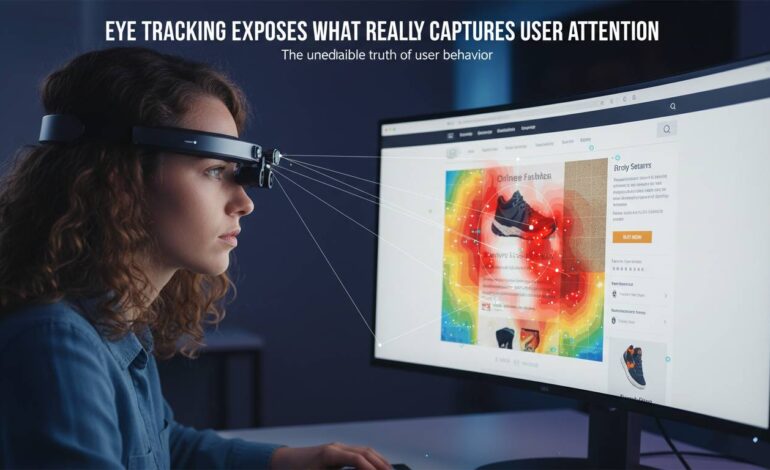
Most of what the UX industry believes about user attention is based on assumptions passed down from conference talk to conference talk, rarely questioned and almost never verified with actual measurement. Eye tracking changes that equation. It doesn’t guess what users are looking at — it shows you exactly where their eyes land, how long they stay, and the patterns that emerge across thousands of real users. The data is often uncomfortable. It contradicts a lot of conventional design wisdom. That’s precisely why it matters.
I’ve spent years reviewing eye tracking research across advertising, e-commerce, and product design. What the studies consistently reveal is a gap between what designers assume captures attention and what users actually process. This isn’t about aesthetics or creativity — it’s about measurable visual behavior. Here are the findings that have fundamentally shifted how I approach any design decision.
The F-pattern Is Real, But It’s Not the Whole Story
Jakob Nielsen’s research at the Nielsen Norman Group popularized the F-pattern more than a decade ago, and it remains one of the most replicated findings in eye tracking. Users read across the top of the page, scan down the left edge, then occasionally break into horizontal reading. This pattern shows up across languages, devices, and content types. If you’re placing critical information in the bottom right of a page, you’re fighting against biology.
But here’s where most designers stop listening. The F-pattern describes initial scanning behavior, not engagement. Users who exhibit the F-pattern are often looking for a reason to leave, not a reason to stay. The real question isn’t how to optimize for the F-pattern — it’s how to disrupt it. Strong headlines, unexpected visual breaks, and relevant subheadings can pull users out of that scanning reflex and into actual reading. The pattern tells you where users start. It doesn’t tell you where you want them to end up.
Banner Blindness Is Worse Than You Think
The phenomenon is well-documented: users actively avoid what they perceive as advertising. What eye tracking reveals is that this avoidance extends far beyond traditional banner ads. Navigation elements, promotional banners, and even branded content areas get systematically ignored when users have learned to filter them out.
Research from the University of Washington and subsequent studies by Infolinks found that users develop “banner blindness” within milliseconds of page load, often before consciously registering what they’re looking at. The eyes skip over entire sections that occupy traditional ad spaces — above the fold, in the sidebar, around the header. This has massive implications for digital advertising that still relies on placement. You’re not just competing for attention with other ads. You’re competing with every ad the user has ever seen.
The practical takeaway: if you want something noticed, make it look less like an ad. Integration with editorial content, native formatting, and value-driven positioning all outperform traditional advertising layouts. The minute something reads as “promotional,” the eyes move on.
Faces Draw Attention — But Not Always the Way You’d Think
There’s a well-established finding that images containing human faces attract fixation more than images without them. Eye tracking studies across e-commerce, news sites, and social platforms confirm this consistently. Faces register faster and hold attention longer than any other visual element.
What most people miss is the nuance. Users aren’t looking at the face to connect with a person. They’re looking at eyes — specifically, at the direction the eyes are pointing. A face looking at a product pulls attention toward that product. A face looking at the camera creates a brief engagement spike but doesn’t direct action. Studies by the Poynter Institute and various advertising research firms have shown that eye direction is a more powerful attention tool than facial presence alone.
This matters for product photography, hero images, and any page where you’re using human subjects. If the goal is directing attention, the eyes need to point the way.
Contrast and Size Trump Color Theory
Designers spend enormous energy on color palettes, believing that the right hue will draw the eye. Eye tracking data suggests this investment is misplaced. What actually drives attention is contrast against surrounding elements and relative size, not color choice.
A small element with high contrast beats a large element with low contrast every time. This applies to buttons, headlines, calls to action, and images. The studies are consistent across different color schemes, cultural contexts, and content types. Users see differences in luminance first, then process color. If your primary action button uses your brand’s accent color but sits on a similarly colored background, it will be ignored regardless of how carefully you selected the hue.
This is why A/B testing consistently shows that simpler changes — making a button larger, increasing its contrast — outperform experiments with color theory. The eye tracks difference, not harmony.
Motion Stops the Scan, But Only Briefly
Animated elements, video autoplay, and moving interfaces all capture attention when they enter the visual field. Eye tracking studies confirm this with high reliability. The eyes move toward motion automatically, a reflex that served evolutionary purposes and shows no sign of fading in digital contexts.
The critical limitation most articles on this topic omit: the attention capture is brief and often reflects surprise rather than interest. Users fixate on moving elements for a fraction of a second, then return to their scanning pattern. Motion doesn’t create sustained engagement — it creates an interruption. For e-commerce, this means video can stop a user who would have scrolled past, but it rarely drives the deep engagement that leads to conversion.
The most effective use of motion isn’t cinematic flourishes. It’s functional: indicating interactivity, showing system status, and confirming actions. Attention capture for its own sake is empty. Using motion to guide the next logical step is genuinely useful.
Mobile Behavior Is Fundamentally Different
The shift to mobile hasn’t just changed screen size — it’s altered the mechanics of visual attention in ways that most responsive design ignores. Eye tracking on mobile reveals shorter fixation durations, more frequent scanning between content areas, and a much stronger reliance on top-of-screen placement.
Thumb reach matters. Users hold phones with one hand and navigate with one thumb, which creates a natural bias toward content in the lower half of the screen — specifically, the lower third where the thumb naturally rests. Studies by Small Improvements and various UX research firms have found that touch targets and critical content placed in this zone receive significantly higher engagement than identical elements placed higher on the page.
Yet most mobile designs still prioritize the top of the viewport, treating mobile as a compressed version of desktop rather than a fundamentally different interaction context. The data is clear: if your mobile design just stacks your desktop layout vertically, you’re ignoring how users actually hold and use their devices.
Text Density Drives Skimming, Not Understanding
There’s a persistent belief in the UX community that users don’t read — they scan. Eye tracking confirms this is true for initial contact with content, but it misses the second half of the equation. Users will read in depth when the text density supports sustained attention.
Studies comparing eye tracking across different content formats show that well-structured long-form content gets substantially more reading time per word than thin content. The difference isn’t about reading versus scanning. It’s about the signal-to-noise ratio. Dense blocks of text without breaks, without visual hierarchy, and without scannable structure get scanned and abandoned. The same information, broken into readable chunks with clear headings and strategic white space, gets read.
This is where most content strategy fails. The assumption that users won’t read anything longer than 300 words leads to superficial content that never gets read at all. The better strategy is creating conditions that reward reading: structure, scannability, and clear value delivery that justifies the attention investment.
Cultural Context Shapes Visual Hierarchy
Eye tracking studies run in Western markets consistently show left-to-right scanning, F-patterns, and specific attention distributions. But research spanning multiple cultures reveals that these patterns aren’t universal. Users in right-to-left reading cultures, such as Arabic and Hebrew speakers, show different scanning behavior. Japanese users — who process both horizontal and vertical text — show more varied attention patterns that don’t conform to Western F-patterns at all.
Even within Western markets, cultural factors influence attention beyond reading direction. Research from Seoul National University and other institutions has found that users from collectivist cultures show different patterns of attention to faces, group images, and social context compared to individualist cultures. The assumption that eye tracking findings from one market apply globally is a mistake that’s rarely acknowledged in the industry.
If you’re designing for international audiences, test in those markets. Don’t assume that a finding from a study in California will translate to São Paulo or Singapore.
The Gap Between Looking and Remembering
This is the finding that most challenges how we evaluate design. Eye tracking shows what users look at, not what they process or remember. Numerous studies have documented the disconnect between fixation patterns and memory encoding.
A user might stare at your logo for two full seconds — longer than any other element on the page — and still not remember the brand name. Fixation indicates visual attention, not cognitive engagement. The eyes can rest on something while the mind wanders. This is why metrics like “time on page” or even fixation duration need to be paired with memory testing, comprehension checks, or conversion data to mean anything at all.
Designers who rely solely on eye tracking to evaluate effectiveness are measuring the wrong thing. Eye tracking tells you where attention goes. It doesn’t tell you whether that attention accomplished anything. The most dangerous conclusion is that a design is working because people are looking at it.
Attention and Intent Don’t Always Align
Eye tracking research in search contexts has revealed something uncomfortable: users often look at results they’re unlikely to click. The eye fixates on a title and snippet, the gaze lingers, and then moves on. The fixation pattern suggests interest, but the behavior suggests the opposite.
This disconnect appears across e-commerce, news, and content sites. Users look at products they won’t buy. They scan headlines they won’t read. They pause on navigation options they won’t select. The eyes express momentary curiosity, not intent.
Understanding this gap is essential for interpreting eye tracking data honestly. A design that captures attention but doesn’t convert is failing at its actual goal. The useful question isn’t “are they looking at it?” but “are they doing what we want them to do after looking?”
What Remains Unknown
Despite significant research investment, several fundamental questions about visual attention in digital contexts remain unresolved. We don’t fully understand how attention works during complex tasks that require multiple information sources. We don’t have reliable models for how attention interacts with voice interfaces and multimodal inputs. The research tends to isolate vision from other sensory and cognitive systems, which may be creating an incomplete picture.
There’s also genuine concern about research validity. Most eye tracking studies use small sample sizes in controlled lab environments — often 20 to 50 participants looking at screens in ways that don’t fully replicate real-world use. The gap between lab data and in-the-wild behavior is acknowledged but rarely addressed.
These limitations don’t invalidate the findings I’ve described. They do suggest that treating any single study as definitive is premature. The field is building toward understanding, not arriving at conclusions.
The uncomfortable truth eye tracking exposes is that much of what we call “design intuition” is really just assumption dressed up in confidence. The data doesn’t always support the conventional wisdom. Sometimes the thing you think is obvious — that a big hero image will capture attention, that your value proposition deserves top-of-page placement, that users read the words you worked hardest on — gets looked at once and discarded.
The alternative to assumption is measurement. Not the easy kind, like click tracking or time on page. The kind that shows you exactly where the eyes go. If you’re not willing to look at what users actually see, you’re designing for yourself. That’s a recipe for beautiful failures.