Daylight Savings 2025: Complete Guide & Key Dates

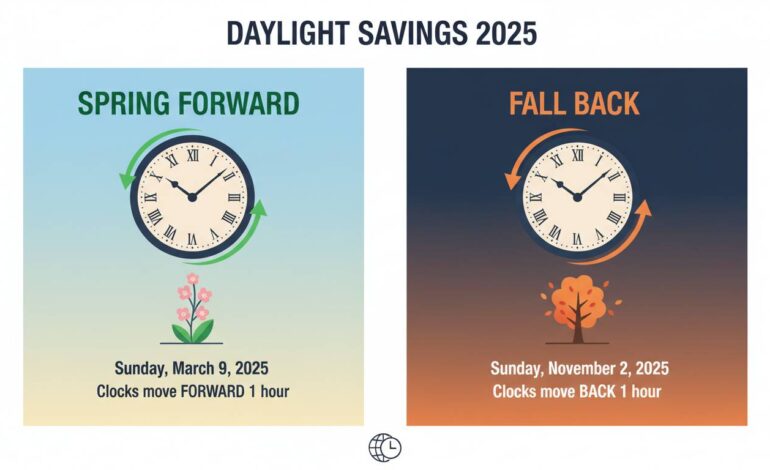
Daylight Saving Time 2025 begins on March 9, 2025, when clocks spring forward one hour at 2:00 AM local time. It ends on November 2, 2025, when clocks fall back. This affects most of the United States, though Hawaii, Arizona, and some U.S. territories opt out.
When Does DST Start in 2025?
DST starts on Sunday, March 9, 2025. At 2:00 AM, clocks jump ahead to 3:00 AM, costing most of us an hour of sleep. The idea is to give us more evening light as days get longer heading into spring and summer.
The second Sunday in March has been the start date since 2007, when the Energy Policy Act extended DST by about four weeks. Before that, it traditionally began on the first Sunday in April.
What to do around March 9:
- Set your clocks forward before bed on Saturday, March 8
- Swap out smoke detector batteries while you’re at it
- Move any appointments that fall in that “lost” hour
- Kids and pets don’t love the change either—ease them into the new schedule if you can
The transition happens at 2:00 AM in every time zone. It’s early enough that most people sleep through the confusion.
When Does DST End in 2025?
DST ends on Sunday, November 2, 2025. At 2:00 AM, clocks roll back to 1:00 AM, giving us an extra hour of sleep. Nights get darker earlier, but mornings are brighter.
The first Sunday in November has been the end date since 2007. That means Halloween and early November activities get extra evening daylight—which is nice until winter kicks in and it gets dark at 5:00 PM anyway.
What happens November 2:
- You “gain” an hour if you sleep through the transition
- Evening darkness comes sooner, especially in northern states
- Mornings are lighter, which some people actually prefer
2025 DST Schedule
| Event | Date |
|---|---|
| DST Begins | March 9, 2025 |
| DST Ends | November 2, 2025 |
The change hits each time zone at 2:00 AM local time—so when the East Coast changes, the West Coast is still three hours behind that moment.
States That Don’t Observe DST
A few places skip the twice-yearly shuffle.
Arizona stays on standard time year-round, except for the Navajo Nation. Arizona ditched DST in 1968 because extra evening sunlight in that brutal summer heat means running air conditioning longer. That logic still holds—Phoenix summers regularly hit 110°F.
Hawaii dropped DST in 1967. Being near the equator means Hawaii only sees about a two-hour difference between the longest and shortest days. The clock change just isn’t worth the hassle.
U.S. territories that skip DST:
- Puerto Rico (stays on Atlantic Standard Time)
- Guam (Chamorro Standard Time)
- American Samoa
- U.S. Virgin Islands
The Navajo Nation is the weird exception—it follows DST even though it sits mostly in non-observing Arizona, because parts of the reservation extend into Utah and New Mexico, which do observe it.
Why Do We Have DST?
Benjamin Franklin first suggested the idea in 1784, though his proposal was mostly a joke about how Parisians slept through useful daylight.
The U.S. actually started using DST during World War I, hoping to save coal for the war effort. It didn’t stick permanently at first—states did their own thing for decades, which got confusing.
The Uniform Time Act of 1966 tried to fix that by setting standard start and end dates, though states could still opt out (hence Hawaii and Arizona).
Then in 2007, Congress extended DST by about a month, moving it to its current March-November schedule. The idea was energy savings—more evening light means less electricity used. But studies on whether that actually works have been mixed.
How DST Affects Your Life
Sleep: The spring change is rough. Studies link the week after “spring forward” to more car accidents and heart attacks. The fall change is easier since you gain an hour, but kids and older folks still feel it.
Business: Retail and restaurants tend to like DST—people shop and go out more when it’s light after work. But the transitions create headaches for anyone managing schedules across time zones.
Agriculture: Farmers historically hated DST. Milking schedules, harvesting, and livestock don’t care about clock time, and the twice-yearly switch throws everything off.
DST Around the World
About 70 countries use some form of DST, but dates vary. The EU follows a similar schedule to the U.S.—last Sunday in March through last Sunday in October.
Countries near the equator almost never use DST. The daylight variation is so small there’s no point. China, despite spanning five time zones, uses one standard time and doesn’t change the clocks.
The Southern Hemisphere flips it—Australia and New Zealand spring forward in September/October and fall back in March/April.
Getting Ready
Before March 9: Ease into it by going to bed 15-20 minutes earlier for a few nights. Update your phone and computer—they should change automatically, but double-check. Good time to test those smoke detectors.
Before November 2: It’s easier since you’re gaining an hour, not losing one. But the earlier darkness can drag on mood, especially up north. Light therapy in the morning helps some people.
The Bottom Line
DST in 2025 runs March 9 through November 2, same as it’s been since 2007. Most of the country deals with the switch, but Hawaii, Arizona, and the usual territories don’t.
Whether you think DST is useful or just an inconvenience, it’s not going anywhere soon. Some states have proposed ending it or making it year-round, but federal law currently requires anyone who observes DST to follow the standard schedule.
So set your reminders: spring forward March 9, fall back November 2.