Arc Length Formula: How to Calculate the Length of a Curve

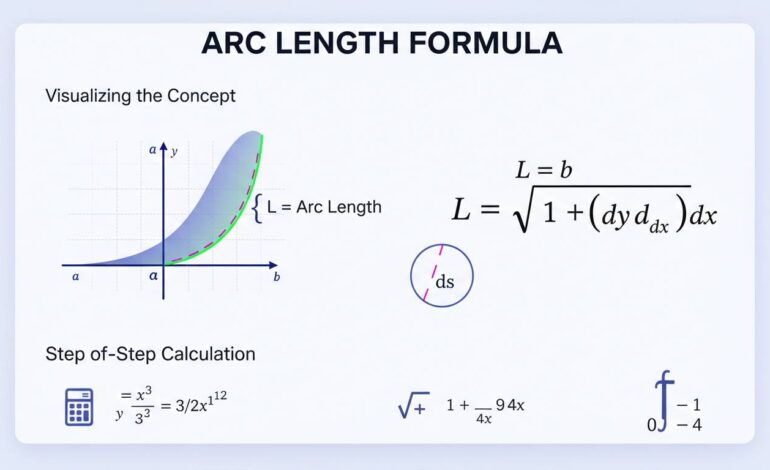
The arc length formula lets you find the distance along a curve—whether it’s a slice of pizza crust or a drawn arc. For circles, the simplest form is L = r × θ (with θ in radians), while for general curves, we use an integral: L = ∫ₐᵇ √(1 + [dy/dx]²) dx. Those are the quickest ways to calculate how long a curve really is.
Understanding the Basics of Arc Length
Arc length can mean two different things, depending on the context:
For Circles (Simple and Intuitive)
The most straightforward case is a circle. If you know the radius (r) and the central angle (θ):
– Radians: L = r × θ
– Degrees: L = (π/180) × θ × r or equivalently L = (θ/360) × 2πr
Beyond circles, the neat formula gives way to something more general.
For Curves (Real-World Paths)
In everyday math or physics, curves may be defined by y = f(x). We break the curve into tiny segments and sum them using an integral:
– Arc Length (general): L = ∫ₐᵇ √(1 + [dy/dx]²) dx
This version covers wavy or irregular curves where no simple geometric shortcut applies.
Why It Matters (Context & Application)
Real-world relevance brings this to life:
- Engineers design curved roads and need accurate distances.
- Animators plot smooth motion along complex paths.
- Architects model arches where precise length matters.
Even tech fields like robotics use these formulas for motion planning.
“Without knowing the arc length, any work along curved paths is guesswork,” said a civil engineer. Think of laying out a curved sidewalk without knowing how long the walkway really will be.
Derivation Made Simple
Let me walk you through how we get the integral arc length formula:
-
Parameterize the Curve
Represent the curve as (x(t), y(t)) for t from a to b. -
Break It Down
Estimate tiny segment lengths using the Pythagorean theorem: -
Δs ≈ √(Δx² + Δy²).
-
Use Derivatives
As Δt → 0: -
ds = √[(dx/dt)² + (dy/dt)²] dt.
-
Integrate
Adding those tiny bits gives us: - L = ∫ₐᵇ √[(x′(t))² + (y′(t))²] dt.
In single-variable form (x = t), that simplifies to √(1 + [dy/dx]²) dx .
Practical Examples You Might Actually Use
Example 1: A Quarter-Circle
Let’s say y = √(1 – x²), with x between –√2/2 and √2/2:
- dy/dx = –x / √(1 – x²)
- Integrand becomes 1/√(1 – x²)
- Integral evaluates to π/2
So the arc length of that quarter circle is π/2 ≈ 1.5708 units.
Example 2: A Straight Line (Trivial Case)
y = 8 on [2, 4]:
- dy/dx = 0, so integrand = √1 = 1
- Integral = 4 – 2 = 2 units
Example 3: Angles in a Circle (Degrees)
Radius 5 cm, θ = 60°:
- L = (2π × 5) × (60/360) = (10π) × (1/6) = (5π)/3 ≈ 5.235 cm
These examples show how formulas shift based on curve type.
When No Closed-Form Exists
Some curves—like parts of a hyperbola—don’t have neat formulas. Instead, their arc length uses special integrals or numerical methods.
For example, one segment length involves arcosh, sinh, elliptic integrals, and other more complex math .
In those cases, numeric integration is your friend.
Quick Comparison at a Glance
| Curve Type | Formula | Notes |
|——————|——————————–|—————————————-|
| Circle (radians) | L = r × θ | Fast and clean |
| Circle (degrees) | L = 2πr × (θ/360) | Converts degrees to full arc fraction |
| General curve | L = ∫ₐᵇ √(1 + [y’]²) dx | Works for any smooth function |
| Parametric curve | L = ∫ₐᵇ √(x’² + y’²) dt | Handles motion or multi-axis paths |
| No closed form | Numerical integration | Hyperbolas, ellipses, etc. |
Real-World Tip: Sector and Chord Info
When you don’t have angle but know sector area or chord length:
- Sector area → find θ via A = ½r²θ → then L = rθ
- Chord length → use chord formula c = 2r sin(θ/2) → solve for θ → L = rθ
Great for when the angle isn’t given directly.
The Bigger Picture in Calculus
This method is part of a broader toolkit in calculus that lets us measure curved distances, surfaces, volumes, even in complex settings like:
- Surfaces in higher dimensions
- Riemannian manifolds (where the notion of distance varies)
It’s fundamental, not just formulaic.
Conclusion
Arc length is surprisingly flexible: from a neat formula for circles to a powerful integral for any curve. You pick based on what data you have—radius and angle or the function itself—and choose geometry or calculus accordingly. When exact solutions aren’t possible, numerical approximation steps in.
This gives both clarity and calculus muscle whenever you’re mapping a curve—on roads, in engineering, in art, or in math.
FAQs
How do I choose between L = r × θ and the integral formula?
Use L = r × θ when you have a circle’s radius and angle (θ in radians). Use the integral formula when dealing with general curves defined by a function or parametric equations.
What if the angle is given in degrees?
Convert degrees to radians: multiply θ (in degrees) by π/180, then apply L = r × θ. Or directly use L = 2πr × (θ/360°).
Can I approximate arc length numerically?
Absolutely. When a closed-form solution is tough or impossible—especially with complex curves—numerical integration (e.g., Simpson’s rule) provides a reliable estimate.
Why is arc length greater than chord length?
Because a chord cuts straight across; the arc follows curvature. The shortest path between two points is a straight line, so the arc is always longer.
How does arc length apply to motion paths?
If a path is parameterized like (x(t), y(t)), arc length gives the distance a point or object moves along that path. You use the formula L = ∫ₐᵇ √(x′² + y′²) dt.
Do all curves have finite arc length?
No. Some pathological curves (like certain fractals) are non-rectifiable—their arc length can be infinite. Most practical curves you use in math or engineering don’t fall into that category.