Alternate Interior Angles: Definition, Properties, and Examples

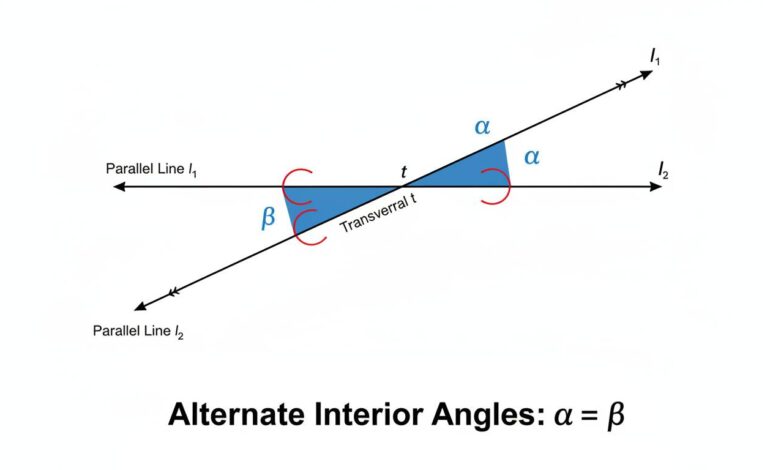
Alternate interior angles are the angles that form on opposite sides of a transversal line and inside two other lines. When those two lines are parallel, the alternate interior angles are equal in measure—this is both their defining property and a quick way to test for parallelism. Whether you’re solving geometry puzzles or checking line relationships, that’s the core idea, plain and simple.
What Alternate Interior Angles Actually Are
Alternate interior angles are created when a transversal—a line that crosses two other lines—intersects them. The angles in question:
- lie inside the region between the two lines,
- and sit on opposite sides of the transversal.
Visualize this as a zigzag or “Z” shape. If the two lines being intersected are parallel, these angles are always congruent.
Why They Matter – The Theorem & Its Converse
1. The Alternate Interior Angles Theorem
If a transversal cuts two parallel lines, the alternate interior angles created are congruent. That means each pair of alternate interior angles has equal measure.
2. The Converse
On the flip side, if those angles are congruent, the two lines must be parallel. That logic often becomes the basis of geometric proofs or real-world architectural reasoning.
Together, these two ideas form a neat, intuitive test for parallelism using angles alone.
Spotting Them: A Quick Z-Test
A simple way to identify alternate interior angles is using the “Z” or backward‑Z method:
- Draw the transversal intersecting your two lines.
- Trace a Z-shape: the top stroke is an angle on one side of the transversal, the middle connects across the inner region, and the bottom stroke is the alternate angle on the other side.
- Those are your alternate interior angles.
Once you spot that Z shape and confirm the lines are parallel, those angles are guaranteed to match.
Walking Through Real-World Examples
Example A
Two parallel lines are crossed by a transversal. One angle measures 40°. The alternate interior angle on the opposite inner side of the transversal also measures 40°. Easy peasy.
Example B
Say line 1 is parallel to line 2 and cut by a transversal. Angles ∠3 and ∠6 are alternate interior angles. If ∠6 is given as 54°, then ∠3 must also be 54°.
Example C (Algebraic)
Two alternate interior angles are given as (5x)° and (3x + 28)°. Set them equal since the lines are parallel:
5x = 3x + 28 → 2x = 28 → x = 14.
These show both quick observation-based reasoning and algebraic application.
Digging Deeper: Properties That Count
These aren’t just textbook notions—they connect to major geometry principles:
-
Congruence: The standout property is simply that the angles are equal in measure when lines are parallel.
-
Parallel Detection: If alternate interior angles are congruent, you’ve got parallel lines. A powerful, visual shortcut.
-
Triangle Angle Sum: When you drop a parallel line through a triangle vertex, alternate interior angles help prove that triangle’s external angles sum to the two opposite interior angles. It’s a classic move in geometric proofs.
-
Co-Interior (Consecutive Interior) Angles: These angles, on the same side of the transversal and inside the lines, sum to 180°—while alternate ones are equal.
Together, these facts form a toolkit for geometry—easy to apply, easy to visualize.
A Mini Case Study: Designing a Butterfly Habitat
Imagine constructing a plan for a butterfly habitat with two parallel railings and one walkway cutting across diagonally:
- You measure the angle the walkway makes with one railing—say it’s 65°.
- Since the railings are parallel, the angle it makes on the opposite side, inside the space between, is also 65°. You use that to guarantee symmetry and ensure the enclosure looks just right.
That’s alternate interior angles at work—practical, visual, reliable.
Expert Insight
“Alternate interior angles are like geometry’s fingerprint for parallelism. Once you recognize the Z-pattern, you’ve unlocked a powerful shortcut.”
That sums it up. These angles are both simple to spot and deep in their logical reach.
Why This Simple Tool Works So Well
- It’s visual—Z‑shapes are intuitive.
- It’s versatile—used in triangle proofs, design layouts, algebra problems.
- It’s robust—no need for complex computation, just angle equality or linearity.
- And it’s foundational—a building block for more advanced geometric reasoning.
Conclusion
Alternate interior angles are the angles formed inside two lines on opposite sides of a transversal. When those lines are parallel, the angles are congruent—plain as that. Spotting a Z-shape helps identify them fast, and algebra solves for unknowns. These angles do more than look neat—they prove parallelism, support proofs, and pop up in real-world design. Keep them in your geometry toolkit—they just click.
FAQs
What exactly are alternate interior angles?
They are the angles inside two lines, on opposite sides of the transversal. When the lines are parallel, these angles are equal in measure.
How can you identify them quickly?
Look for a Z‑ or backward Z‑pattern. The top and bottom points of the Z are your alternate interior angles.
What does it tell you if alternate interior angles are congruent?
It tells you the two lines being intersected are parallel.
How are co-interior angles different?
Co-interior angles lie on the same side of the transversal inside the lines and are supplementary (sum to 180°), unlike alternate interior angles which are just equal.
Can this idea help in triangle problems?
Yes—drawing a parallel line through a triangle vertex creates alternate interior angles that help prove properties like exterior angles equaling the sum of opposite interior angles.
Do alternate interior angles still exist if lines aren’t parallel?
They do exist, but they are not congruent unless the lines are parallel.