ai news today recency

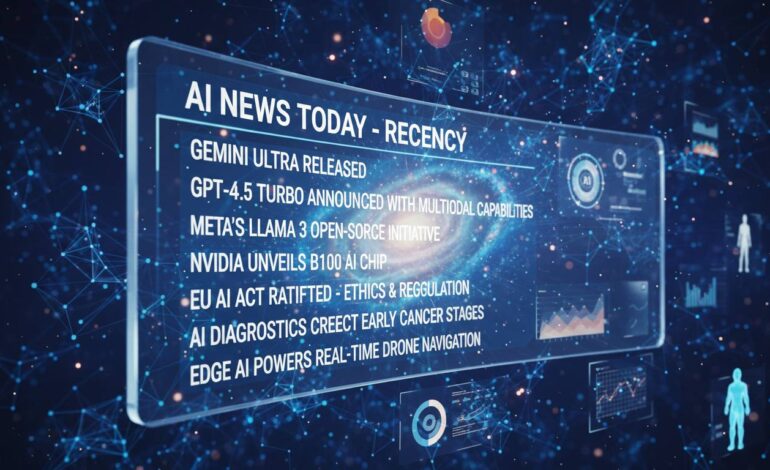
The artificial intelligence landscape continues its relentless pace of innovation, with major technology companies unveiling new capabilities, regulators worldwide grappling with governance frameworks, and enterprises accelerating their adoption of AI tools across every sector. From next-generation language models pushing the boundaries of reasoning to breakthroughs in multimodal AI that blur the lines between creative and analytical tasks, the developments shaping AI news today reflect an industry in full transformation. This comprehensive overview examines the most significant recent advancements, the competitive dynamics driving innovation, and the emerging challenges that will define the trajectory of artificial intelligence throughout the remainder of 2025.
The New Generation of Foundation Models
The foundation model landscape has undergone a dramatic evolution since the debut of earlier language models, with leading AI labs racing to release increasingly capable systems that demonstrate improved reasoning, longer context windows, and enhanced multimodal understanding. OpenAI’s GPT-4o and its subsequent iterations have established new benchmarks for general-purpose AI assistance, integrating text, image, audio, and video processing into unified models that can engage in near-real-time conversation with human-like responsiveness. These models have moved beyond simple text completion into complex tasks involving code generation, mathematical reasoning, and nuanced creative writing that rivals professional output in many domains.
Google’s Gemini suite has emerged as a formidable competitor, with the Ultra variant specifically designed to compete at the highest levels of capability across reasoning, coding, and multimodal tasks. The integration of Gemini into Google’s ecosystem—spanning Search, Workspace, and Android—represents one of the most aggressive deployments of AI at scale, affecting hundreds of millions of users worldwide. Meanwhile, Anthropic’s Claude family has carved out a distinctive position emphasizing safety, helpfulness, and extended reasoning capabilities, with the Claude 3.5 series receiving particular praise for its nuanced approach to complex ethical questions and its enhanced ability to follow complex instruction sets over extended conversations.
Microsoft has leveraged its partnership with OpenAI while developing its own Copilot ecosystem, embedding AI assistance into Windows, Office, Microsoft 365, and Azure cloud services. The company’s strategy centers on making AI accessible to enterprise users through familiar productivity tools, with Copilot now handling millions of daily interactions across business applications. Meta has released open-source models including Llama 3, contributing to an ecosystem where smaller developers can build upon foundation models without requiring massive computational resources, democratizing access to cutting-edge AI capabilities in ways that reshape competitive dynamics across the industry.
Enterprise AI Adoption Reaches Critical Mass
Enterprise adoption of artificial intelligence has transitioned from experimental pilots to mission-critical deployment, with organizations across financial services, healthcare, manufacturing, and retail integrating AI into core business processes. The financial services sector has embraced AI for fraud detection, risk assessment, and algorithmic trading, with major banks reporting significant efficiency gains from deploying machine learning models that can analyze transaction patterns in milliseconds. Healthcare applications have expanded to include diagnostic assistance, drug discovery acceleration, and personalized treatment recommendations, though regulatory requirements continue to shape deployment strategies in this highly sensitive domain.
The consulting and professional services industry has experienced particular disruption, with AI-powered tools increasingly handling tasks that previously required significant human expertise. Legal research, contract analysis, and due diligence processes that once consumed hundreds of billable hours can now be completed in minutes, forcing firms to reconsider their service delivery models and value propositions. Marketing and sales organizations have adopted AI for customer segmentation, content personalization, and predictive analytics, with revenue growth attributed to AI-driven insights reaching double-digit percentages in early-adopting companies.
Supply chain and logistics companies have found AI invaluable for demand forecasting, route optimization, and inventory management, capabilities that proved essential during recent global disruptions. Manufacturing giants have deployed AI-powered quality control systems that identify defects with greater accuracy than human inspectors, while predictive maintenance applications have reduced unplanned downtime significantly. The retail sector has seen AI reshape customer experience through personalized recommendations, dynamic pricing, and automated customer service, with leading e-commerce platforms reporting conversion rate improvements directly attributable to AI-powered personalization.
Regulatory Landscape and Governance Frameworks
Governments worldwide have intensified their focus on AI regulation, recognizing both the technology’s transformative potential and the risks associated with uncontrolled deployment. The European Union’s Artificial Intelligence Act represents the most comprehensive regulatory framework to date, establishing risk-based categories that restrict certain AI applications while requiring transparency and accountability measures for high-risk systems. Implementation phases are underway, with full compliance requirements scheduled to phase in over the coming years, creating significant compliance obligations for companies operating in European markets.
The United States has taken a more sector-specific approach, with existing agencies asserting authority over AI applications within their domains. The FDA has issued guidance on AI-powered medical devices, while financial regulators have examined algorithmic trading and credit scoring systems. Executive orders on AI have established voluntary safety standards and promoted research investment, though comprehensive federal legislation remains under deliberation. State-level initiatives, particularly California’s recent AI legislation efforts, have emerged as significant factors for companies operating across multiple jurisdictions.
China has implemented its own regulatory framework governing algorithmic recommendations, deepfakes, and generative AI, requiring registration and content review for certain AI services. These regulations reflect governmental priorities around information control and technological sovereignty while maintaining support for domestic AI development. International bodies including the OECD and United Nations have advanced frameworks for AI governance, though harmonizing approaches across different political and economic systems remains challenging. The tension between fostering innovation and managing societal risks defines the central challenge for policymakers navigating this complex terrain.
Investment Trends and Startup Ecosystem
Venture capital investment in artificial intelligence startups has demonstrated remarkable resilience despite broader market corrections, with funding concentrating in companies addressing enterprise applications, developer tools, and vertical-specific solutions. Companies developing AI infrastructure—including specialized chips, development platforms, and MLOps tools—have attracted significant capital as the demand for AI compute continues to outpace supply. The competition among chip manufacturers including NVIDIA, AMD, and emerging players has intensified, with each vying for position in an market where AI accelerators command premium pricing and extended lead times.
Startup activity has flourished in areas where foundation models require specialized adaptation for particular use cases. Legal technology companies have built AI systems trained on case law and regulatory documents, while healthcare-focused startups develop clinical decision support tools meeting stringent accuracy and privacy requirements. The rise of AI agents—autonomous systems capable of completing multi-step tasks—has generated particular excitement, with startups positioning to automate complex workflows across customer service, software development, and business operations.
Corporate venture activity has accelerated, with major technology companies and established enterprises investing directly in AI startups to gain access to emerging capabilities and shape market development. Strategic acquisitions have consolidated talent and technology, with well-funded buyers acquiring startups that have demonstrated product-market fit in specialized domains. The public markets have shown increased interest in AI-focused companies, though valuation debates continue regarding which businesses possess sustainable competitive advantages versus those benefiting from temporary hype cycles.
Multimodal and Specialized AI Advancements
The evolution beyond text-only models into truly multimodal systems represents one of the most significant technical developments in recent AI news. Contemporary models can process and generate text, images, audio, and video with remarkable coherence, enabling applications ranging from video conferencing summarization to real-time translation to automated content creation across formats. These capabilities have created new possibilities for creative industries, education, and accessibility, while simultaneously raising concerns about synthetic media and verification challenges.
Code generation and software development assistance have matured substantially, with AI systems now capable of understanding large codebases, suggesting improvements, and even autonomously debugging complex issues. Developer productivity tools integrated into popular programming environments have reduced time spent on routine tasks, though debates continue about the implications for software engineering careers and the changing nature of programming work. The emergence of AI-native applications—designed from the ground up around AI capabilities rather than retrofitting AI into existing workflows—suggests a deeper transformation in how software is conceived and built.
Specialized models for scientific research have demonstrated capabilities in protein structure prediction, materials discovery, and climate modeling, accelerating research cycles that previously required years of dedicated investigation. The pharmaceutical industry has embraced AI-driven drug candidate identification, with several AI-designed molecules now in clinical trials—a development that could fundamentally alter the economics of pharmaceutical development. Academic research has increasingly relied on AI for literature synthesis, hypothesis generation, and experimental design, though questions about reproducibility and appropriate oversight continue to generate discussion within the scientific community.
Challenges and Emerging Concerns
The rapid advancement of AI capabilities has amplified longstanding concerns about bias, fairness, and the concentration of power among a small number of technology companies. Research has documented instances where AI systems perpetuate or amplify existing societal biases, particularly in applications affecting employment, lending, criminal justice, and healthcare. Addressing these issues requires sustained investment in diverse training data, rigorous testing across demographic groups, and ongoing monitoring of deployed systems—investments that some companies have prioritized more than others.
Environmental concerns regarding AI’s energy consumption have gained attention as model sizes and training compute have grown exponentially. While efficiency improvements have partially offset the energy demands of larger models, the overall trend toward more capable systems continues to raise questions about sustainability. Some organizations have committed to renewable energy for AI operations, and research into more efficient model architectures represents an active area of investigation.
Workforce impacts remain a subject of intense debate, with economists offering widely varying predictions about automation’s effects on employment across different sectors and skill levels. While AI has clearly automated certain routine cognitive tasks, the emergence of new job categories and the transformation rather than elimination of existing roles appears to be the more accurate characterization thus far. However, the pace of change and the uncertainty about which roles will be affected next has generated anxiety among workers across many industries, driving policy discussions about education, retraining, and social safety nets.
Looking Ahead: The Trajectory of AI Development
The trajectory of artificial intelligence development suggests continued rapid advancement across multiple dimensions, with reasoning capabilities, agentic systems, and improved factual accuracy representing key areas of ongoing research. Competition among major players shows no signs of abating, with each company racing to demonstrate superior capabilities while simultaneously seeking sustainable business models that justify massive research investments. The integration of AI into everyday devices and services will likely accelerate, making advanced capabilities accessible to users who may not consciously recognize the AI powering their interactions.
The intersection of AI with other transformative technologies—robotics, biotechnology, quantum computing—promises to unlock capabilities that currently exist only in research laboratories. The development of more capable and reliable AI systems could accelerate scientific discovery across numerous fields, while simultaneously requiring governance frameworks that can adapt to rapidly changing capabilities. The decisions made by companies, governments, and society in the coming years will shape whether AI’s development proceeds in ways that broadly benefit humanity or exacerbate existing inequalities and risks.
For organizations and individuals seeking to navigate this landscape, staying informed about developments while maintaining realistic expectations about both capabilities and limitations represents a prudent approach. The AI field moves quickly enough that developments considered state-of-the-art can become outdated within months, yet the fundamental principles of evaluating AI systems—understanding their training data, testing thoroughly before deployment, monitoring for unexpected behaviors—remain consistently relevant. Engaging with AI thoughtfully, rather than either embracing or rejecting it wholesale, positions stakeholders to capture benefits while managing risks appropriately.
Conclusion
The artificial intelligence landscape in 2025 reflects a technology at an inflection point, with capabilities that would have seemed miraculous just years ago now becoming commonplace while even more ambitious developments loom on the horizon. The convergence of increasingly powerful foundation models, accelerating enterprise adoption, evolving regulatory frameworks, and substantial ongoing investment suggests that AI will continue its trajectory toward greater integration into economic and social life. Organizations that develop thoughtful strategies for AI adoption—balancing innovation with risk management, and efficiency with ethical consideration—will be best positioned to thrive in this transforming environment.
The challenges accompanying AI’s advancement require sustained attention from technical experts, policymakers, and the public alike. Issues of bias, environmental impact, workforce displacement, and the concentration of power deserve serious consideration rather than dismissal as secondary to technological progress. History suggests that technologies shaped by broad societal input tend to produce outcomes more aligned with public interest than those developed primarily behind closed doors. As AI’s influence continues to expand, the conversations happening today about governance, accessibility, and responsible development will prove decisive in determining whether this powerful technology serves humanity’s collective interests.
FAQs
What are the most significant recent AI developments in 2025?
The most notable developments include the continued advancement of multimodal AI models capable of processing text, images, audio, and video; aggressive enterprise adoption across financial services, healthcare, and manufacturing; the implementation of the European Union’s AI Act; and the emergence of AI agent systems that can autonomously complete multi-step tasks.
Which AI companies are leading the industry right now?
OpenAI, Google (through Gemini), Microsoft (through Copilot and OpenAI partnership), Anthropic, and Meta represent the leading AI companies, each with distinct strategies and areas of focus. Additionally, NVIDIA maintains a dominant position in AI hardware, while numerous startups compete in specialized vertical applications.
How is AI regulation changing in 2025?
The European Union’s AI Act is being implemented in phases, establishing risk-based categories and compliance requirements. The United States continues with a sector-specific approach, while California has introduced state-level AI legislation. International efforts to harmonize approaches continue through bodies like the OECD.
What industries are adopting AI most rapidly?
Financial services, healthcare, manufacturing, retail, and professional services have adopted AI most rapidly, with applications spanning fraud detection, diagnostic assistance, quality control, customer personalization, and document analysis. Enterprise software integration has accelerated adoption across virtually all sectors.
What are the main concerns about current AI development?
Primary concerns include AI system bias and fairness issues, environmental impact from energy-intensive training and deployment, workforce displacement, the concentration of power among few technology companies, and the challenges of verifying authentic versus AI-generated content.
How can businesses prepare for AI integration?
Businesses should develop clear AI strategies aligned with their core objectives, invest in employee training and reskilling, establish governance frameworks for AI use, start with high-impact, lower-risk applications, and maintain oversight mechanisms to ensure AI systems perform as expected while identifying issues promptly.