Competency-Based Interviews: What They Are & How to Prepare

If you’ve ever walked out of an interview feeling confident but then got rejected, chances are you stumbled on competency-based questions. These aren’t the “where do you see yourself in five years” prompts that let you coast on generic answers. Competency-based interviews dig into your actual behavior in specific situations, and they have a logic that most candidates completely miss. The good news: once you understand how they work, you can prepare for them systematically. Most people don’t. That’s your advantage.
What Competency-Based Interviews Actually Are
A competency-based interview (also called a behavioral interview) is structured around the idea that past behavior predicts future behavior. Instead of asking theoretical questions about how you would handle a situation, the interviewer asks you to describe how you did handle a real situation in your past. They’re not interested in what sounds good in theory—they want concrete evidence of what you’re actually capable of.
This approach came from industrial-organizational psychology research in the 1970s, from McClelland’s work on selecting employees based on competencies rather than credentials alone. Companies adopted it because it proved more predictive of on-the-job performance than traditional interviewing methods. When an interviewer asks you to tell them about a time you managed a difficult project, they’re not just making conversation. They’re testing whether you possess the competencies they care about—leadership, problem-solving, time management—and they have a rubric for evaluating your answer.
The structure matters. Most competency-based interviews follow a consistent format: the interviewer selects competencies relevant to the role, then designs questions to probe each one. If they’re hiring for a customer service position, expect questions about handling conflict and maintaining composure under pressure. For a leadership role, they’ll ask about motivating others and making tough decisions. The questions are rarely spontaneous. They’re derived from a competency framework the company developed specifically for that position.
This is different from traditional interviews where you might get away with vague, rehearsed answers about your greatest strengths. Here, the interviewer has a follow-up question ready for every vague claim. Say you’re a “great communicator”? They’ll ask for a specific example. Claim you “thrive under pressure”? They’ll want to know exactly what you did during that high-stakes moment last quarter.
The STAR Method
Here’s where most candidates lose ground. They understand that competency questions require examples, but they don’t structure their answers effectively. The result is rambling responses that miss the point or, worse, answers that sound scripted and inauthentic.
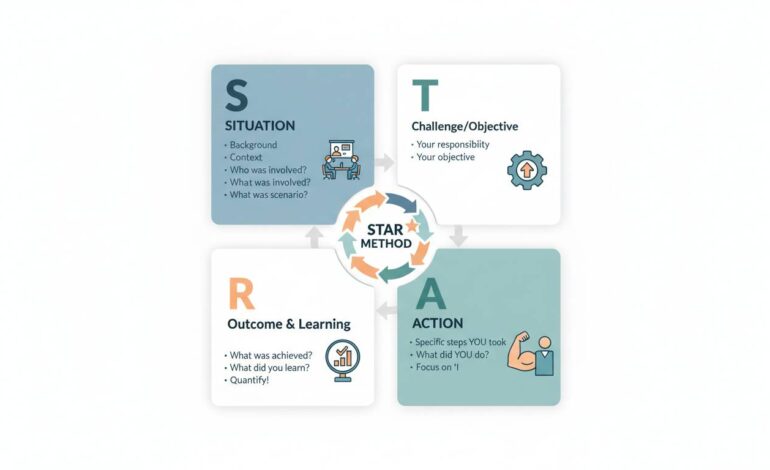
The STAR method solves this. It stands for Situation, Task, Action, and Result—a four-part framework that organizes your response into a clean, compelling narrative.
Situation: Set the scene. Give enough context so the interviewer understands what was at stake. Be specific about the circumstances, but keep it concise—two or three sentences should do it. Avoid vague openings like “I was working on a project” without specifying what the project was or why it mattered.
Task: Explain your specific responsibility. What were you personally accountable for? This is where you clarify your role within the situation, especially if you were part of a team. The interviewer needs to know what you did, not just what your team accomplished.
Action: This is the heart of your answer. Describe the specific steps you took to address the situation. Focus on your individual contribution. Use active verbs—led, created, negotiated, resolved. The interviewer is evaluating your behavior, so they need to understand exactly what you did, not what happened around you.
Result: Quantify the outcome whenever possible. Did you increase efficiency by a certain percentage? Save the company money? Improve customer satisfaction scores? If you can’t provide numbers, describe the positive impact in clear terms. Then briefly acknowledge what you learned or what you would do differently.
A strong STAR answer typically runs 90 seconds to 3 minutes. Anything shorter feels underdeveloped; anything longer risks losing the interviewer’s attention. Practice delivering your key stories within this window until it feels natural.
One honest admission: the STAR method can feel rigid when you’re first learning it. Some of the best answers I’ve heard from candidates actually flow more conversationally while still hitting all four elements. The framework is a scaffold, not a cage. Once you internalize the logic, you can adapt it to your speaking style.
The Competencies Employers Actually Test
Every role has its own competency framework, but certain competencies appear across almost every industry and position. Understanding these gives you a head start because you can prepare relevant stories before you ever walk into the interview room.
Leadership: This doesn’t mean you have to have been a manager. Leadership competencies show up when you took initiative, motivated others, or guided a project forward without formal authority. An intern who organized a team brainstorm and followed through on action items demonstrates leadership just as clearly as a department head.
Teamwork and Collaboration: Employers want to know you can work with others effectively. They’ll ask about both successes and conflicts—how you handled disagreement, how you contributed to a team goal, how you supported a struggling colleague. The key is showing you can collaborate without ego.
Problem-Solving and Critical Thinking: These questions reveal how you approach challenges. Expect scenarios where something went wrong, resources were limited, or unexpected obstacles appeared. Interviewers want to see analytical thinking, not just effort.
Communication: Written, verbal, presenting to stakeholders, explaining complex concepts to non-experts—communication manifests in many forms. They’ll look for evidence that you can tailor your message to your audience and handle difficult conversations.
Adaptability and Resilience: The ability to handle change and recover from setbacks has become increasingly important. They’ll ask about learning new skills quickly, pivoting strategies when circumstances shifted, or dealing with failure productively.
Customer Focus: For roles with any external or internal customer interaction, this competency is often critical. They’ll explore how you’ve handled dissatisfied customers, balanced customer needs with business constraints, or gone above and beyond to deliver results.
Some industries emphasize additional competencies. Tech roles frequently test for analytical thinking and innovation. Healthcare positions prioritize empathy and ethical judgment. Finance and consulting firms care deeply about drive and achievement orientation. Review the job description carefully—the competencies they list there are almost certainly what they’ll test.
Sample Questions with STAR Answers
Seeing the framework in action clarifies everything. Here are five common competency-based questions with strong STAR-formatted responses.
“Tell me about a time you had to manage a challenging project with a tight deadline.”
Situation: Our team was three weeks out from launching a new product feature when our lead developer quit unexpectedly. We had already communicated the launch date to clients.
Task: As project lead, I needed to redistribute his workload, adjust our timeline, and still deliver on our commitment to clients without compromising quality.
Action: I immediately met with each team member to assess their capacity and relevant skills. I identified two tasks that could be reassigned internally and negotiated a two-day deadline extension with our client by explaining the situation transparently. I also worked overtime to cover the lead developer’s documentation responsibilities so the team had clear guidance.
Result: We launched on time—two days late from the original plan, but within our revised commitment to the client. The client appreciated the honesty and extended their contract the following quarter. Our team morale actually improved because people felt supported during a stressful period.
“Describe a time you had a conflict with a coworker. How did you handle it?”
Situation: My marketing colleague and I disagreed strongly about the direction of a campaign. She wanted to focus on brand awareness while I believed we should prioritize lead generation based on our quarterly goals.
Task: I needed to resolve the conflict constructively and ensure our team moved forward with a unified approach.
Action: I requested a private meeting rather than continuing to debate in group settings. I started by acknowledging her perspective and asking her to walk me through her reasoning in detail. Once I understood her concerns, I shared my data on lead generation priorities and invited her to review the numbers with me. We found a middle ground: a campaign that led with brand content but included strong calls-to-action that served both objectives.
Result: The campaign exceeded our lead generation target by 15%. More importantly, my colleague and I developed a productive working relationship that included a protocol for addressing disagreements before they escalated. We collaborated on three more campaigns that year.
“Give me an example of a time you had to learn something quickly.”
Situation: Two months into a content marketing role, my company launched a new product in a vertical I had no experience with—industrial manufacturing.
Task: I needed to become knowledgeable enough about industrial manufacturing to create credible content for this new audience within six weeks.
Action: I spent my first week consuming everything I could: industry publications, competitor content, customer interviews with our sales team. I created a one-page brief summarizing key terminology, pain points, and messaging approaches. I also found a subject matter expert internally who agreed to review my early drafts for accuracy. I set aside two hours every morning for the first month specifically for learning, protecting that time from other interruptions.
Result: I published our first industrial manufacturing blog post five weeks in. It generated 40% more leads than our average post. My manager later told me that fast ramp-up was a significant factor in her decision to promote me eight months later.
“Tell me about a time you made a mistake. How did you handle it?”
Situation: Early in my career, I sent a client a proposal with incorrect pricing—an error that made our services appear significantly more expensive than they actually were.
Task: I needed to correct the mistake, preserve the client relationship, and ensure it didn’t happen again.
Action: I called the client directly within an hour of discovering the error. I owned it completely—no excuses—and explained the correct pricing. I also offered a 5% discount on their first project as a gesture of good faith. Then I created a checklist that our team now uses for all proposals: double-check pricing against our internal systems and have a second person review before sending.
Result: The client appreciated my honesty and moved forward with a project. They’ve been a client for four years now. The checklist has prevented similar errors and became a small process improvement our manager shared with other teams.
“Describe a time you had to convince someone to see things your way.”
Situation: Our department wanted to invest in new project management software that would cost $20,000 annually. Our CFO was skeptical because she hadn’t seen clear ROI from previous software investments.
Task: I needed to build a compelling case that would justify the expense to someone focused on cost control.
Action: I interviewed team members to document current inefficiencies—time spent on manual tracking, communication delays, project overruns. I calculated that the software would save approximately 15 hours per week across our six-person team, which translated to $45,000 in recovered productive time annually. I also found case studies from similar companies that showed measurable improvements after implementing the same software. I presented this to the CFO with a clear breakdown: $20,000 cost, $45,000 savings, 125% ROI.
Result: She approved the investment. Within six months, we had tracked enough data to show we’d recovered the first year’s cost and exceeded our projected time savings. She now includes our department in discussions about other technology investments.
How to Prepare Before Interview Day
Preparation for competency-based interviews is different from traditional interview prep. You’re not rehearsing answers—you’re building a story library you can draw from under pressure.
Analyze the job description. Read it with fresh eyes. Identify every competency mentioned, either explicitly or implicitly. If “cross-functional collaboration” appears, that’s teamwork. If they mention “managing multiple priorities,” that’s time management and organization. Create a list of six to eight competencies you’re likely to face.
Build your story inventory. For each competency, prepare two to three specific examples from your experience. The best stories demonstrate growth, impact, and learning. They don’t all need to be triumphant—some of your strongest answers come from failures you handled well. Spread your examples across different roles, projects, or contexts. Using the same story for multiple competencies signals weak preparation.
Structure each story using STAR. Write out your stories in the STAR format, even if you’ll never bring notes to the interview. The act of writing clarifies your thinking and reveals gaps. Practice telling each story out loud. You’ll notice which ones flow naturally and which feel awkward—the awkward ones need refinement.
Conduct mock interviews. This matters more for competency-based interviews than for any other format. The pressure of real-time recall is genuine. Practice with a friend, a career coach, or even in front of a mirror. Record yourself and listen back. You’ll catch filler words, rambling, and unclear transitions that you can’t feel in the moment.
Prepare your own questions. Interviewers almost always ask if you have questions. Good questions demonstrate genuine interest in the role and the company. Ask about the team dynamics, what success looks like in the first 90 days, or what challenges the team is currently navigating. Avoid questions easily answered by browsing their website.
One thing most articles won’t tell you: prepare for the curveball. Not every question will match your prepared stories exactly. When asked about a competency you haven’t specifically prepared, your goal is to buy time and find a relevant story. A phrase like “Let me think about a good example of that” gives you a moment to search your inventory. The key is having enough stories that you can adapt them to slightly different framings. If you prepare eight solid stories covering the core competencies, you’ll have something relevant even when the question is phrased unexpectedly.
Tips That Actually Move the Needle
The difference between good and great competency answers often comes down to subtle choices in delivery and content.
Focus on your actions, not just the team’s. Interviewers are evaluating you, not your colleagues. Phrases like “we decided to” and “the team accomplished” are dead ends. Instead, say “I proposed,” “I led,” “I convinced,” “I developed.” You can acknowledge support from others while making your contribution unmistakably clear.
Quantify your results whenever possible. Numbers stick in interviewers’ memories. “Improved efficiency” is vague. “Reduced processing time from eight hours to three” is memorable. If quantification isn’t possible, describe the tangible outcome: a client retained, a problem prevented, a process that became standard procedure.
Match your answer length to the complexity of the question. A simple “tell me about a time you showed leadership” might warrant a 90-second answer. A “describe a time you had to convince skeptical stakeholders” probably needs more detail. Watch the interviewer’s body language—if they seem ready to move on, wrap up your result and stop.
Be specific about your role in team successes. This is where candidates often undersell themselves. If you were part of a team that delivered a successful project, explain what you specifically contributed and how it mattered. Then acknowledge the team’s contribution. This comes across as confident without being dismissive of others.
Don’t fake it. Interviewers can usually tell when a story feels rehearsed or when you’re stretching the truth. The competency-based format is designed to probe deeper. If you claim to have led a major initiative, expect follow-up questions about specifics: budget numbers, stakeholder names, obstacles you overcame. It’s better to have fewer, genuine examples than a long list of questionable ones.
Mistakes That Kill Your Chances
Some errors are more damaging than others. Here are the ones that most frequently cost candidates offers.
Vague, generic answers. “I’m a great problem-solver” means nothing without a story. But not just any story—a specific one that shows problem-solving in action. Candidates who describe their approach in abstract terms without grounding it in experience fail to demonstrate the competency. Every claim needs evidence.
Not using STAR. I included this earlier, but it deserves emphasis. Interviewers trained in competency-based questioning are specifically listening for structured answers. Rambling responses that don’t clearly delineate the situation, your task, your action, and the result signal poor preparation. This format exists for a reason—it makes answers comparable across candidates.
Taking too long to get to the point. Interviewers are evaluating hundreds of candidates. If your answer wanders through irrelevant context before reaching the point, you’ve lost them. Front-load the most important information. Get to the Action and Result quickly.
Focusing on the team’s actions rather than yours. Especially for teamwork questions, candidates often describe what “we” accomplished without clarifying their personal role. This is fatal in competency-based interviews, which are specifically designed to isolate your individual contributions.
Providing the same example for multiple questions. Interviewers compare notes. If you describe your cross-functional project leadership for the teamwork question and then reference the same project for the leadership question, they notice. Build enough distinct stories that you don’t have to recycle.
Frequently Asked Questions
How are competency-based interviews scored?
Most employers use a structured scoring rubric. Each competency is rated on a scale—often 1 to 4 or 1 to 5—with defined descriptors for each level. A “1” might mean the candidate provided no relevant example or gave a response that didn’t address the competency. A “4” or “5” typically requires a specific, well-structured answer with quantifiable results that clearly demonstrated the competency at a strong level. Some companies average scores across multiple questions testing the same competency. Others weight different competencies based on role importance. The point is: there’s less subjectivity than you might fear. Prepare structured answers and you’ll score well.
What if I don’t have experience with a particular competency?
This happens, especially for career changers or entry-level candidates. First, look broadly at your experience—academic projects, volunteer work, and personal situations often contain relevant examples you haven’t considered. If you genuinely have no relevant experience, be honest. Say something like, “I haven’t faced that exact situation professionally, but here’s how I would approach it based on related experience…” Then explain your logic. Interviewers value self-awareness and learning ability. Trying to fabricate an example almost always backfires.
How many examples should I prepare?
Aim for six to eight detailed stories that cover different competencies. Some career coaches recommend preparing two examples each for your top three or four competencies. The key is having more than you need so you’re not desperate to fit a story into a question that doesn’t quite fit. You can always have extra stories you don’t use.
Should I ask which competencies they’ll focus on?
It’s reasonable to ask during the interview setup what competencies are most important for the role. Many interviewers will tell you directly—things like “we’ll focus a lot on your customer service experience and your ability to work independently.” This helps you prioritize your strongest examples. Even if they don’t share specifics, the question itself shows you’re thoughtful about preparation.
Your Next Steps
Competency-based interviews aren’t going away. They’re too effective at predicting job performance, and too many companies have built their hiring processes around them. The candidates who excel aren’t necessarily the most experienced—they’re the ones who understood the game and prepared accordingly.
You now have the framework. You know what these interviews measure, how to structure your answers, and which competencies appear most frequently. You have sample questions and strong answers to study. You understand the mistakes that cost candidates offers.
But knowledge without action is just information. Your next step is specific: take the competency list from the job description you want, identify your six strongest stories, write each in STAR format, and practice them out loud until they feel natural. Do one mock interview before your real one. That investment will separate you from candidates who walked in with confidence but no preparation.
The interview is a performance, but the competency-based format rewards authenticity within structure. Prepare the framework, bring genuine examples from your experience, and let your actual capabilities speak. That’s what gets you to the offer.