STAR Method Explained: When It Works vs. When It Sounds Robotic

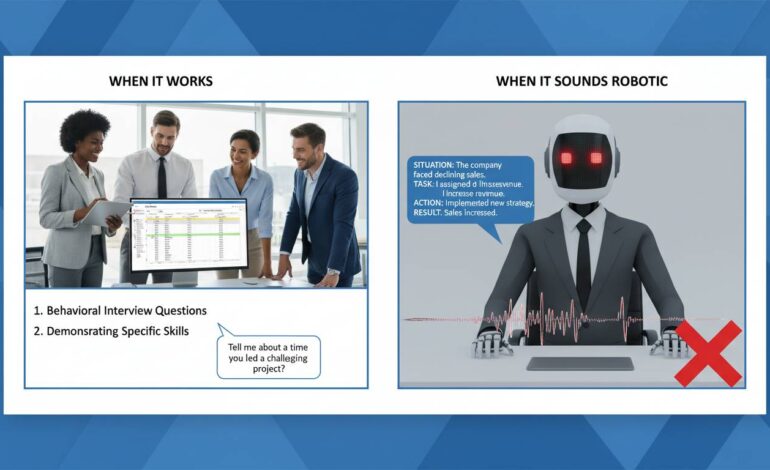
The STAR method isn’t optional anymore—it’s the baseline expectation in any structured interview. Hiring managers at companies like Google, Amazon, and Goldman Sachs explicitly train their interviewers to look for STAR-style responses when asking behavioral questions. Yet here’s the uncomfortable truth that most career advice glosses over: you can follow the STAR framework perfectly and still get rejected because your answer sounds rehearsed, flat, or like you’re reading from a script. The difference between a STAR answer that gets you the job and one that kills your candidacy often has nothing to do with the content of your story and everything to do with how you deliver it.
This guide covers what STAR actually means, walks through concrete examples for each component, and—most importantly—explains why so many qualified candidates sound robotic despite doing everything “right.” You’ll learn the specific patterns that trigger the “rehearsed” label and the techniques that make your STAR answers feel like natural conversation instead of a performance.
What Is the STAR Method?
STAR stands for Situation, Task, Action, and Result. It’s a framework for answering behavioral interview questions—those prompts that start with “Tell me about a time when…” or “Give me an example of…” The logic behind STAR is straightforward: instead of giving vague, general answers, you anchor your response in a specific story with a clear beginning, middle, and end.
The Situation sets the scene. You describe the context—what was happening, what environment you were working in, who was involved. The Task explains your specific responsibility or challenge in that moment. The Action is the meat of your answer: what you actually did, step by step. The Result concludes with outcomes—ideally measurable ones—that show the impact of your actions.
Here’s a quick example in practice. If an interviewer asks, “Tell me about a time you dealt with a difficult customer,” a non-STAR answer might be: “I handled an angry customer once and resolved the issue.” That’s vague. A STAR answer version: “A customer called in furious because her order arrived damaged despite our guarantee. She was threatening to post a negative review and cancel her subscription. I listened to let her feel heard, then personally expedited a replacement with next-day shipping at no cost and included a handwritten apology note. She renewed her subscription the following month and left a positive review mentioning the personal touch.”
Notice the difference. The second answer has specificity, movement, and a quantifiable outcome. That’s STAR working correctly.
Breaking Down Each STAR Component
Understanding STAR in theory is easy. Understanding what makes each component strong in practice is where most people stumble.
The Situation needs just enough context to make the story understandable, nothing more. This is where candidates most commonly overshoot. They provide pages of background about their company, the industry, organizational charts, and context that the interviewer doesn’t need. The test: can you explain your situation in two to three sentences? If you’re going on for more than thirty seconds on context alone, you’ve already lost your interviewer’s attention. A good Situation component establishes stakes and relevance without drowning in detail.
The Task should clarify your specific role, not just describe what the team was doing. Candidates err here by saying “we needed to increase sales” without specifying what they personally owned. Interviewers want to know what challenge was theirs to solve. Phrases like “I was responsible for…” or “My specific mandate was…” signal that you understand the difference between team efforts and individual contribution.
The Action is where most candidates under-prepare. This component requires you to walk through your decision-making process, not just list what you did. “I created a spreadsheet” tells the interviewer nothing useful. “I built a spreadsheet that tracked customer complaint categories over six months, which revealed that 60% of issues stemmed from a specific shipping partner—we switched providers and complaints dropped 40%”—that’s an Action that demonstrates analytical thinking and ownership.
The Result must be measurable whenever possible. Numbers convert abstract competence into concrete proof. But be careful: inflating results or claiming credit for outcomes you only partially influenced backfires badly. Interviewers probe here. A result like “sales increased significantly” invites follow-up questions that expose vagueness. “Sales increased 23% quarter-over-quarter” invites follow-up questions that let you show the methodology behind your work.
Why STAR Answers Sound Robotic (And How to Fix It)
This is where it matters. You’ve prepared STAR stories. You’ve practiced them. You walk into the interview and deliver your carefully crafted response, and you can see your interviewer’s eyes glaze over. Here’s what went wrong.
Problem one: over-rehearsal. The most common cause of robotic STAR answers is that candidates memorize their stories word-for-word. When you recite a response rather than tell it, the delivery becomes flat. Your cadence loses natural variation. You pause in the wrong places—not to think, but because you’re waiting for the next memorized phrase. Interviewers aren’t fooled. They can tell the difference between someone recalling a real experience and someone performing a practiced monologue.
The fix isn’t to stop preparing—preparation is essential—but to prepare in the right way. Practice telling your STAR stories out loud until you’re comfortable with the key points and sequence, then deliberately vary your wording each time you practice. The goal is to internalize the structure and the details, not the exact sentences.
Problem two: emotional disconnection. Robotic answers feel robotic because the speaker delivers facts without conveying what the experience actually felt like. A story about navigating a crisis with zero stress signal, zero urgency in your voice, zero indication that anything was at stake—it signals that either the story isn’t true or you weren’t actually invested in the outcome.
This doesn’t mean hamming it up or adding fake drama. It means letting your natural engagement show. If the situation was genuinely challenging, let that come through in how you describe it. If you felt frustrated, relieved, proud—whatever the emotional thread was—it’s okay to let that surface. The best STAR answers have a human quality that makes the interviewer lean in, not lean back.
Problem three: ignoring the conversation. The most subtle cause of robotic delivery is treating your STAR answer like a recorded message that must be delivered in full before the interview can continue. Real conversation involves reading the room. If your interviewer asks a clarifying question mid-story, answer it. If they nod and you can tell they want more detail on a specific point, elaborate. If they’re checking their watch, wrap up.
The STAR framework is a guide, not a contract. Rigid adherence to “I must cover all four letters in order” makes answers feel scripted. Adapt. Pivot. Let the conversation shape how much detail you provide.
The Most Common STAR Mistakes
After years of coaching candidates through interviews, certain mistakes appear over and over. Knowing them in advance lets you avoid them.
The Result-less Answer. Candidates spend sixty seconds on Situation and Task, thirty seconds on Action, and then trail off with “and it went well” or “the client was happy.” The Result component is where your answer justifies itself. Interviewers use Results to compare candidates, to assess impact, to predict future performance. Omitting a strong Result makes your entire answer feel like setup without payoff. Always, always, always land your story on a clear outcome.
The Vague Action. “I worked with the team to improve the process” shows nothing. Which team? Which process? What did “improving” actually involve? What was the before state? What did you specifically contribute? Interviewers hear vague Actions constantly, and they immediately discount the answer as lacking substance. Force yourself to name the exact steps you took.
The Over-Engineered Answer. On the other side of vagueness, some candidates provide so much detail that the answer becomes impossible to follow. They name every meeting, every stakeholder, every sub-task. They give the interviewer more information than they can process. The fix: identify the single most important Action you took and focus on that. You can mention supporting actions briefly, but don’t let them crowd out your main point.
The Generic Story. “I once had a conflict with a coworker and we resolved it through communication” tells the interviewer nothing about you that applies to the job. Every component of your STAR answer should reflect something specific to your actual experience. Generic stories that could apply to anyone in any role don’t differentiate you from other candidates.
The One-Story-Fits-All Approach. Using the same STAR story for multiple behavioral questions, even when the questions ask about different competencies, signals that you either lack experience or haven’t thought critically about your background. Interviewers expect you to have multiple stories in your pocket—ideally four to six strong examples that demonstrate different skills and can be adapted to various prompts.
When STAR Actually Works: Real Examples That Land
Knowing what makes STAR fail makes it easier to understand what makes it succeed. The best STAR answers I’ve heard share several characteristics.
First, they pick the right story for the question. A candidate for a project manager role asked about influencing stakeholders told this story: “Our VP wanted to launch a product in Q3, but my analysis showed we’d need Q4 to hit our quality standards. I built a financial model showing the revenue difference between a rushed launch versus a polished one, presented it to the VP privately first to give her space to react, and then walked the executive team through the tradeoffs. They pushed the launch to Q4. The product had zero critical bugs at launch and we got a 4.7 App Store rating instead of the 3.9 we projected with the original timeline.”
This answer nails every component. The Situation establishes a real conflict with stakes. The Task clarifies the candidate’s specific responsibility—influencing upward. The Action shows strategy, preparation, and tactical execution. The Result is specific and impressive.
Second, strong STAR answers sound like the candidate is thinking in real time, not recalling a memorized script. Notice the natural phrasing in that example—there’s no “Let me tell you about a time when…” preamble. The candidate just starts talking, as if the memory is coming to them in the moment.
Third, they include just enough detail to be compelling without overwhelming. The example above takes about ninety seconds to deliver. That’s the sweet spot—long enough to show depth, short enough to maintain tension.
How to Practice STAR Without Sounding Rehearsed
Preparation matters, but how you prepare matters more. Here’s a practice methodology that builds natural delivery.
Start by generating your story list. Spend time before any interview identifying six to eight experiences from your career that demonstrate relevant skills. Write them out fully in STAR format—not to memorize, but to clarify your thinking. Identify the specific Action component in each story and make sure you can articulate it in two to three sentences.
Practice out loud, not in your head. The difference between thinking through an answer and delivering it aloud is enormous. Practice with a friend, a mirror, or a recording device. Listen back. Does your delivery sound natural? Are you hitting the key points without sounding like you’re reading?
Embrace imperfection in practice. The goal of practice isn’t to create a perfect script—it’s to build confidence that you can tell your stories in various ways while hitting the critical points. When you practice, deliberately pause in different places. Change your wording. See if you can tell the same story starting with different components. This builds flexibility so that in the actual interview, you’re not locked into one version.
Do a reality check on emotional authenticity. Before each story, briefly recall how you actually felt in that moment—the stress of the deadline, the frustration with the obstacle, the satisfaction of solving it. Let that feeling inform your delivery. Interviewers may not consciously register emotion, but they feel it.
The Honest Limitation: When STAR Isn’t Enough
Here’s something most career articles won’t tell you: STAR has limits, and pretending it solves every interview challenge is misleading.
STAR works brilliantly for competency-based questions where you need to demonstrate skills through past behavior. But it falls short in several scenarios. When interviewers ask forward-looking questions—”Where do you see yourself in five years?”—or hypothetical ones—”How would you handle a situation you’ve never encountered?”—STAR doesn’t apply directly. Candidates who try to force every answer into STAR format come across as inflexible.
Additionally, STAR rewards specific, positive outcomes. If your best story involves a failure or a situation where you did everything right but still failed, STAR can feel awkward because the Result component doesn’t land with a win. Yet these stories are often the most compelling in interviews. The fix: don’t abandon STAR structure, but adapt the Result to focus on what you learned or how you grew, even if the ultimate outcome wasn’t positive.
Finally, STAR cannot compensate for a weak resume, irrelevant experience, or poor cultural fit. It’s a tool for presenting your existing qualifications effectively, not a magic framework that transforms an unqualified candidate into a strong one. Understanding this keeps your expectations realistic.
Conclusion
The STAR method earned its place in interview preparation for a reason—it works. It forces structure where chaos often reigns, it pushes candidates toward specificity over vagueness, and it gives interviewers a framework for comparing candidates fairly. But structure alone doesn’t win interviews. The delivery, the authenticity, the human connection behind your words—those are what separate candidates who get offers from those who don’t.
Practice your STAR stories until the structure is second nature, then forget the structure and let your actual experience come through. The goal isn’t to sound like someone who learned STAR. The goal is to sound like someone who did interesting work and can talk about it in a way that makes your interviewer want to hear more.
If you’re preparing for upcoming interviews, pick your strongest stories this week. Practice them out loud. Record yourself. Listen back and ask: does this sound like me, or does this sound like advice I read online? That distinction is the difference between a STAR answer that gets you the job and one that disappears into the pile of competent-but-forgettable responses.
Now go make your next interview the one where you actually get to talk about what you built, what you solved, and what you’re capable of—not just recite a framework.