Professional Respondents: Why Researchers Filter Them Out

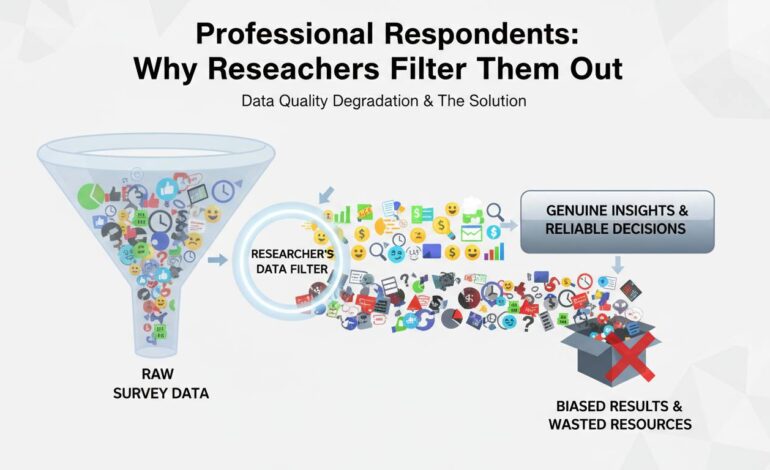
The survey looks legitimate. The demographics check out. The open-ended responses are perfectly formatted, enthusiastic, and use exactly the right keywords. But something feels off—because it is. Somewhere between the respondent hitting “start” and submitting their completed questionnaire, a professional respondent has manipulated the process to earn rewards without providing genuine insight.
These individuals have become one of the most persistent threats to research validity. Understanding why researchers work so hard to filter them out requires understanding what they actually do, how they operate, and the specific damage they cause to the research ecosystem.
This article breaks down the professional respondent phenomenon from the researcher’s perspective. You’ll learn what distinguishes these respondents from ordinary participants, the telltale signs that indicate their presence, and the concrete reasons why filtering them matters for anyone relying on survey data. I’ll also examine the detection methods that work, the limitations of those methods, and the uncomfortable reality that eliminating professional respondents entirely may be impossible—but that doesn’t mean trying isn’t worth it.
What Are Professional Respondents?
A professional respondent is someone who participates in market research, academic surveys, or user experience studies primarily for financial incentive rather than genuine interest in the topic. They treat survey completion as a job, optimizing for speed and reward accumulation rather than thoughtful, accurate responses. Their primary goal is maximizing earnings per hour across multiple research panels, and they have learned which tricks generate compensation with minimal effort.
This differs fundamentally from an engaged participant who happens to receive compensation for their time. A genuine respondent considers each question carefully, provides authentic answers, and may even find the research topic interesting. A professional respondent treats every survey as a transaction—complete the requirements, collect the incentive, move to the next opportunity. The distinction matters enormously for data quality, though detecting it requires more than simply asking respondents about their motivations.
The professional respondent phenomenon emerged alongside the growth of paid survey panels in the early 2000s. As companies like SurveyMonkey, Qualtrics, and Momentive made survey distribution easier and research budgets increasingly shifted toward online data collection, the financial opportunity attracted people who saw these platforms as income sources. Panel providers like MTurk, Prolific, and Respondent.io scaled to meet demand, creating ecosystems where respondents could earn meaningful money—and where the temptation to prioritize quantity over quality became overwhelming for some participants.
The research industry has no universally accepted threshold for when a respondent becomes “professional.” Some firms define it by volume—respondents who complete an unusually high number of surveys within a panel in a short timeframe. Others look at behavior patterns—rushing through questions, providing identical responses across different surveys, or demonstrating knowledge of screening questions that suggests panel-hopping experience. The common thread is intent: professional respondents approach research participation as employment rather than contribution.
How Professional Respondents Undermine Research Quality
The impact of professional respondents on data quality extends far beyond a few bad responses. When these individuals comprise even a small percentage of a survey sample, they can distort findings in ways that lead researchers to incorrect conclusions.
First, professional respondents introduce systematic response bias. Because these participants aren’t engaged with the actual topic, they tend to respond in predictable patterns—selecting middle options, choosing the first reasonable answer, or using what they guess is the “correct” response based on question framing. A respondent who doesn’t care about consumer attitudes toward a new product will likely choose neutral responses to avoid cognitive effort, artificially inflating middle-of-the-road results. This flattens distributions and makes it impossible to distinguish genuine ambivalence from disengaged guessing.
Second, professional respondents destroy the validity of open-ended responses. Thoughtful qualitative data requires respondents to reflect genuinely on their experiences, preferences, and reasoning. Professional respondents either skip these questions, provide minimum-length responses to meet completion requirements, or copy-paste generic text that applies to any survey. Researchers analyzing open-ended data for themes and insights find their analysis contaminated by this noise.
Third, incentive-driven respondents skew demographic and behavioral data. Many professional respondents maintain multiple panel memberships and lie about their demographics to qualify for more surveys. A 35-year-old professional respondent who wants to complete a survey about parenting might pretend to have children. Someone without a college education might claim advanced credentials to access surveys targeting educated respondents. These fabrications corrupt the demographic variables that researchers use to segment and analyze data, leading to conclusions that don’t reflect actual population segments.
The financial impact compounds across research programs. A company spending $50,000 annually on survey research might lose 15-25% of that investment to professional respondents providing unusable data. When you factor in the time analysts spend cleaning data, re-running analyses after discovering contaminants, and explaining unexpected results to stakeholders, the true cost multiplies further. Research teams that ignore professional respondents effectively burn budget on data that misleads rather than informs decisions.
Signs That Identify Professional Respondents
Experienced researchers develop intuition for professional respondents, but the identification process relies on specific behavioral indicators. These signs aren’t foolproof individually, but clusters of them create a compelling picture.
Speeding stands as the most obvious indicator. Professional respondents maximize earnings by completing surveys as quickly as possible. When average completion times drop significantly below the estimated duration—especially for surveys with complex questions or lengthy scenarios—speeding becomes likely. Most survey platforms now flag responses completed in less than 40% of the estimated time, though professional respondents have learned to pace themselves to avoid obvious detection.
Straight-lining describes the pattern of selecting identical answers across multiple questions, particularly in grid or matrix formats. A genuine respondent reading through a series of rating questions processes each item individually, producing natural variation. A professional respondent seeking efficiency often clicks the same position repeatedly. Research from institutions studying survey data quality has documented that straight-lining correlates strongly with low-quality responses in subsequent questions.
Generic or contradictory open-ended responses reveal respondents who aren’t genuinely engaging with questions. When a respondent provides the same vague answer—”I like this product because it is good and I would recommend it”—across multiple different questions, they are clearly performing compliance rather than providing insight. Similarly, contradictory responses across a single survey—claiming to dislike social media in one section and spending four hours daily on platforms in another—indicate inattentive or dishonest answering.
Panel hopping behavior emerges when respondents join multiple panels and spread their activity across all of them. These individuals often have histories across several panel providers, carrying different email addresses and browser fingerprints. When researchers attempt cross-panel deduplication, these respondents may slip through using different identities.
Suspicious response patterns include answers that technically satisfy requirements but provide no useful information. Responses to “tell us what you think” that say “nothing” or “I don’t know” meet completion criteria without contributing data. Similarly, responses that use exact wording from the question itself suggest copy-paste behavior rather than genuine engagement.
Detection requires looking for patterns rather than individual flags. A single fast response might indicate a quick reader with genuine interest. Straight-lining through a single grid might reflect genuine indifference to the rated attributes. But respondents displaying three or four of these behaviors simultaneously represent strong candidates for exclusion.
How Researchers Filter Professional Respondents
The filtering process begins before a respondent even sees a survey question. Pre-screening mechanisms attempt to identify professional respondents at the panel level, while in-survey techniques catch those who slip through initial gates.
Speed checks remain the first line of defense. Most research platforms automatically terminate surveys for respondents completing them significantly faster than expected. The threshold varies by survey complexity—a five-minute survey might allow completion in three minutes for a fast reader, but flag anything under ninety seconds. These checks work because professional respondents consistently push against time boundaries, and even small speed variations create detectable patterns across large samples.
Attention checks embed test questions throughout surveys that require genuine engagement to answer correctly. Common formats include “Please select ‘strongly agree’ for this item” or “What is 3 + 4?”—questions with obvious correct answers that respondents paying attention will answer correctly and speeders will likely miss. Multiple attention checks throughout longer surveys help identify respondents who maintained focus versus those who started fast and then disengaged.
Cross-panel deduplication attempts to identify respondents participating across multiple panels. When researchers recruit from multiple panel providers for the same study, deduplication software checks for matching email addresses, IP addresses, or device fingerprints. Professional respondents often try to work around this by using different emails or clearing cookies, but sophisticated matching algorithms catch many attempts. Some panel providers now require identity verification, though this creates its own friction for legitimate respondents.
IP and device fingerprinting tracks respondents across sessions and platforms. Researchers maintain blacklists of known professional respondent IP addresses and device identifiers. When a flagged device attempts to access a survey, the system can exclude them automatically. This approach has limitations—professional respondents can use VPN services and virtual machines to mask their devices—but it catches those who haven’t invested in workarounds.
Response quality metrics analyze submitted data for patterns indicating professional respondents. These include statistical measures like standard deviation across grid questions (low variance suggests straight-lining), analysis of text responses for generic content, and comparison of response patterns against known professional respondent profiles. Platforms like Qualtrics and Decipher include built-in quality scoring that flags suspicious responses for review.
The uncomfortable reality is that no single filtering method works perfectly. Professional respondents adapt to each new detection technique, creating an ongoing arms race. The most effective approach combines multiple methods, accepts that some professional respondents will slip through, and focuses on keeping their numbers below thresholds that would significantly distort findings.
The Limits of Professional Respondent Filtering
An honest assessment of professional respondent filtering must acknowledge that current methods have significant limitations—some inherent to the problem, others stemming from practical constraints.
False positives exclude legitimate respondents. Every filtering technique risks catching engaged participants who happen to behave similarly to professionals. A rushed but genuine respondent might fail attention checks. A thoughtful participant with a slow internet connection might trigger speed flags. A grandmother who genuinely doesn’t understand technology might provide responses that look like fabricated demographics. When research teams set filtering thresholds aggressively to exclude more professionals, they increasingly exclude legitimate respondents, reducing sample quality in different ways.
Filtering reduces sample sizes and increases costs. Each respondent excluded represents lost data and wasted recruitment spending. When panels already struggle with declining response rates, aggressive filtering compounds the problem. Some research topics—particularly those targeting rare populations or specialized behaviors—become nearly impossible to study when professional respondent removal eliminates too much of the accessible sample.
Professional respondents evolve faster than detection methods. As soon as researchers develop new filtering techniques, professional respondent communities share strategies to work around them. Speed checks prompted professionals to slow their completion times. Attention checks led to copy-paste strategies for answering correctly while remaining disengaged. Panel fingerprinting resulted in sophisticated evasion techniques using browser virtualization. The economic incentive for professional respondents to adapt always exceeds the incentive for researchers to improve detection, creating an inherent asymmetry.
Some professional respondent behavior looks identical to legitimate response variation. Consider the respondent who genuinely has no strong opinions about a product—their middle-of-the-road responses look like straight-lining. Consider the genuinely busy professional who must rush through a survey—their speed looks like incentive-seeking. Consider the respondent with multiple genuinely held opinions that happen to contradict each other—their inconsistent answers look like fabrications. Without the ability to observe respondent cognitive processes, statistical distinction becomes impossible.
These limitations suggest that professional respondent filtering will never be solved completely. The goal shifts from elimination to management—keeping professional respondents to levels where their impact remains manageable while accepting that some contamination is inevitable.
The Difference Between Professional Respondents and Other Survey Fraud
Not all survey quality problems originate from professional respondents. Understanding the distinction helps researchers apply appropriate responses to different quality threats.
Straight-lining often indicates a professional respondent, but can also reflect questionnaire design problems. When grids present too many similar items, even engaged respondents may experience fatigue and provide less varied responses. Good questionnaire design minimizes this fatigue through rotation, randomization, and limiting grid length. Before attributing straight-lining to professional respondents, researchers should examine whether their questionnaire structure created artificial patterns.
Demographic fabrication occurs when professional respondents lie to qualify for surveys, but also happens when legitimate respondents misunderstand questions or when survey routing creates confusion. A respondent who accidentally selects the wrong age bracket isn’t behaving like a professional respondent—they’re making a mistake. The detection challenge involves distinguishing deliberate fraud from confusion, which often requires examining additional evidence beyond the single demographic discrepancy.
Bot-generated responses represent a distinct threat that professional respondents don’t typically engage in. Automated response systems can complete surveys at scale, generating fake data without human involvement. Detection methods differ—bots often fail captcha challenges, display impossible response timing patterns, and lack the subtle variation that characterizes human cognition. Professional respondents, by contrast, are human beings behaving badly, not machines generating artificial data.
Inattentive respondents exist on a spectrum with professional respondents. Someone who starts a survey with genuine interest but loses focus halfway through provides low-quality responses that resemble professional respondent behavior. The distinction matters for remediation: inattentive respondents might be salvaged through better survey design, while professional respondents require exclusion regardless of questionnaire improvements.
The most effective quality assurance approaches address all these threats together, since many detection methods flag multiple problem types simultaneously. But understanding the different sources of poor data helps research teams diagnose root causes and develop targeted prevention strategies.
Moving Forward: The Ongoing Battle for Survey Data Quality
The professional respondent problem isn’t going away. As long as financial incentives exist for survey participation, some respondents will optimize for earning rather than insight. The research community continues developing new detection methods, but the fundamental economics create persistent pressure toward quality degradation.
What has changed is awareness. A decade ago, many researchers didn’t fully appreciate how significantly professional respondents could distort findings. Today, data quality considerations influence everything from questionnaire design to panel selection to analysis techniques. Major research platforms now build quality scoring into their standard offerings, reflecting industry recognition that this problem requires systematic attention.
For practitioners, the practical implications are clear. Accept that some professional respondents will appear in every non-verified online sample. Implement multiple filtering layers rather than relying on any single method. Document your filtering decisions and their impact on sample composition so stakeholders understand the tradeoff between purity and accessibility. Most importantly, treat professional respondent management as an ongoing process rather than a solved problem—the landscape will continue evolving, and your methods must evolve with it.
The question isn’t whether you can eliminate professional respondents entirely. You can’t. The question is whether you’re doing enough to minimize their impact on the decisions your research is meant to inform. For most organizations, the honest answer is that more attention to this problem would improve data quality across the board.