Monday Market Prediction: Expert Analysis for This Week

Traders and investors have long been fascinated by Monday sessions—the first trading day of the week behaves differently from Tuesdays through Fridays. Whether you’re a day trader chasing short-term moves or a longer-term investor trying to understand weekly rhythms, Monday has its own personality.
This analysis looks at current market conditions, historical Monday patterns, key technical levels, and trading strategies for the week ahead.
Understanding Monday Market Dynamics
The first trading day of the week has distinct characteristics. Trading volumes typically drop on Mondays compared to Tuesday through Thursday, as participants process weekend news and new information emerges. This lower-volume environment can amplify price movements—both up and down.
Market sentiment crystallizes over the weekend. Investors digest earnings reports, economic data, and geopolitical developments that happened while markets were closed. Monday opening prices often reflect this accumulated sentiment, leading to gap openings more frequently than on other days.
The “Monday Effect” has been studied extensively. Some research suggests stocks historically show slightly negative returns on Mondays—the first session after weekend breaks. Other studies indicate this pattern has weakened in recent decades as markets evolved and became more efficient.
Current Market Sentiment Analysis
Understanding where markets stand means examining several sentiment indicators together. Current conditions reflect a mix of economic data, Federal Reserve policy expectations, corporate earnings momentum, and broader macroeconomic trends.
Institutional investors gauge sentiment through put-to-call ratios, volatility indices, and bond market movements. When these signal extreme optimism or pessimism, contrarian traders may find opportunities to position against prevailing sentiment. But markets can stay irrational longer than most traders can stay solvent—sentiment analysis gives context, not certainty.
Sector rotation patterns offer additional insight. When defensive sectors like utilities and consumer staples outperform during Monday sessions, it may indicate risk aversion among institutional managers. Strength in growth and technology sectors often signals confidence in economic expansion. Watching which sectors lead Monday mornings helps traders understand the underlying market narrative.
Historical Monday Performance Patterns
Statistical analysis of Monday trading reveals patterns that active traders use in their strategies. Research shows Mondays historically experience higher volatility compared to other weekdays, with average true range measurements often elevated during the first session.
The “weekend gap” phenomenon remains relevant. When significant news breaks Saturday or Sunday—economic data releases, corporate announcements, or geopolitical developments—Monday’s opening price frequently gaps from Friday’s closing level. Traders must assess whether this gap will fill (prices returning toward Friday’s close) or extend in the gap’s direction.
Monthly seasonality affects Monday performance too. The first trading day of the month behaves differently than mid-month Mondays, with retirement fund inflows and option expirations creating additional dynamics.
Key Technical Levels to Watch
Technical analysis helps identify support and resistance levels that influence Monday price action. Major moving averages—particularly the 50-day, 100-day, and 200-day—serve as reference points where buying or selling pressure may emerge.
Support levels are price zones where buyers have historically accumulated stock, creating floors that price may bounce from when tested. Resistance levels function as ceilings where selling pressure historically increases. On Mondays, breakouts above resistance or breakdowns below support often accelerate quickly due to lower weekend participation creating liquidity gaps.
Volume profile analysis reveals where significant trading occurred on recent sessions, identifying high-volume nodes that may act as future support or resistance.
Pivot points calculated from previous trading periods—daily, weekly, and monthly—provide additional reference levels that algorithmic traders frequently monitor.
Trading Strategy for Monday Sessions
Developing a Monday trading strategy requires adapting to these unique dynamics. Pre-market analysis forms the foundation—examining overnight developments and futures market movements to gauge likely opening conditions.
Gap analysis deserves particular attention. When futures indicate a significant overnight gap, traders assess whether it will likely fill or extend. Historical patterns suggest gaps in the direction of the prevailing trend tend to extend, while counter-trend gaps often fill quickly as prices revert toward recent averages.
Risk management becomes especially critical during Monday sessions when volatility may exceed normal levels. Position sizing should account for increased potential for rapid price movements. Many experienced traders reduce exposure during the first session until market character becomes established.
Time-of-day strategies also matter. The opening bell brings elevated volatility as overnight orders execute and participants react to weekend news. Some traders prefer to observe the initial半小时 of trading before committing capital, allowing market makers to establish proper pricing.
What to Watch This Week
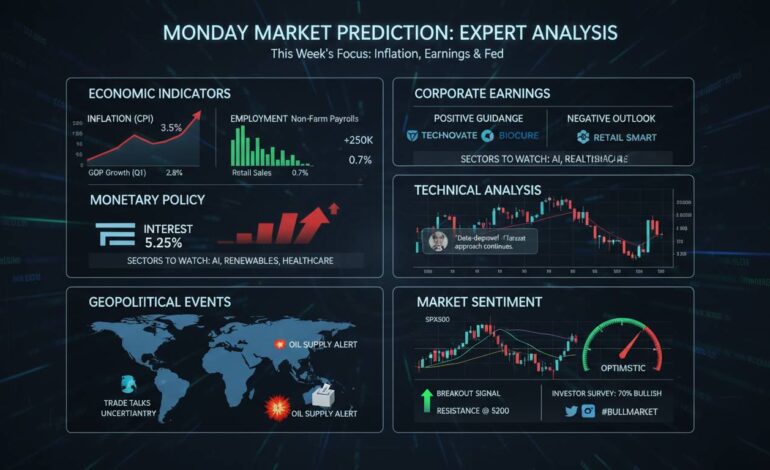
Several catalysts may influence Monday’s direction and set the tone for the trading week. Federal Reserve speaker schedules provide opportunities for insights into monetary policy direction—any comments about interest rate trajectories can move markets significantly.
Earnings reports from major corporations, particularly in growth sectors, deserve close attention as they may trigger sector-wide movements. When leading companies report results that beat or miss expectations, their performance often influences related stocks and broader sector sentiment.
Economic data releases—inflation figures, employment indicators, consumer confidence readings—provide fundamental context for market direction. Monday sessions may show heightened sensitivity to surprising economic data as markets incorporate new information.
Geopolitical developments continue influencing sentiment, with any escalation or de-escalation of international tensions potentially affecting risk appetite and flows between equities, bonds, and safe-haven assets.
Conclusion
Monday market prediction requires combining multiple approaches—fundamental context, technical levels, historical patterns, and current sentiment indicators. While no prediction system guarantees accurate forecasts, understanding Monday’s unique characteristics gives traders valuable context for making informed decisions.
The key points: Mondays typically exhibit higher volatility, respond significantly to weekend news, and often set the tone for the entire trading week. Successful traders adapt their strategies to these dynamics while maintaining disciplined risk management regardless of the prediction environment.
Remember that markets inherently contain uncertainty, and even sophisticated analysis cannot eliminate risk entirely. Position sizing, stop-loss discipline, and portfolio diversification remain essential components of any trading approach.
FAQs
What is the stock market prediction for Monday?
Monday predictions depend on weekend news, economic data, and technical positioning. Traders analyze futures markets, overnight news, and key technical levels to gauge likely Monday direction, though predictions inherently contain uncertainty.
Is Monday a good day to buy stocks?
Monday can offer opportunities, but it depends on market conditions and your strategy. Historically, Mondays show higher volatility, which can create favorable entry points and increased risk. Evaluate each Monday independently based on current conditions.
What days are best for stock market predictions?
Tuesday through Thursday typically feature higher trading volumes and more stable price action, making technical analysis more reliable. However, the “best” day depends on your trading style—day traders may exploit Monday volatility while swing traders might prefer mid-week stability.
How do you predict Monday market movement?
Predicting Monday markets involves analyzing pre-market futures, overnight news developments, technical support and resistance levels, and historical Monday patterns. Many traders also monitor weekend earnings and economic releases that may influence Monday opening prices.
Does the Monday effect still exist in modern markets?
Research shows the traditional Monday effect—where stocks historically underperformed on Mondays—has diminished significantly in recent decades. Modern markets appear more efficient, with overnight and weekend information incorporated more quickly into stock prices.
What should I watch before Monday market opens?
Before Monday’s opening, monitor pre-market futures contracts, any weekend corporate or economic news, international market performance, and overnight developments in commodities and currencies. These factors provide context for likely Monday price action.