JHA vs TN: Key Differences & Which to Choose

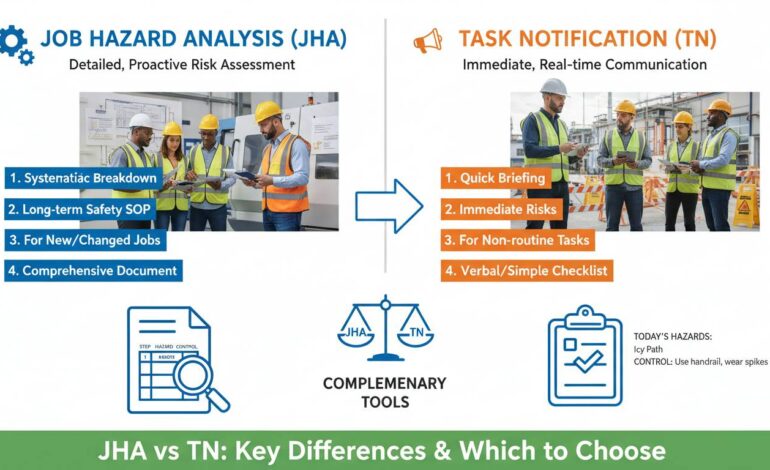
If you’re working in construction or industrial safety, you’ve probably heard both terms thrown around. But what’s the actual difference between a Job Hazard Analysis (JHA) and a Technical Note (TN)? And more importantly, which one do you actually need?
This guide breaks down the distinctions in plain English so you can figure out what documentation makes sense for your project.
What is a Job Hazard Analysis (JHA)?
A Job Hazard Analysis (sometimes called a Job Safety Analysis or JSA) is a way to break down a specific job into steps, look at what could go wrong at each step, and figure out how to prevent it. OSHA recommends this as a basic safety practice—it’s one of those things safety pros do to get ahead of problems instead of reacting after someone gets hurt.
Here’s how it works: you take a task, write out each step in order, note the hazards for each step, then list what you’ll do to control those hazards. Simple enough, but it forces you to think through the work before anyone climbs a ladder or touches a live wire.
For example, a JHA for roofing work might look like this:
- Step 1: Set up ladders — Hazard: falls — Control: use ladder stabilizers, tie off ladders
- Step 2: Carry materials to roof — Hazard: struck by falling objects — Control: use hoists, establish drop zones
- Step 3: Install underlayment — Hazard: slips on steep roof — Control: fall protection systems, safety nets
You get the idea. The JHA stays specific to that job. If the job changes—new equipment, different materials, new workers—you update the JHA.
What is a Technical Note (TN)?
A Technical Note in construction and safety is a document that gives technical guidance on something specific. Maybe it’s how to interpret a confusing regulation, or how to apply a certain standard to your work. Unlike a JHA, which focuses on one task, a TN usually covers a broader topic.
OSHA issues Technical Information Alerts and Technical Notes. So do engineering groups, trade associations, and equipment manufacturers. The content varies widely—some are detailed engineering specs, others are plain-language explanations of rules.
Here’s the key thing: TNs are guidance, not law. They help you understand what the regulations actually mean in practice. But they’re not themselves enforceable the way a standard is.
Key Differences Between JHA and TN
Here’s the short version:
| Aspect | JHA | TN |
|---|---|---|
| What it does | Breaks down one job task | Gives guidance on a topic |
| Why it exists | Prevent injuries on specific work | Help people understand technical stuff |
| How specific is it | Very—one job at a time | Broad—applies to many situations |
| Format | Usually a table with steps, hazards, controls | Varies—depends on the topic |
| When to update | Whenever the job changes | When standards change or new info comes out |
Purpose: A JHA looks at hazards for one job. A TN explains something technical that might apply to lots of different jobs.
Regulatory weight: OSHA pushes JHA as a good practice, and some standards actually require it for certain high-hazard work. TNs are guidance—helpful, but not the law itself.
Scope: JHA is narrow and focused. TN is wider.
When to Use JHA vs TN
Use a JHA when:
- You have a specific task to plan
- OSHA recommends it (high injury rates, hazardous materials, new processes, inexperienced workers)
- You want to prevent injuries before starting work
Use a Technical Note when:
- You’re confused about what a standard means
- You need to implement something technical (a specific protection system, a new method)
- You want to understand best practices for a general topic
Most contractors end up using both. The TN tells you what the rule generally requires, then you write a JHA for your specific job to meet that requirement.
Compliance Requirements
OSHA doesn’t require every employer to do JHAs, but here’s the catch: the General Duty Clause says you have to keep workplaces free from recognized hazards. If you didn’t do a JHA when you should have, that’s potential evidence you weren’t taking safety seriously.
Some specific standards do require documented analysis of job tasks—especially in construction and for particularly dangerous stuff like confined spaces or fall hazards.
For Technical Notes: they’re guidance, but they explain mandatory standards. Ignore the guidance at your own risk. If a TN says “do X to comply with Y standard” and you don’t do X, you’re probably violating Y.
Best Practices
For JHAs:
- Get the workers who actually do the job involved in the analysis—they know what can go wrong
- Look at your incident history to find where you’ve had problems
- Write down hazards and controls clearly
- Train people on the JHA before they start the job
- Update it when things change
For Technical Notes:
- Find the ones that apply to your work
- Share them with the right people
- Build the guidance into your procedures
- Keep them organized so you can find them later
Which Do You Need?
It depends on what you’re trying to do.
If you’re planning specific work and need to stop injuries before they happen—that’s a JHA.
If you’re trying to understand what a standard means or how to do something technically—that’s a TN.
Most safety programs benefit from both. The TN keeps you informed about requirements and best practices. The JHA puts that knowledge to work on your actual job site.
One more thing: documentation is great, but it doesn’t actually save anyone. The real value is using these tools to actually change how work gets done—training people, watching for problems, making adjustments before someone gets hurt.
FAQs
Is a JHA required by OSHA?
OSHA recommends JHA as a core safety practice but doesn’t mandate it for all employers. That said, some industry-specific rules do require documented task analysis for particular hazards. Even when not required, doing JHAs shows you’re making a good-faith effort to meet your General Duty Clause obligations.
What’s the difference between JHA and JSA?
They’re the same thing. JHA stands for Job Hazard Analysis, JSA stands for Job Safety Analysis. Different organizations prefer different terms.
How often should a JHA be updated?
Update whenever the job changes significantly—new equipment, different materials, changed procedures, new hazards discovered, or after an incident. At minimum, review annually even if nothing seems to have changed.
Are Technical Notes legally binding?
No—they’re guidance, not regulations. But they explain how to comply with regulations. If a TN spells out what you need to do and you ignore it, you’re probably still violating the underlying standard.
Who should help develop a JHA?
Get input from the workers who actually do the job, their supervisors, and someone with safety expertise. Workers know the real hazards. Supervisors know what’s practical. Safety people know the rules. Combined, you get something actually useful.
Where can I find Technical Notes for my industry?
OSHA’s website has some. Industry groups like the American Society of Safety Professionals have others. Equipment manufacturers often publish them. Check with your industry association or state safety agency to see what’s relevant to your work.