Ukulele History: From Hawaiian Roots to Modern Day

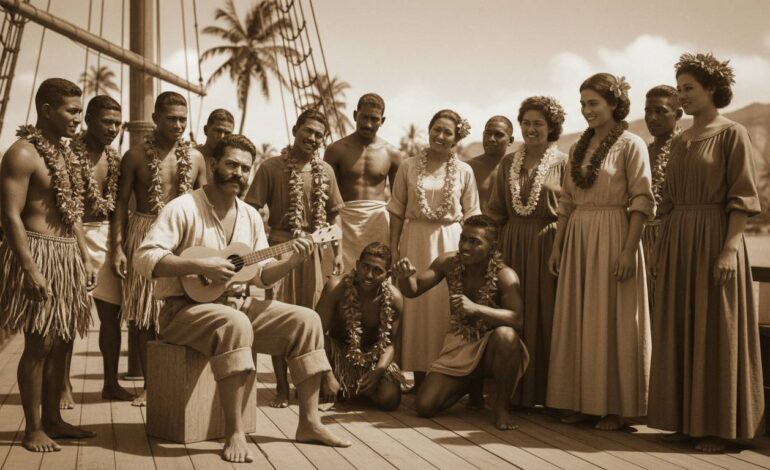
The ukulele originated in Hawaii in the 1870s and 1880s, descended from small Portuguese instruments called the machete or braguinha. Portuguese immigrants—particularly João Fernandes, Augusto Dias, and Manuel Nunes—brought these instruments to Hawaii in 1879, where they evolved with Hawaiian characteristics and gained their distinctive name, meaning “jumping flea” in Hawaiian. The instrument then spread to mainland America through the 1915 Panama-Pacific Exposition in San Francisco, experienced a golden age in the 1920s, faced a decline, and underwent a significant revival beginning in the 1960s that continues today.
Portuguese Origins and the Machete
The ukulele’s story begins in Portugal, on the island of Madeira and in the Azores. These Atlantic islands, about 500 miles north of the Canary Islands, had a rich musical tradition involving small, portable stringed instruments that peasants and farmers played during gatherings and celebrations.
The specific instrument that became the ukulele was known as the machete, the machete de braga, or the braguinha. It traced its roots to the cavaquinho, a small four-stringed instrument popular in Portugal since the medieval period. What set the machete apart was its compact, lightweight design—easy to carry or pack for travel.
The instrument had a wooden soundboard, usually spruce or cedar, with four strings made from gut or nylon. Its small body produced a bright, cheerful tone that carried well outdoors. The neck was short and narrow, making chord formations relatively easy, which helped its popularity among amateur musicians and working-class players.
Madeiran and Azorean immigrants brought these instruments with them as they traveled to Brazil, South Africa, and eventually Hawaii. Sailors and merchants often carried small instruments for entertainment during long voyages, and these instruments frequently remained in their new destinations as the musicians settled or returned periodically.
By the mid-1800s, the machete had already gone through several modifications as it traveled through different regions. Brazilian luthiers developed their own versions, influencing the instrument’s evolution. This pattern of adaptation would repeat itself in Hawaii, where the machete would transform into something entirely new.
The Historic Journey to Hawaii in 1879
The pivotal moment in ukulele history came in 1879, when three Portuguese immigrants arrived in Honolulu Harbor aboard the SS Ravenscrag. These men—João Fernandes, Augusto Dias, and Manuel Nunes—were carpenters and musicians from Madeira who had heard that Hawaii offered economic opportunities in its thriving sugar plantations and expanding economy.
According to historical accounts, these three men played their machetes upon arriving in Hawaii and quickly attracted attention with their music. They performed at local gatherings and festivals, introducing locals to the Portuguese stringed instrument. Its small size and cheerful sound resonated with Hawaiian musical traditions, which already included the ukulele’s cousin instrument, the taro-patch fiddle, a three-stringed instrument that had arrived with earlier settlers.
What happened next became the stuff of musical legend. Hawaiian musicians, including the future King David Kalākaua, showed strong interest in this new instrument. The king himself encouraged local craftspeople to create their own versions, adapting the Portuguese design to suit Hawaiian musical preferences and materials.
The timing of the immigrants’ arrival proved significant. King Kalākaua, who reigned from 1874 to 1891, actively promoted Hawaiian culture and music during his reign. He was known as “the Merrie Monarch” for his love of music and dance, and he supported the development of Hawaiian musical traditions. Under his patronage, the Hawaiian ukulele flourished, transforming from an imported Portuguese curiosity into a distinctly Hawaiian instrument.
The three original immigrants—Fernandes, Dias, and Nunes—eventually became known as the “Fathers of the Ukulele.” Each established businesses crafting instruments in Honolulu, and their workshops produced many of the earliest Hawaiian-made ukuleles. Their descendants continued the tradition, and their instruments are now highly collectible, with original examples from these early makers selling for thousands of dollars at auction.
Manuel Nunes, in particular, is credited with establishing one of the most successful early ukulele manufacturing businesses. He founded the M. Nunes Company, which produced instruments from the late 1800s through the mid-1900s. His instruments are known for their quality craftsmanship and distinctive sound, and they remain prized by collectors and musicians alike.
How the Ukulele Got Its Name
The instrument’s name is as distinctive as its sound. “Ukulele” (pronounced oo-koo-LEH-leh) translates roughly to “jumping flea” in Hawaiian, a name that supposedly referenced the way a player’s fingers moved rapidly across the strings, resembling the jumping motion of a flea.
The origin of the name has been debated by historians and musicians for generations. Some accounts suggest that English-speaking observers, struggling to pronounce the instrument’s Portuguese name, simply called it “Ukulele,” which Hawaiian speakers then adopted. The Hawaiian language contains no true consonants for the letter “R,” so the Portuguese “machete” or “braguinha” would have been difficult for Hawaiian speakers to pronounce accurately.
Another theory holds that the name came from a Hawaiian phrase describing the instrument’s small size—”uku” meaning “gift” or “reward,” and “lele” meaning “to come”—though this interpretation is less commonly accepted among linguists.
Interestingly, early Hawaiian references to the instrument sometimes used different terms. Some historical documents mention the “ukelele” (with an extra “e”), while others simply referred to it as “the Portuguese guitar.” Over time, the spelling “ukulele” became standardized, though variations still appear in older texts and in some contemporary usage.
The name’s playful quality suited the instrument’s cheerful sound and its association with informal, joyful music-making. Unlike classical instruments with names derived from technical specifications or geographic origins, “jumping flea” captured something essential about the ukulele’s character—its vivacity, its accessibility, and its ability to bring smiles to listeners’ faces.
The Four Original Sizes and Models
As the ukulele developed in Hawaii, it evolved into several distinct sizes, each with its own character and purpose. These four original models—soprano, concert, tenor, and baritone—became the standard classification that still defines ukulele manufacturing today.
The soprano ukulele, also known as the standard or classic ukulele, was the original and smallest model. With a typical scale length of around 13-14 inches and a compact body, the soprano produced the bright, plunky tone that many people associate with the instrument. Its small size made it extremely portable and accessible, perfect for beginners and casual players. The soprano remained the most common ukulele throughout the instrument’s early history.
The concert ukulele, slightly larger than the soprano with a scale length of about 15 inches, offered more volume and a slightly richer tone. The added size provided more room for the soundboard to vibrate, producing a more resonant sound that appealed to players seeking more projection. The concert also featured a slightly wider neck, which some players found more comfortable for chord formations.
The tenor ukulele, with a scale length around 17 inches, represented the next step up in size and sound. Tenor ukuleles offered even greater volume and sustain, making them suitable for professional performance situations. Many professional ukulele players preferred the tenor for its enhanced tonal range and playability.
The baritone ukulele, the largest of the four original models, tuned differently from the others. While soprano, concert, and tenor ukuleles all tuned to G-C-E-A (often with a re-entrant high G), the baritone tuned to D-G-B-E, like the four highest strings of a standard guitar. This tuning made it particularly attractive to guitar players looking to branch out into ukulele, as they could apply much of their existing chord knowledge directly to the instrument.
These four sizes provided options for players of all preferences and skill levels. The smaller sopranos and concerts remained popular among beginners and children, while tenors and baritones found favor with more advanced players and professionals. This variety contributed significantly to the instrument’s widespread adoption.
The Ukulele Comes to Mainland America
The instrument’s journey to mainland United States began in 1915, when the Panama-Pacific International Exposition brought world cultures together in San Francisco. This world’s fair, celebrating the completion of the Panama Canal and marking San Francisco’s recovery from the 1906 earthquake, featured Hawaiian music as one of its attractions.
Hawaiian musicians performed at the exposition, introducing millions of visitors to the ukulele. The instrument’s infectious sound and cheerful personality captivated audiences accustomed to more traditional American music. Visitors returned home with ukuleles purchased at the fair or memories of performances they wanted to replicate.
The timing proved ideal for the ukulele’s mainland debut. America’s interest in Hawaiian culture had been growing for decades, fueled by Hawaiian plantations’ use of American shipping to transport sugar and other goods, by the tourism industry’s promotion of Hawaii as a tropical paradise, and by the American annexation of Hawaii in 1898. The exposition served as a cultural catalyst, transforming casual interest into full-blown enthusiasm.
One performer who capitalized on this enthusiasm was Ernest K. Kiana, a Hawaiian musician who became known as “the father of the ukulele on the mainland.” Kiana moved to San Francisco and established himself as a ukulele teacher and performer, publishing instructional materials and promoting the instrument to eager students. His work helped establish the ukulele as a legitimate musical instrument rather than merely a novelty.
The 1920s became the ukulele’s golden age in America. The instrument appeared everywhere, from vaudeville stages to living rooms across the country. Music stores reported brisk sales of ukuleles and instructional books. Families gathered around to play songs together, and the ukulele became associated with casual enjoyment, beach parties, and the carefree spirit of the Jazz Age.
The ukulele’s popularity during this period was closely tied to the rise of recorded music. Early jazz and popular recordings featured ukuleles prominently, helping spread the instrument’s sound across America. Artists like ukulele virtuoso Roy Smeck became national celebrities, demonstrating the instrument’s versatility in recordings and films.
“The ukulele is the easiest instrument to play and the hardest to play well,” observed one music teacher of the era, capturing the instrument’s deceptive simplicity. This balance of accessibility and depth would prove key to its enduring appeal.
The Golden Age and Subsequent Decline
The 1920s represented the ukulele’s peak popularity in America, but the subsequent decades brought significant changes. The Great Depression of the 1930s affected musical instrument sales across the board, as consumers focused on necessities rather than discretionary purchases like musical instruments. While the ukulele remained relatively affordable compared to pianos or guitars, the economic hardship still impacted its market.
The swing era of the 1930s and 1940s favored larger instruments capable of cutting through big band arrangements. The guitar rose in popularity during this period, benefiting from innovations in amplification that allowed it to compete with louder instruments. The ukulele, with its naturally quiet volume, struggled to find a place in the emerging musical landscape.
World War II further disrupted the ukulele’s trajectory. Military personnel stationed in Hawaii during the war encountered the instrument firsthand, and some brought ukuleles home with them after their service. However, the war years generally saw declining interest in musical instruments as resources and attention focused on the conflict.
The post-war period brought the rise of rock and roll and other new musical genres that emphasized electric instruments and amplification. The acoustic ukulele, with its small body and quiet voice, seemed increasingly outdated to younger generations seeking modern sounds.
By the 1960s, the ukulele had largely faded from mainstream American musical culture. It survived in Hawaii, where it remained deeply connected to local musical traditions, and in the hands of a few dedicated enthusiasts, but the instrument that had once dominated American living rooms had become a curiosity.
The Ukulele Revival
The ukulele’s renaissance began in the 1960s, driven by several cultural factors that converged to resurrect interest in acoustic music and vintage instruments. The folk music revival, led by artists like Bob Dylan and Joan Baez, sparked renewed interest in acoustic instruments across America. While the ukulele was not typically associated with folk music’s protest songs, the broader trend toward acoustic authenticity created a favorable environment for its return.
Hawaiian music experienced its own revival during this period, with artists like Israel Kamakawiwoʻole bringing new attention to the islands’ musical traditions. Kamakawiwoʻole’s famous rendition of “Somewhere Over the Rainbow/What a Wonderful World” became an international hit and introduced the ukulele to new generations of listeners. His distinctive voice and heartfelt performances demonstrated the instrument’s emotional depth.
Tiny Tim, the eccentric musician known for his falsetto voice and ukulele performances, also contributed to the instrument’s visibility during the 1960s. While Tiny Tim’s persona was deliberately theatrical, his performances on programs like “The Tonight Show” reached massive audiences and kept the ukulele in the public consciousness.
The 1970s and 1980s saw the formation of ukulele clubs and organizations dedicated to the instrument. The Ukulele Hall of Fame Museum, founded in the 1980s, worked to preserve the instrument’s history and promote appreciation. Manufacturers began producing new ukulele models, responding to growing demand from resurgent markets.
The internet revolution of the 1990s and 2000s transformed the ukulele scene dramatically. Online tutorials, forums, and video platforms like YouTube made learning the instrument accessible to anyone with an internet connection. Players could now learn songs from distant instructors, discover new techniques, and connect with fellow enthusiasts across the globe.
Social media platforms further accelerated the ukulele’s revival. The hashtag #ukulele generated millions of posts on Instagram, while TikTok featured countless videos of musicians performing ukulele covers of popular songs. The instrument’s compact size made it perfect for short-form video content, and its cheerful sound fit naturally with the platform’s lighthearted aesthetic.
The 2010s saw the ukulele reach new heights of popularity. Major music retailers reported double-digit growth in ukulele sales year after year. Manufacturers expanded their product lines, offering instruments at various price points from budget-friendly student models to professional-grade instruments costing thousands of dollars. The ukulele had truly returned to mainstream musical culture.
Notable Players and Cultural Impact
The ukulele’s history is filled with memorable players who demonstrated the instrument’s versatility and appeal. Beyond the musicians already mentioned, several other artists have left indelible marks on the instrument’s legacy.
George Formby, a British musician and actor, became one of the ukulele’s most prominent advocates during the early twentieth century. Known for playing a distinctive ukulele-style instrument called the banjolele, Formby performed in numerous films and recorded hundreds of songs, becoming a major star in Britain and beyond. His cheerful, toe-tapping music helped maintain the ukulele’s popularity during challenging economic times.
Judd Lo投影, a Hawaiian musician who recorded extensively during the mid-twentieth century, helped keep traditional Hawaiian ukulele music alive. His recordings showcased the instrument’s role in authentic Hawaiian musical traditions, preserving techniques and styles for future generations.
Contemporary artists have continued to push the ukulele’s boundaries. Jake Shimabukuro, a virtuoso player from Hawaii, demonstrated that the ukulele could be a serious concert instrument capable of complex, sophisticated performances. His viral video performances introduced millions of new listeners to the instrument’s potential.
Other modern players have experimented with the ukulele in various genres, from pop and rock to jazz and classical. Artists like Phillip Phillips, Train’s Pat Monahan, and numerous others have incorporated the ukulele into mainstream popular music, ensuring the instrument’s visibility in contemporary culture.
The ukulele has also served as a tool for music education. Its compact size and relatively easy learning curve make it an excellent first instrument for children and beginners. Many schools have introduced ukulele programs, using the instrument to teach fundamental musical concepts and foster a love of music-making.
The Modern Ukulele Scene
Today’s ukulele scene is remarkably vibrant and diverse. The instrument is manufactured by companies ranging from century-old Hawaiian workshops to large musical instrument corporations. Players can choose from an enormous variety of instruments, from inexpensive entry-level models to handcrafted works of art.
The materials used in ukulele construction have expanded beyond the traditional koa wood native to Hawaii. While koa remains prized for its beautiful grain and warm tone, manufacturers now produce ukuleles from mahogany, maple, spruce, cedar, and various exotic woods. Some contemporary instruments feature innovative materials like carbon fiber and sustainable alternatives to traditional tonewoods.
Ukulele sizes have also diversified beyond the original four. The soprano, concert, tenor, and baritone remain standard, but manufacturers have introduced new variations including the pineberry (a small-bodied tenor), the guitalele (a hybrid guitar-ukulele), and various extended-range instruments with additional strings. The six-string ukulele and eight-string ukulele (taro ukulele) have gained followings among players seeking expanded harmonic possibilities.
The ukulele has proven remarkably adaptable to different musical styles. While it remains closely associated with Hawaiian music, it appears regularly in pop, rock, folk, jazz, and classical contexts. Professional musicians increasingly incorporate the ukulele into their work, while amateur players enjoy its accessibility and portability.
The instrument’s role in music therapy and wellness has received increasing recognition. Music therapists use ukuleles in various therapeutic settings, benefiting from the instrument’s gentle sound and manageable physical demands. The act of playing music has been shown to reduce stress, improve mood, and enhance cognitive function, and the ukulele’s approachable nature makes it particularly suitable for these applications.
Looking forward, the ukulele seems positioned for continued growth and evolution. New technologies, including digital manufacturing and sustainable materials, offer possibilities for instrument innovation. Online communities continue to expand, connecting players across borders and fostering global exchange of ideas and techniques.
The ukulele’s journey from Portuguese machete to global phenomenon represents a remarkable story of cultural adaptation and enduring appeal. Its cheerful sound and accessible nature have brought music to millions of people, and its future seems brighter than ever.
Conclusion
The ukulele’s history spans over 150 years, tracing a path from Portuguese immigrant workshops in Madeira to worldwide popularity in the digital age. What began as a small instrument brought to Hawaii in 1879 evolved into a cultural icon, surviving periods of decline to experience a revival that shows no signs of slowing. The instrument’s journey reflects broader patterns of cultural exchange, adaptation, and the universal human desire to make and share music. Whether played by beginners strumming their first chords or professionals performing on concert stages, the ukulele continues to bring joy to musicians and listeners alike.
FAQs
When was the ukulele invented?
The ukulele was developed in Hawaii during the 1870s and 1880s. Portuguese immigrants brought related instruments (machete or braguinha) to Hawaii in 1879, where they evolved into the ukulele over the following years.
Who invented the ukulele?
No single person invented the ukulele. Three Portuguese immigrants—João Fernandes, Augusto Dias, and Manuel Nunes—are credited as the “Fathers of the Ukulele” for their roles in introducing the instrument to Hawaii and establishing early manufacturing.
Why is the ukulele associated with Hawaii?
The ukulele became Hawaii’s national instrument after Portuguese immigrants introduced it in 1879. King Kalākaua supported its development, and Hawaiian musicians adopted and transformed it, creating distinctive playing styles and repertoire that established the instrument’s identity.
What are the four main ukulele sizes?
The four original sizes are soprano (smallest), concert (medium), tenor (larger), and baritone (largest). Each offers different tonal characteristics and playability, though all use the same standard tuning (G-C-E-A) except the baritone (D-G-B-E).
How did the ukulele get its name?
“Ukulele” means “jumping flea” in Hawaiian, supposedly describing the rapid finger movements of skilled players. The name may also derive from difficulties Hawaiian speakers had pronouncing the Portuguese instrument names.
Is the ukulele difficult to learn?
The ukulele is considered one of the easiest stringed instruments to learn. Its small size makes it comfortable to hold, its four strings simplify chord formations, and numerous learning resources exist for beginners. Mastering the instrument, however, like any musical pursuit, requires practice and dedication.