NYT Connections: Today’s Answer & Daily Puzzle Hints & Tips

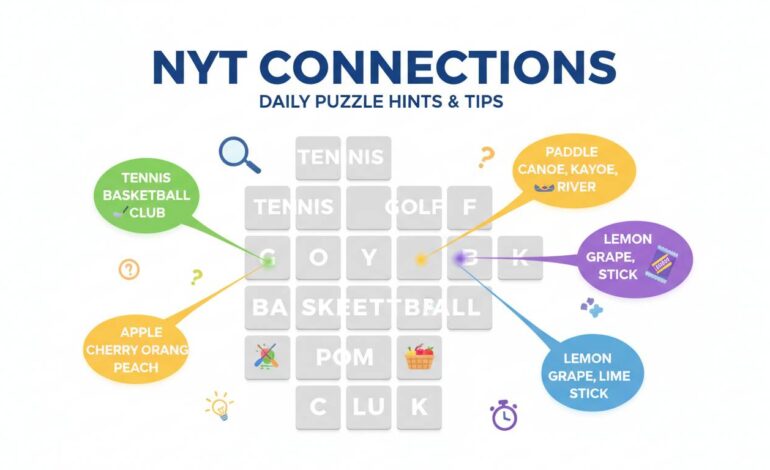
NYT Connections is The New York Times’ daily word categorization puzzle where players arrange 16 words into four groups of four based on hidden themes. Each day at midnight EST, a fresh puzzle drops, challenging players to spot connections between seemingly unrelated words. This guide covers everything you need to know—from game rules and mechanics to practical solving strategies—plus today’s puzzle hints if you’re stuck.
What Exactly is NYT Connections?
NYT Connections launched in June 2023 as the latest addition to the Times’ growing portfolio of digital word games. If you’ve played Wordle, think of Connections as its categorization-focused cousin. The game presents you with a grid of 16 words, and your job is to sort them into four thematic groups before making four mistakes.
The puzzle draws from a wide range of categories. One day you might be grouping types of fruit, and the next you’re dealing with words that share a connection in pop culture, history, or language. Some categories are straightforward—”things that are blue”—while others require lateral thinking or specialized knowledge.
The difficulty system sorts your guesses from easiest to hardest, indicated by color coding: Yellow represents the simplest connections, followed by Green, Blue, and Purple for the most challenging groupings. This gives players immediate feedback on their progress without spoiling the answers.
The game quickly became a viral hit, with players sharing their results on social media and comparing how many attempts it took to solve the daily puzzle. It’s the kind of game that works perfectly for morning coffee breaks or quick mental workouts throughout the day.
How to Play Connections: The Complete Rules
Getting started with Connections is straightforward, but understanding the nuances will help you solve puzzles faster and with fewer mistakes.
The Basic Gameplay Loop
When you load the game, you’ll see 16 words displayed in a 4×4 grid. Your objective is to identify four words that share a common theme and select them by clicking or tapping. Once you’ve chosen four words, you submit your guess. If the group is correct, those words disappear and reveal their difficulty level. If you’re wrong, you lose one of your four available mistakes.
The game continues until you’ve correctly identified all four categories or exhausted your mistake allowance. That’s it—simple concept, but the daily puzzles can be genuinely tricky.
Understanding the Mistake System
You get exactly four mistakes per puzzle. Each incorrect guess costs you one “life,” displayed as small circles that turn gray when used. Once all four mistakes are gone, you’re locked out and the puzzle reveals itself.
This limitation forces players to think before guessing randomly. A careless first guess can cost you later when you’re stuck on the final, trickiest category. Many experienced players develop strategies to minimize mistakes by eliminating obvious candidates first.
The Difficulty Categories
After solving, the game reveals how you performed using color-coded categories:
Yellow (Easiest): These are typically the most accessible connections—common knowledge that most players spot immediately. Think basic vocabulary or everyday concepts.
Green: Slightly more challenging, requiring some specialized knowledge or the ability to recognize related but less obvious patterns.
Blue: Now we’re getting into tricky territory. These connections often involve wordplay, homophones, or less commonly known information.
Purple (Hardest): The final category usually contains the most obscure or cleverly disguised connections. These might involve compound words, double meanings, or knowledge that requires specific expertise.
Today’s Puzzle Hints (Fresh Hints for [Current Date])
If you’re stuck on today’s Connections puzzle, here are some progressive hints to help without spoiling the solution completely. Work through them only if you need to.
Hint #1: Look at Word Lengths
Sometimes the physical structure of the words provides a clue. Are there any words with unusual letter counts? Do several words share the same number of letters? This can hint at word-based categories rather than meaning-based ones.
Hint #2: Consider Multiple Meanings
Many Connections puzzles use words that have more than one definition. A word like “bank” could refer to a financial institution, the side of a river, or to tilt something. If a word seems unrelated to your first guess, consider its alternative meanings.
Hint #3: Think About Categories in Threes
If you can confidently identify three words that seem to belong together, you’re onto something. Look for a fourth word that might fit that same category in a less obvious way.
Hint #4: Examine Common Word Pairings
Some words frequently appear together in phrases. “Right” and “Write,” for instance, sound identical but have different meanings. These homophones often appear in the same puzzle.
“The beauty of Connections is that it rewards both broad knowledge and the ability to think about words in unconventional ways. A category that seems obvious in hindsight often catches players off guard because they’re thinking too literally.” — a puzzle enthusiast on Reddit
Winning Strategies: Tips from Experienced Players
After solving hundreds of Connections puzzles, certain approaches consistently prove more effective than others. Here’s what works.
Start with Elimination, Not Addition
Rather than trying to build groups from scratch, start by identifying words that clearly don’t belong together. Remove the outliers first, and you’ll naturally narrow down the possibilities for each category.
This reverse approach often reveals patterns you might have missed when looking for connections. By process of elimination, you’re essentially forcing your brain to examine each word from multiple angles.
Don’t Guess Early
The temptation to make a quick guess when you think you’ve spotted a connection is strong. Resist it. Unless you’re extremely confident, use your early guesses to test hypotheses rather than commit to answers.
Think of each guess as an experiment. If you guess wrong, you gain information about what that word isn’t connected to. This information is valuable, but it’s even better if you can gather that information through careful reasoning rather than wasted guesses.
Look for Compound Words
Many Connections puzzles include words that can combine with other words to create something new. “Fire” might connect to “fly” (firefly), “man” (fireman), or “fighter” (firefighter). These compound word connections are incredibly common, especially in harder categories.
When stuck, try mentally pairing each word with common modifiers or suffixes. Do any of them create familiar compound words or phrases?
Consider Wordplay and Sound
Connections isn’t always about meaning. Sound-based puzzles—rhymes, homophones, alliteration—appear regularly. If words sound similar but have different spellings or meanings, you might be looking at an audio-based category.
Similarly, look for words that rhyme with each other or share similar syllable patterns. These sound connections can be surprisingly difficult to spot because we’re so conditioned to think about meaning rather than phonetics.
Use the Timer Wisely
The daily puzzle doesn’t disappear—you can come back to it anytime. If you’re stuck, step away for a few hours or even overnight. Fresh eyes spot connections that tired ones miss. This is probably the single most underrated strategy.
Many players report solving puzzles they were stuck on simply by returning to them with a different mindset. The answer that seemed impossible sometimes becomes obvious within seconds of looking at the grid again.
Common Mistakes That Cost Games
Understanding what trips up most players can help you avoid these pitfalls.
Guessing Without Reasoning
Random guessing is the fastest path to failure. With only four mistakes allowed, even two or three unlucky guesses can end your game prematurely. Always have a reason for your selections, even if that reason is “these three seem to fit, let’s test the fourth.”
Getting Stuck on One Category
Sometimes players fixate on finding a connection that doesn’t exist. If a group of words isn’t working, move on. Come back later with fresh perspective. Forcing a connection that isn’t there wastes guesses and mental energy.
Overthinking the Difficult Categories
The purple (hardest) category is supposed to be difficult. Don’t get frustrated if you can’t crack it immediately. Sometimes the answer becomes clear only after solving the other three categories, as those solved words provide context clues.
Not Using Process of Elimination
Many players forget that they can learn from wrong answers. When you guess wrong, those words are now ruled out for whatever category you were testing. Use that information to inform your next guess.
The Connections Community and Cultural Impact
NYT Connections has spawned a vibrant community of players who share strategies, celebrate wins, and discuss the daily puzzle. Reddit’s r/Connections subreddit has grown into a substantial community where players analyze patterns, debate puzzle difficulty, and offer mutual support.
The game has also become a social phenomenon. People share their results using colored squares (mimicking Wordle’s famous grid), comparing performance with friends and coworkers. The daily puzzle has joined the morning routine of millions, competing with coffee and news for attention.
What’s remarkable is how the game has brought together people who might not otherwise connect. The puzzle transcends age, background, and expertise level. A teenager and a retiree can both enjoy the same daily challenge, even if one solves it in two guesses and the other takes all four.
The game has also influenced other puzzle creators. Its success demonstrated that word games could still innovate and find new audiences. Several competing games have emerged, though none have matched Connections’ cultural penetration.
Connections vs. Other NYT Games
The New York Times has built an impressive lineup of digital puzzles. Here’s how Connections stacks up against its famous siblings.
Wordle remains the most famous, a daily five-letter word guessing game that kicked off the modern word puzzle craze. Wordle focuses on deduction through green, yellow, and gray feedback. Connections requires a different skill set—categorical thinking rather than letter-by-letter elimination.
Strands is the Times’ newer addition, a spelling bee-style game where you find words within a letter grid. It combines elements of Connections and traditional word searches but hasn’t reached the same popularity.
The Mini Crossword serves those who prefer clue-based puzzles in compact form. It’s perfect for quick breaks but requires different knowledge and solving approaches.
What makes Connections unique is its accessibility. Unlike Wordle, where vocabulary matters, or crosswords where you need broad knowledge, Connections relies more on pattern recognition and flexible thinking. Anyone can play, regardless of educational background.
Conclusion
NYT Connections offers a daily mental workout that’s become as habitual as morning coffee for millions of players. The game’s clever design—graduated difficulty, color-coded hints, and the satisfying feeling of cracking each category—keeps people coming back.
Whether you’re a newcomer learning the ropes or a seasoned player seeking better strategies, the key is patience and flexible thinking. Don’t rush to guess, use the elimination process wisely, and don’t fear stepping away when stuck. The daily puzzle will always be there waiting.
Remember: there’s no shame in using hints or taking multiple attempts. The goal isn’t perfection—it’s the satisfaction of spotting connections you might have missed and the small victory of completing another day’s puzzle.
FAQs
How do I access NYT Connections?
You can play Connections through the New York Times Games app or website. The game is included with a NYT Games subscription, which also gives access to Wordle, Strands, and the Crossword. Many players find the subscription worthwhile for unlimited access to all puzzles.
What time does the new puzzle release?
NYT Connections updates at midnight Eastern Standard Time each day. Some players notice slight variations depending on their timezone, but the puzzle officially resets at 12:00 AM EST.
Can I play past puzzles?
Currently, Connections only offers the daily puzzle. Unlike Wordle, where you can access past games through various methods, Connections doesn’t have a built-in archive. Each puzzle is meant to be solved within its 24-hour window.
Why do my guesses sometimes count as mistakes when I’m right?
This occasionally happens due to the game’s sorting system. If you select words in an order that doesn’t match the game’s internal solution, it might not recognize your guess immediately. Try re-selecting the same words in a different order.
Is Connections getting harder over time?
The puzzle difficulty varies daily rather than progressively increasing. However, some players report that categories have become more varied and creative as the game matures, introducing more wordplay and less conventional categories.
What’s the best first move in Connections?
Most experienced players recommend scanning all 16 words first to get a general impression. Look for obvious pairs or triples that seem to belong together, then test those hypotheses systematically. Avoid guessing until you’ve eliminated obvious non-matches.