Best Smartwatches for CrossFit in 2025


Finding the right smartwatch for CrossFit isn’t about grabbing the most expensive option. CrossFit demands durability, accurate workout tracking across constantly varied movements, and reliable recovery data—all in a device that won’t slide around your wrist during burpees or interfere with Olympic lifts. The best options balance rugged construction with sophisticated movement detection, giving you actionable data whether you’re crushing a WOD, lifting heavy, or working on mobility. Here’s what actually matters and which watches deliver.
What CrossFit Athletes Actually Need in a Smartwatch
Before diving into specific models, it helps to understand what separates a decent fitness tracker from something actually useful for CrossFit. The constantly varied nature of the sport means your watch needs to handle everything from running and rowing to heavy snatches and wall balls—sometimes within the same workout.
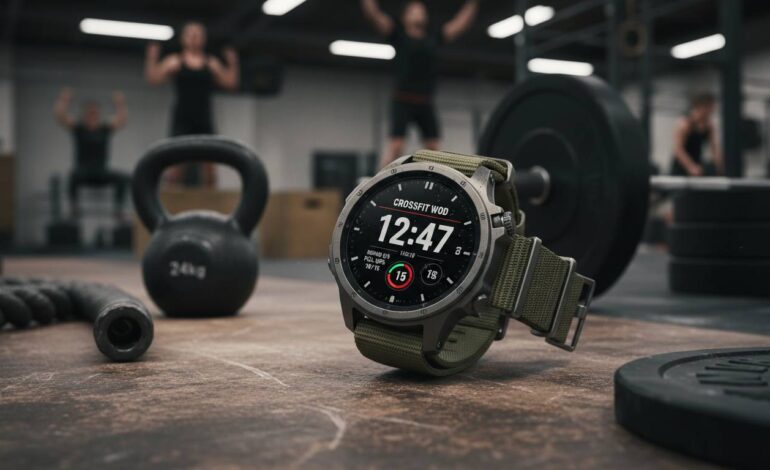
Durability matters most. CrossFit boxes aren’t gentle environments. Chalk dust, dropped weights, sweat, and impacts against pull-up bars are part of daily life. A watch with at least 5ATM water resistance and a reinforced case isn’t optional—it’s necessary. Plenty of athletes have cracked displays during thruster-heavy WODs and learned this the hard way.
Rep counting has gotten better, but don’t expect miracles. Early fitness trackers couldn’t distinguish between different exercise types or count reps in complex movements. Modern devices use accelerometer data, heart rate patterns, and machine learning to identify movements like box jumps, pull-ups, and thrusters. Some come closer than others, but none are perfect.
Battery life catches people off guard. A workout app that dies halfway through a 45-minute AMRAP is worse than no tracking at all. CrossFit workouts easily exceed an hour, and that’s before warm-ups, cool-downs, and additional sessions in the same day.
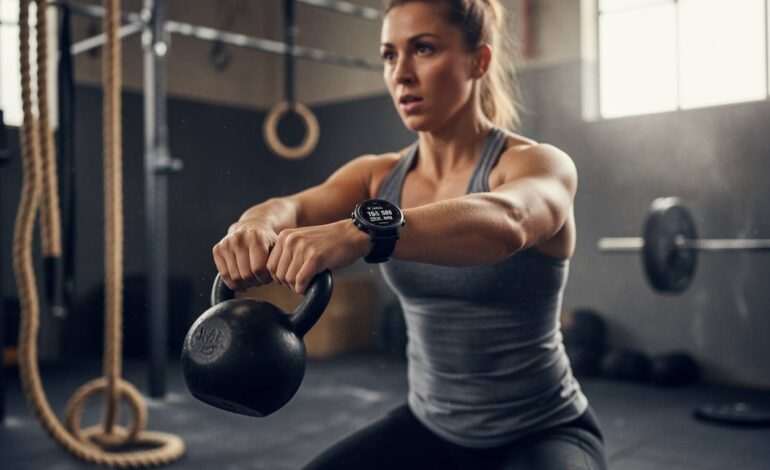
Comfort during lifting gets overlooked. A bulky watch with a thick case can mess up your grip during cleans, snatches, or back squats. The best CrossFit watches either slim down significantly or offer bands that sit flush against the wrist.
Apple Watch Series 9 and Ultra 2: The Ecosystem Powerhouse
Apple has built one of the most capable CrossFit ecosystems available, though you need to do some setup to get the full benefit. The Series 9 gives you solid fundamentals in a compact form, while the Ultra 2 pushes durability and battery life further for athletes who need maximum performance.
The Ultra 2 stands out with 100-meter water resistance, a titanium case, and a flat sapphire crystal display. During Fran-style workouts or swimming intervals, this durability matters. The battery handles two-hour workouts with GPS on—a real improvement over earlier Apple Watch models that would die around the 90-minute mark.
The third-party app ecosystem is what makes Apple work for CrossFit. Apps like WODproof and Hevy provide dedicated workout logging with rep counting, movement tracking, and score storage. The built-in Workout app handles standard exercises fine, but these specialized apps fill the gap between what Apple provides and what CrossFit athletes actually need. You can log your WOD, track times, and review performance history across sessions.
The S9 chip delivers snappy performance for switching between apps mid-session. During a workout with running, rowing, and weightlifting segments, you won’t find yourself waiting for the watch to catch up. The always-on Retina display stays readable in bright sunlight—useful for outdoor workouts or garage gym sessions with variable lighting.
The optical heart rate sensor works well during moderate-intensity work, though like all optical monitors, it struggles during high-interval intensity when your arm is moving constantly. Grab a chest strap if you’re serious about accurate zone training.
The main drawback for CrossFit is case thickness. Even the Ultra 2 sits fairly thick on the wrist. During barbell work, some athletes say the case catches on their forearms. The regular Series 9 is thinner but less durable. Apple hasn’t fully solved this trade-off yet.
Garmin Fenix 7 and Epix Pro: The Dedicated Athlete’s Choice
Garmin has been the go-to brand for serious functional fitness athletes, and the Fenix 7 and Epix Pro continue that with refinements addressing CrossFit-specific needs. These watches feel purpose-built, not adapted from running or cycling focus.
Both models have built-in flashlights—a small addition that proves surprisingly useful in early morning or evening gym sessions. More importantly, they include comprehensive strength training profiles that track exercises, set counts, and estimated volume. The muscle heat map shows which muscle groups you’ve worked, helping balance training across sessions.
CrossFit-specific features have come a long way. The activity profile now includes “CrossFit Training” as a dedicated option, logging work type, duration, and providing a framework for scoring. It won’t perfectly count every rep of every movement, but it handles workout structure well and integrates with Garmin Connect for long-term analysis.
Battery life is worth mentioning specifically. The Epix Pro (solar version) can stretch to 28 days in smartwatch mode and over 50 hours in GPS mode. During a weekend competition or long training session, this battery capacity means one less thing to worry about. The Fenix 7 Pro Solar offers similar endurance with a more traditional watch look.
Garmin’s Elevate heart rate sensor sits on the back and provides reliable readings during most workout intensities. The sensor has improved a lot from earlier generations, though the same optical HR limitations apply during extremely high-intensity moments with lots of arm movement.
The MIP display on the Fenix 7 stays excellent for outdoor visibility, though it looks less vibrant than the AMOLED screen on the Epix Pro. If you train mostly indoors under artificial lighting, the Epix Pro’s brighter display might appeal more. For garage gym athletes working in varied light, the Fenix’s always-readable screen has practical advantages.
Both watches handle multi-sport transitions smoothly. If your WOD includes swimming, running, and weightlifting, switching between activity profiles takes a couple of button presses. GPS acquires satellites quickly for outdoor running or rowing segments, and GLONASS/Galileo support improves accuracy in challenging environments.
COROS Apex 2 Pro: The Value Performer
COROS has built a loyal following among CrossFit athletes by delivering most of what Garmin offers at a lower price. The Apex 2 Pro represents their most refined offering yet, with improvements in durability, battery life, and workout tracking that make it genuinely competitive with more expensive options.
The titanium bezel and sapphire crystal give the Apex 2 Pro real rugged credentials. It feels substantial without being bulky, and 50-meter water resistance handles pool work and sweat without worry. At around $500, it undercuts comparable Garmin models by $150-200 while delivering 95% of the functionality.
Battery life matches or exceeds what you’d expect from Garmin. The Apex 2 Pro gives you 30 days of daily use and 75 hours with full GPS. During a typical training day with a morning WOD and afternoon mobility work, you’d struggle to drain this battery in a week.
COROS has invested heavily in strength training tracking. The workout mode automatically detects rest periods, tracks your sets, and builds a comprehensive log of your lifting volume over time. Rep counting isn’t perfect—especially for complex movements—but the system captures enough data to be useful for progressive overload tracking. The exercise library covers standard barbell movements, dumbbells, and bodyweight exercises well.
The digital dial crown provides one-handed operation that proves practical during workouts. Scrolling through workout data or adjusting settings without smearing sweat across the touchscreen becomes genuinely useful mid-WOD. This interface choice sets COROS apart from touchscreen-only competitors.
One area where COROS trails slightly is third-party apps. While Garmin and Apple benefit from larger developer communities, COROS relies more on first-party features. For most CrossFit athletes, this matters less than you’d think—the built-in functionality covers 90% of what you’d want from a dedicated app.
Heart rate monitoring uses COROS’ own optical sensor, which performs adequately but not exceptionally. During steady-state cardio, readings seem accurate. During high-interval work with significant arm movement, expect some data gaps or delays. Same workaround as other optical systems: pair a chest strap for critical training sessions.
Whoop 4.0: The Recovery Expert
Whoop takes a different approach in the CrossFit wearable space. It doesn’t try to be everything. Instead, it focuses on strain tracking, recovery monitoring, and actionable feedback based on your training load. This resonates with CrossFit athletes who want to optimize training rather than just track it.
Whoop 4.0 wears as a band rather than a traditional watch face. This design choice eliminates bulk entirely—you forget you’re wearing it within minutes. During Olympic lifting or gymnastics movements, there’s zero interference with range of motion or grip. The trade-off is no built-in display; you interact with Whoop through your phone app rather than the device itself.
The strain coach feature gives real-time feedback during workouts. As your heart rate rises and strain accumulates, Whoop calculates your exertion level and tells you when you’re approaching your capacity. During long AMRAPs or repeat sprint workouts, this data helps you pace better rather than redlining early and paying the price later.
Recovery scoring based on HRV, resting heart rate, and sleep quality gives you a daily readiness assessment. CrossFit athletes often struggle with balancing training hard and recovering adequately. Whoop quantifies this balance, suggesting which days you should push and when you should prioritize rest or active recovery.
The downside is less detailed workout logging compared to Garmin or Apple. Whoop tracks strain and heart rate well, but if you want to log specific movements, track your Fran time progression, or analyze snatch technique, you’ll need a different tool. Whoop complements other tracking methods rather than replacing them entirely.
The subscription model—required for full functionality—divides opinion. At $239 annually, Whoop costs more over time than a one-time smartwatch purchase. Supporters say the data insights justify the expense; critics point out you can get similar recovery data from other devices without the ongoing fee. The honest answer depends on how much you value the specific strain/recovery framework Whoop has built.
Samsung Galaxy Watch 6 and Ultra: The Android Alternative
Samsung’s Galaxy Watch lineup deserves attention from CrossFit athletes in the Android ecosystem, though it doesn’t quite match the dedicated athletic focus of Garmin or COROS. The Galaxy Watch 6 provides solid general fitness tracking with enough CrossFit capability to satisfy casual practitioners, while the Galaxy Watch Ultra pushes toward more serious athletic use.
The BioActive sensor combines optical heart rate, electrical heart (ECG), and bioelectrical impedance analysis (BIA) for body composition estimates. While body composition tracking has limited immediate utility during a WOD, the improved heart rate monitoring from the multi-sensor approach gives more reliable data during varied intensity workouts.
Samsung Health offers workout tracking including strength training, HIIT, and running. The strength training mode logs exercises and provides visual feedback on form suggestions—a useful addition for newer athletes still learning movement patterns. However, CrossFit-specific features lag behind dedicated fitness platforms.
The Galaxy Watch Ultra’s 100-hour battery in power saver mode and 48-hour battery in workout mode handles most training scenarios. Samsung has clearly prioritized battery improvements, addressing a historical complaint about Galaxy Watch models.
The titanium case and 10ATM water resistance give the Ultra real durability credentials. It survives the typical CrossFit environment without issue, though the rotating bezel design might catch on equipment during certain movements. The 47mm case size sits large on smaller wrists, potentially creating fit issues for some athletes.
Integration with Samsung’s ecosystem stays strong if you’re already using Galaxy phones, tablets, or earbuds. Seamless connectivity makes notifications, music control, and data syncing work smoothly. If you’re in the Apple ecosystem, these advantages disappear, and you’d be better served by the Apple Watch.
Choosing the Right Smartwatch for Your CrossFit Goals
Matching your smartwatch to your needs involves honest assessment of how you train and what data actually matters to you. The most expensive option isn’t necessarily the best for every athlete.
For athletes competing in CrossFit or focusing heavily on functional fitness programming, the Garmin Fenix 7 Pro or Epix Pro remains the benchmark. The combination of dedicated CrossFit tracking, rugged durability, exceptional battery life, and comprehensive strength training profiles justifies the premium pricing. If budget matters, the COROS Apex 2 Pro delivers nearly identical functionality at a significantly lower price.
If you’re deep in Apple’s ecosystem and prioritize the app ecosystem over dedicated athletic features, the Apple Watch Ultra 2 gives excellent CrossFit capability with iOS integration convenience. Third-party app support effectively supplements Apple’s solid first-party features.
For athletes primarily concerned with recovery, strain management, and training load optimization, Whoop 4.0 offers something different. The band-style design, recovery scoring, and strain tracking provide insights that traditional sports watches only partially address.
Samsung users in the Android ecosystem get a capable all-rounder with the Galaxy Watch Ultra, though they’ll find slightly better CrossFit-specific features elsewhere. The decision often comes down to ecosystem loyalty rather than pure feature comparison.
Regardless of which watch you choose, expect a learning curve before the device becomes a seamless part of your training. Setting up activity profiles, understanding data displays, and establishing a tracking routine takes time. The investment pays off through better training insights, more effective programming, and improved awareness of your body’s response to CrossFit’s unique demands.
FAQs
Can smartwatches accurately count reps during CrossFit workouts?
Most smartwatches struggle with accurate rep counting during complex CrossFit movements. While Garmin and COROS have improved movement detection, they work better for tracking exercise types and set counts rather than precise rep numbers. For competitive CrossFit, manual logging or specialized apps like WODproof remain more accurate.
Do I need a chest strap heart rate monitor with these watches?
Optical heart rate sensors on the wrist have improved significantly but can still miss readings during high-intensity movements with lots of arm motion. For critical training sessions where accurate zone data matters, pairing your watch with a chest strap (like Garmin HRM-Pro or Wahoo TICKR) gives more reliable readings.
Which smartwatch has the best battery life for long CrossFit workouts?
The Garmin Epix Pro and Fenix 7 Pro Solar offer the longest battery life, exceeding 50 hours with GPS tracking. The COROS Apex 2 Pro matches this endurance at a lower price. Apple Watch Ultra 2 handles workouts up to about two hours comfortably but needs charging between multiple daily sessions.
Are these smartwatches waterproof enough for swimming in CrossFit?
Most modern fitness watches offer at least 5ATM water resistance (50 meters), which handles pool swimming and sweat exposure. Garmin’s Fenix and Epix series, Apple Watch Ultra 2, and COROS Apex 2 Pro all meet or exceed this standard, making them suitable for swimming intervals in CrossFit workouts.
Can I track my lifting progress on these watches?
Garmin and COROS watches offer the most detailed strength training tracking, including exercise logging, set counting, and volume tracking. Apple Watch needs third-party apps for comparable lifting tracking. Data integrates with each platform’s ecosystem for long-term progress analysis.
What’s the best smartwatch for CrossFit on a budget?
The COROS Apex 2 Pro delivers the best balance of price and CrossFit-specific features. At roughly $500, it undercuts comparable Garmin models while offering nearly identical workout tracking, battery life, and durability. It’s the current value leader for dedicated CrossFit athletes.