What Is a Lavender Marriage? Meaning, History, and Examples Explained

A lavender marriage is when two people—often one or both—enter into a marriage that hides or subdues their true sexual orientation, typically arranged to protect careers, social standing, or personal privacy. It’s often discussed in the context of celebrities or public figures whose real-life partnerships are obscured by this kind of agreement.
Origins and Historical Roots of Lavender Marriages
Lavender marriages trace back to early Hollywood and beyond, where rigid social norms forced LGBTQ+ individuals to hide their identities. In practice, these unions offered cover—especially in the 1920s to 1950s—keeping public images tightly controlled. They were often orchestrated by studios or families keen to protect reputation and box office appeal.
During Hollywood’s Golden Age, queer actors and actresses turned to lavender marriages as a strategy to maintain careers and avoid scandal. These strategic pairings often involved negotiation between studios, agents, and stars themselves—all working in tandem to keep sexual identities hidden from the press and the public.
How the Term Evolved
The phrase “lavender marriage” comes from lavender’s long-standing association with queer culture. Over time, it’s become shorthand for relationships that serve as a public façade rather than genuine romantic partnerships.
Even today, while society has grown more accepting, the term still serves as a reminder of past constraints—and how much has changed, as well as how much remains to be addressed.
Reasons Behind Lavender Marriages
The reasons people arranged lavender marriages can range widely:
- Social/Family Pressure: In more conservative or high-profile families, revealing a queer identity could lead to ostracism.
- Protection of Career: Celebrities risked box office failure or loss of mainstream fan support if they were outed—so marriages served as insurance.
- Personal Privacy: Some individuals preferred to maintain a private life without revealing intimate personal details to the public.
Even today, while visibility is greater, stigmas persist. LGBTQ+ individuals in certain cultures or industries might still find pressure to conform, making the concept of a lavender marriage relevant in some circles.
Real-World Examples and Famous Cases
Here are a few notable instances that illustrate what lavender marriages looked like in practice:
-
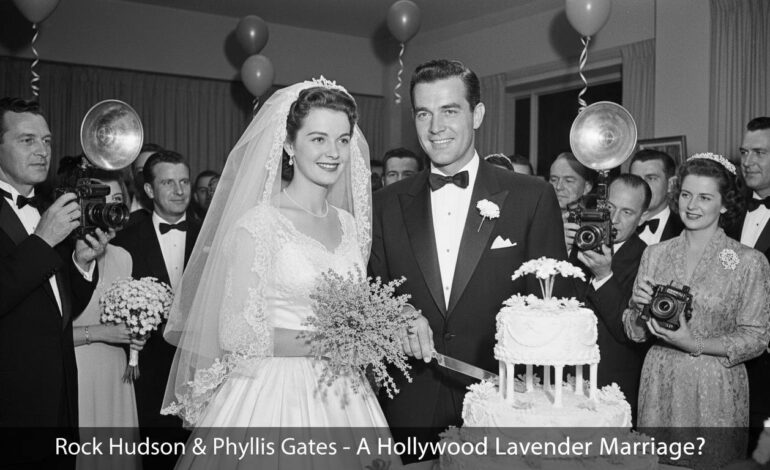
Rock Hudson and Phyllis Gates
Rock Hudson, a leading man of the 1950s and 1960s, married his secretary Phyllis Gates in 1955. While the marriage lasted three years, it ultimately ended in divorce and Hudson later came out as gay. It is widely seen today as a prototypical lavender marriage. -
Liberace
Though he never officially married, the flamboyant performer often maintained close, ambiguous relationships with women that were interpreted as cover for his homosexuality. His carefully curated image serves as a real-world example of how lavender dynamics worked even in informal arrangements. -
Sir Ian McKellen
Long before coming out in 1988, McKellen reportedly navigated public life through quietly managing his personal narrative. He didn’t enter a lavender marriage—but his experience demonstrates the personal complexity behind such choices.
These stories show how lavender marriages have shaped public perception and celebrities’ private lives for decades.
Lavender Marriages Today: Are They Still a Thing?
The short answer: rarely. Social norms have shifted dramatically. Same-sex marriage is legally recognized in many places, and LGBTQ+ representation is more visible and varied than ever. Yet, in certain contexts—maybe in highly traditional cultures or industries with rigid expectations—some people may still opt for marriages of convenience.
More commonly now, there’s just complexity. Many queer people feel empowered to live openly. Still others might choose marriage for unrelated reasons—cultural, financial, familial—that have nothing to do with hiding their sexuality.
Why This Still Matters
Lavender marriages matter because they illustrate how social pressure once constrained personal truth. Recognizing this helps us value how far we’ve come toward LGBTQ+ acceptance—and where gaps remain.
They serve as historical documents in a way—markers of a time when access, career, and image forced individuals into certain life choices. As society evolves, these stories underscore the importance of authenticity and the right to live openly.
Expert Reflection
“Lavender marriages weren’t just personal arrangements—they were strategic shields against a judgmental society.”
This captures the heart of the issue. These marriages were often carefully orchestrated. They weren’t simple lies—they were survival mechanisms in environments that punished truth.
Summary of Key Insights
- A lavender marriage hides one’s true sexual orientation for social or career-related reasons.
- They’re rooted in historical pressures, notably in mid-20th-century Hollywood.
- Famous examples include Rock Hudson and others who felt the need to protect reputations.
- The practice is rare today, thanks to broader societal acceptance, but it remains a reminder of past constraints.
- Understanding these marriages helps foreground the value of authenticity and representation.
FAQs
What does “lavender” in lavender marriage symbolize?
Lavender has long been linked to queer culture. So “lavender marriage” came to denote unions that mask a person’s queer identity, using the color as a subtle signal.
Is a lavender marriage always fake?
Not necessarily. Some couples may care for each other deeply while also hiding important personal truths. But the union’s main purpose is often concealment or social convenience.
Are lavender marriages still happening today?
They’ve become rare, especially where LGBTQ+ rights are recognized. But in conservative or high-pressure environments, similar arrangements might still surface.
How is a lavender marriage different from a marriage of convenience?
A marriage of convenience typically refers to practical benefits—like residency or financial gain. Lavender marriages specifically involve hiding sexual orientation for image or safety.
Can lavender marriages be positive or empowering?
While rooted in concealment, some individuals used them strategically to protect careers or mitigate risk in hostile environments. Though not ideal, they show resilience in difficult times.
Does everyone in a lavender marriage know it’s a facade?
Often both parties are aware. In most cases, it’s negotiated explicitly as a mutually beneficial arrangement. But motivations and awareness can vary widely from one union to another.