PST to EST Conversion: Pacific Time to Eastern Time Explained

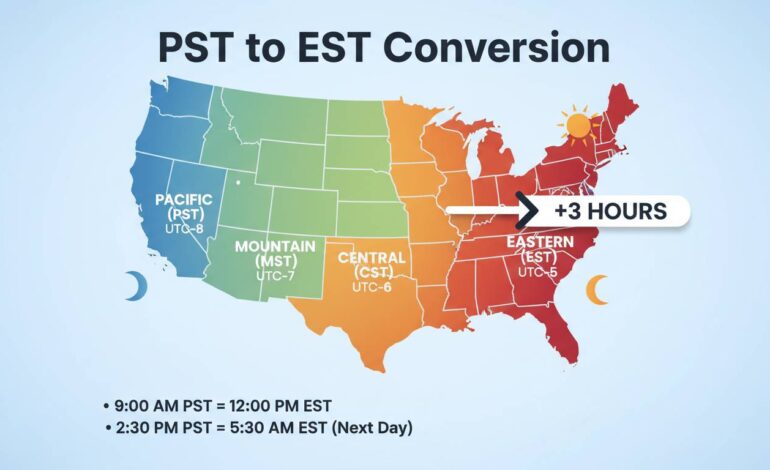
If you want to convert PST to EST, it’s simple: add three hours to Pacific Standard Time to get Eastern Standard Time. In other words, when it’s 2:00 PM PST, it’s 5:00 PM EST.
Let’s unpack that further — in a friendly, conversational way — so you kinda get why it is that way, and how daylight savings plays into it too.
Understanding Time Zones and Their Differences
What Are PST and EST?
These are two common time zones in North America:
-
Pacific Standard Time (PST) is the time zone for the U.S. West Coast — think Los Angeles, Seattle, Vancouver. In standard time, it’s UTC−08:00. During daylight saving time, it’s called Pacific Daylight Time (PDT), and shifts to UTC−07:00 .
-
Eastern Standard Time (EST) covers places like New York, Miami, Toronto — the U.S. East Coast. In standard time, it’s UTC−05:00, and during daylight saving time, it’s called Eastern Daylight Time (EDT), at UTC−04:00 .
Why the 3-Hour Difference?
Because UTC−05:00 minus UTC−08:00 equals three hours, Eastern Time is three hours ahead of Pacific Time. So, 2 PM PST becomes 5 PM EST. This difference stays consistent because both time zones switch for daylight savings on the same dates .
Converting PST to EST: Daylight Saving Considerations
Same Shift on Both Coasts
Both PST/PDT and EST/EDT switch for daylight saving time on the same day. In the U.S., clocks go forward on the second Sunday in March and back on the first Sunday in November, keeping that consistent three-hour difference intact .
So, whether you’re in PST → EST or PDT → EDT, it remains a three-hour gap .
Quick Reference Table
| Pacific Time (PST/PDT) | Eastern Time (EST/EDT) |
|————————|————————-|
| 6:00 AM PST | 9:00 AM EST |
| 9:00 AM PST | 12:00 PM EST |
| 12:00 PM PST | 3:00 PM EST |
| 3:00 PM PST | 6:00 PM EST |
| 7:00 PM PST | 10:00 PM EST |
| … | … |
This three-hour addition is the quickest way to convert.
Real-World Scenarios You Might Relate To
Scheduling a Business Meeting
You’re in San Francisco and need to call New York at 10:00 AM EST. You dial at 7:00 AM PST. Works smoothly. Though, awkward early wakeups for West Coasters, right? .
Watching a Live TV Event
Game starts at 8:00 PM EST — that’s 5:00 PM PST. If you’re on the West Coast, you’ll catch it just as you’re wrapping up the workday. Nice overlap.
Flying Across Time Zones
Flight leaves LA at 6:00 AM PST and lands in NYC at 2:00 PM EST. Yes, you’ve crossed three time zones — but the clock just pushes forward three hours.
Tips, Gotchas, and Handy Advice
Always Double-Check the Time Labels
PST refers to standard time. If you’re in daylight saving, say PDT, or just stick with the umbrella term PT (Pacific Time) or ET (Eastern Time) for clarity .
Smart Use of Online Tools
Converters like Time.now, SavvyTime, and TimeNow make conversions effortless. They show current time, allow swaps, and handle daylight savings for you .
Best Time Slots for Calls or Meetings
For West Coast (PST) folks, sync hours between 9:00 AM–3:00 PM PST work well — they match 12:00 PM–6:00 PM EST. That overlap is golden for collaboration .
Avoiding Common Mistakes
- Don’t assume times without checking if daylight saving is active.
- If you’re unsure if it’s PST or PDT, use PT instead.
- Confirm with other participants — best to be safe, not sorry.
What Experts Say
“The simplest rule: wherever you see a time in PST, just add three hours — that’ll give you the correct time in EST. Daylight savings? Doesn’t change the rule, because both zones shift in sync.”
This holds practical value, especially when booking meetings, booking flights, or watching live events across the coasts.
Quick Conversions Cheat Sheet
- PST → EST: Add 3 hours
- PDT → EDT: Also add 3 hours
- Use PT → ET when unclear
- Check for daylight savings if it’s during March or November transitions
Conclusion
Converting from PST to EST is one of those tasks that can sound complicated, but in reality, it’s consistent and straightforward — add three hours. That rule holds whether you’re dealing with standard or daylight saving time.
With thoughtful use of labels (PT vs. PT) and quick reference converters, staying on the right time has never been easier.
FAQs
Q: Is the time difference always three hours?
A: Yes. Because both zones shift for daylight savings on the same dates, the three-hour gap stays put year-round.
Q: What if it’s PDT or EDT instead of PST or EST?
A: The conversion stays the same — you still add three hours whether it’s PDT to EDT or PST to EST.
Q: What’s the best overlap for business calls?
A: Aim for 9 AM–12 PM PST, which lines up with 12 PM–3 PM EST, avoiding early or late hours for either coast.
Q: Can I just use “PT” and “ET” to avoid confusion?
A: Definitely. PT and ET are broad terms that include both standard and daylight times and reduce mislabeling risks.
Q: Where can I quickly convert times?
A: Tools like Time.now, SavvyTime, and TimeNow are accurate, easy to use, and handle daylight saving changes automatically.
Thanks for sticking with me through this — converting time zones doesn’t have to be a headache when you know the simple math!