What Does SOS Mean? Definition, Origin, and Common Uses

SOS means a distress signal in Morse code consisting of three dots, three dashes, and three dots (··· – – – ···), sent as an unbroken sequence. It’s not actually an acronym for “Save Our Ship” or “Save Our Souls”—those are backronyms that grew popular later .
Origins of SOS: Why Those Dots and Dashes?
The SOS signal began in German maritime radio rules on April 1, 1905, as a simple, unmistakable pattern in Morse code meant for distress calls . It wasn’t letters at that time—just a code sequence: three short, three long, three short, sent as one continuous signal .
In 1906, at the International Radiotelegraph Convention in Berlin, 27 countries agreed to adopt this pattern as the global standard, and it officially took effect on July 1, 1908 .
Why SOS, Not CQD?
Before SOS took hold, the Marconi company used “CQD”—where “CQ” meant a general call and “D” indicated distress . But CQD was less clear in noisy transmissions. SOS offered a cleaner pattern that cut through interference. In the transition period, some operators—like on the Titanic—sent both CQD and SOS to maximize clarity .
SOS: Not an Acronym, But Memory Aids Came Later
The choice of SOS wasn’t meant as shorthand for anything. The sequence was chosen purely for its simplicity in Morse code . However, popular backronyms like Save Our Ship, Save Our Souls, or even Send Out Succor emerged later to help people remember it .
SOS Through the Ages: From Sea to Pop Culture
After World War II, voice communication became more common, and pilots began using “Mayday” (from French m’aider, “help me”) in spoken distress calls. By 1927, Mayday was adopted internationally for voice, while SOS remained the telegraphic standard .
Eventually, Morse code faded from maritime practice with the introduction of the Global Maritime Distress and Safety System (GMDSS) in the late 1990s. SOS was phased out by February 1999, replaced by satellite-based systems . But its legacy persists—in emergency visuals, smartphone icons, and everyday speech.
SOS in Context: Real-World Examples and Surprising Usage
-
Titanic (1912): Wireless operators initially sent CQD, then alternated with SOS when advised, ensuring broader recognition of the call .
-
MV Oak (1997): The last vessel to transmit SOS officially, just before Morse code was retired from maritime use on December 31, 1997 .
-
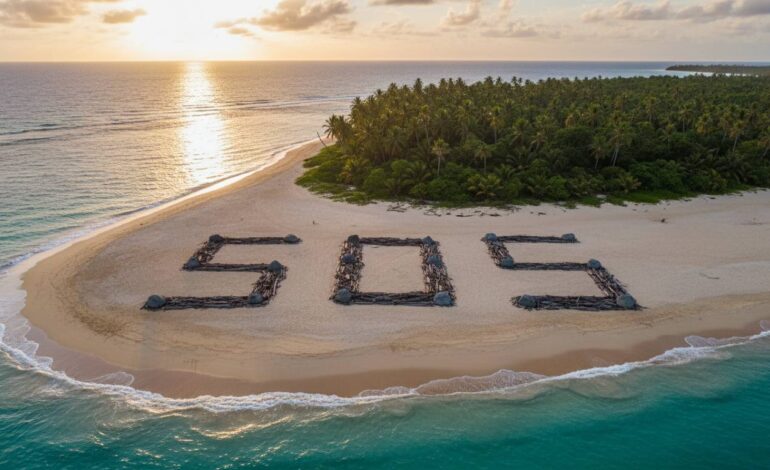
Visual Distress Codes: SOS is still used visually—like arranging logs or carving letters in the sand. Its ambigram property means it’s visible even upside down .
-
Modern Metaphors: People say “sending out an SOS” when in a figurative emergency, like needing quick help or a sudden crisis, showing how deeply SOS has integrated into language .
The Human Angle: Why SOS Works So Well
It’s weird, right? A bunch of dots and dashes turned into an icon for help worldwide. The genius of SOS lies in its:
- Simplicity: You don’t need expert training to tap three short, three long, three short.
- Clarity: Even with static or weak signals, SOS cuts through noise.
- Global Reach: Emerging right as radio was taking off, it became the universal distress voice long before satellites or cell towers.
- Cultural Momentum: People cling to symbols—SOS morphed into metaphor and design, sticking around even when the tech behind it changed.
“SOS was chosen because it could not be misinterpreted as being a message for anything else.”
Summary of Key Points
SOS is a Morse code distress signal—three dots, three dashes, three dots—transmitted as one continuous signal. It originated from German maritime regulations in 1905 and became international law by 1908. SOS isn’t an acronym but gained powerful mnemonic meanings over time. By the late 1990s, Morse code methods were replaced, but SOS remains a cultural touchstone and symbol of help.
FAQs
Why do people think SOS stands for “Save Our Ship”?
Backronyms like “Save Our Ship” or “Save Our Souls” emerged to help folks remember the code. But originally, SOS was not intended to stand for anything—just an easy-to-send and recognize Morse pattern .
When did SOS become official?
SOS was officially adopted at the International Radiotelegraph Convention in 1906 and became effective on July 1, 1908 .
When did SOS stop being used at sea?
The Global Maritime Distress and Safety System phased out Morse code for maritime distress signals by 1999 .
Is SOS still used today in emergencies?
Yes—though not in maritime radio. SOS is still used visually—for instance, drawn in snow or sand—and as a metaphor in everyday language to signal aid is needed .
What replaced SOS in voice communications?
The spoken equivalent of SOS is “Mayday,” adopted in 1927 for voice distress calls because it sounds like the French m’aider, meaning “help me” .
Could someone still tap SOS today?
Absolutely. In survival situations where electronics fail, tapping three short, three long, three short—SOS—remains a reliable distress signal.
SOS is more than code—it’s a cultural beacon. Even if radios go dark, its three-dot, three-dash pattern still says one clear thing: “Help needed, now.”