510 Area Code: Location, Cities, Map & Phone Number Guide

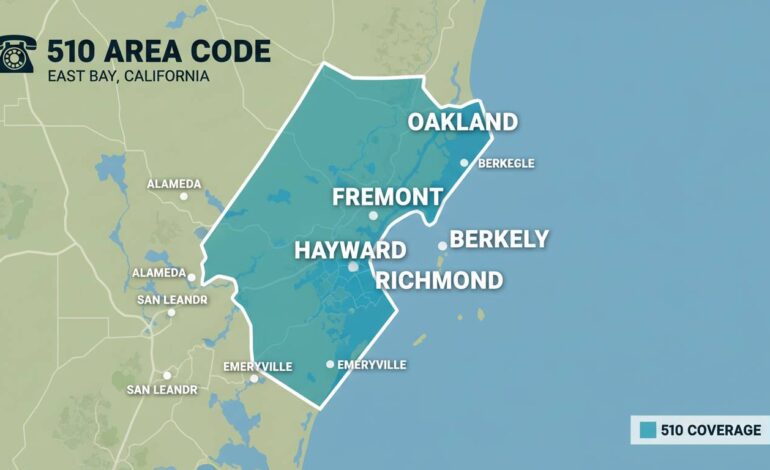
The 510 area code covers the East Bay region of Northern California, predominantly serving western Alameda County and parts of western Contra Costa County. It includes major cities like Oakland, Berkeley, Fremont, Hayward, Richmond, and others, and shares the region via an overlay with area code 341.
Where Exactly is the 510 Area Code?
The 510 area code was created on September 2, 1991, carved out from the older 415 area code . It spans much of Alameda County and the western portion of Contra Costa County .
In 1998, the eastern half of the East Bay split off into the 925 area code, with the Berkeley Hills roughly marking the boundary . Today, 510 remains the identifier for the West of the hills, while 925 covers the East.
What’s the 341 Overlay About?
By 2019, 510 was set to run out of available phone numbers. To solve this, authorities introduced area code 341 in July 2019 as an all-service overlay: new numbers may bear 510 or 341, and ten-digit dialing became mandatory across the region .
This overlay ensures continuity and avoids disrupting existing numbers, while keeping geographic coverage identical for both codes .
Which Cities Fall Under the 510/341 Area Code?
Alameda County
Key cities include Alameda, Albany, Berkeley, Castro Valley, Emeryville, Fremont, Hayward, Newark, Oakland, Piedmont, San Leandro, San Lorenzo, Union City, and smaller communities like Ashland, Cherryland, Fairview .
Contra Costa County
Within Contra Costa County, the area includes El Cerrito, El Sobrante, Hercules, Pinole, Richmond, Rodeo, San Pablo, Crockett, Port Costa, Rollingwood, Bayview-Montalvin, East Richmond Heights, North Richmond, Canyon, and Tara Hills .
Several sources also list similar cities, while some general directories include broader areas erroneously like San Francisco or Sacramento—but those listings are unreliable .
Map and Time Zone Details
Although a visual map isn’t shown here, the 510/341 region is well-defined on sources like OpenStreetMap via overlays . The area operates under the Pacific Time Zone (PST/PDT) .
Landmarks and Local Identity
Locals sometimes refer to 510 as “the nickel and dime,” or “five-ten”—nicknames showing how the area code is woven into East Bay identity .
Technical Background: Prefix Usage & Carriers
Providers have allocated numerous central office prefixes in the 510 area, covering both wireless and landline services. Examples include:
- 510-200 in Hayward (MetroPCS)
- 510-203 in Fremont-Newark (T-Mobile)
- 510-204 in Berkeley/Oakland region (Pacific Bell)
- 510-307 for Richmond (Pacific Bell)
- 510-312 in Crockett (Commio)
The region includes hundreds of prefixes (from 510-200 to 510-999) assigned across many providers .
Why Should You Know This?
- Businesses wanting local credibility in Oakland or Fremont often seek 510 numbers—but since new 510 numbers are scarce, 341 is the practical alternative .
- Individuals recognizing local area codes can quickly infer caller location (East Bay versus elsewhere).
- For researchers or planners, combining prefix data with geography gives insight into telecom distribution and regional growth.
“Area code 510 is one of the most recognized in Northern California, known for its strong local identity and connection to the greater San Francisco Bay Area.”
Quick Comparison: 415 → 510 → 925 → 341
- 415: original Bay Area code from 1947 covering SF and East Bay.
- 510 split from 415 in 1991 to serve East Bay west of the hills.
- 925 split from 510 in 1998 to cover East Bay east of the hills.
- 341 overlay added in 2019 to share the same region as 510 and enable new numbers.
Recap of Key Facts
- Where: Western Alameda & Contra Costa counties (East Bay).
- Founded: 510 created in 1991; 341 overlay in 2019.
- Major cities: Oakland, Berkeley, Fremont, Hayward, Richmond, and others.
- Time zone: Pacific.
- Dialing: Always ten digits (area code + number).
- Prefixes: Hundreds across carriers like T-Mobile, AT&T, MetroPCS, etc.
Conclusion
The 510 area code is a defining part of East Bay’s identity, covering places like Oakland, Berkeley, Hayward, and Fremont in western Alameda and Contra Costa counties. It originated as a split from 415 in 1991, was split again by 925 in 1998, and now shares regional coverage with 341 via an overlay introduced in 2019. Dialing in the region requires the full ten-digit number, and while original 510 numbers are largely assigned, 341 fulfills new number needs. Understanding 510’s history, coverage, and local culture helps businesses, residents, and telecom professionals navigate the East Bay landscape effectively.
FAQs
Q: What is the overlay for the 510 area code?
A: The overlay is area code 341, introduced in July 2019 to share the same East Bay region and support expanded number capacity.
Q: Why does the East Bay use ten-digit dialing?
A: Ten-digit dialing became mandatory in June 2019 to accommodate both 510 and 341 area codes in the same geographic area.
Q: Are new 510 phone numbers still available?
A: No, most new numbers now use 341. Existing 510 numbers can be ported, but new assignments are rare.
Q: Which major cities are in area code 510?
A: It includes Oakland, Berkeley, Hayward, Fremont, Richmond, San Leandro, Alameda, Union City, Castro Valley, and others in western Alameda and Contra Costa counties.
Q: When did area code 510 first come into effect?
A: It was activated on September 2, 1991, after splitting off from area code 415.
Q: How was the East Bay divided between 510 and 925?
A: In March 1998, 925 was created for the region east of the Berkeley Hills, while 510 continued to serve areas west of the hills.