How to Address an Envelope Correctly: Step-by-Step Guide

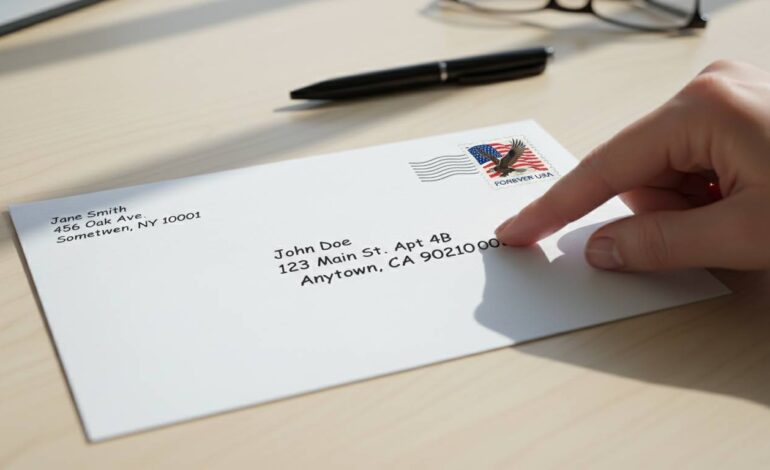
If you’re wondering how to address an envelope, here’s the short answer: write the recipient’s full address neatly in the center, your return address in the upper-left, and the postage stamp in the upper-right—using proper formatting, all-capital letters (optional but very helpful), and the correct ZIP code. That’s the practical, essential setup to make sure your mail arrives — quick and clear.
Why Addressing Properly Matters
Even small slips—like writing a zip code wrong or placing info in the wrong spot—can delay delivery. Automated systems read key zones on the envelope, and if these are smudged or misplaced, mail gets rerouted or returned. In fact, mail without a return address may become “dead mail” at USPS holdings .
Layout Essentials: Where Everything Goes
Sender (Return) Address
- Positioned in the upper-left corner of the envelope .
- Optionally, can be placed on the back flap—though this can confuse sorting equipment and delay handling .
- Format:
Your Name

  Apt/Suite (if needed)

  Street Address or P.O. Box

City STATE ZIP+4 - USPS best practice:
- Use all capital letters
- No punctuation
- Include ZIP+4 if known .
Recipient (Delivery) Address
- Centered in the lower-middle or lower-right quadrant of the envelope .
- Format similarly to return address, with optional organization and attention lines.
- Use standard state abbreviations and ZIP+4 for efficiency .
Stamp Placement
- Always in the upper-right corner .
- Make sure the value covers postage for weight/class.
Style Tips to Help the Post Office
Clear, Legible Writing
- Use black or dark blue ink on light-colored envelopes, for best OCR readability .
- Block letters are easiest—avoid cursive or flashy fonts .
- Keep consistent spacing; ideally left-aligned for both addresses .
Avoid Punctuation, Stick to Standard Abbreviations
- Skip commas, periods, and other symbols—omit them for cleaner sorting .
- Use USPS-recommended abbreviations for streets (ST, AVE), states (e.g., CA, NY), and directionals (N, S) .
Leave Bar Code Clear Zone
- The lower-right area must be free of text or graphics—USPS prints its barcode there .
- Let about ½″–5/8″ of blank space at the bottom for scanning .
Special Cases: When Standards Shift
Military Addresses (APO/FPO)
- Use this format:
RANK NAME

  UNIT OR PSC BOX

  APO AE ZIPCODE
Example:
SGT JOHN SMITH

  UNIT 2340 BOX 132

  APO AE 09350
International Mail
- Format as usual, but add the country name on the last line, in uppercase .
- For non-Latin scripts, include a translation in Roman letters .
Quick Checklist Before Sealing
- [✔] Return address in upper-left, front side.
- [✔] Recipient address centered lower.
- [✔] Stamp in upper-right.
- [✔] Clear zone free of text/graphics.
- [✔] USPS abbreviations, no punctuation.
- [✔] Legible, dark ink on light background.
- [✔] ZIP+4 used where possible.
“Real-world envelope prep isn’t rocket science—but little mistakes cause big delays. Keep it tidy, clear, and where it belongs.”
— Postal equipment operator, cited by a high-volume mailer in Forbes (paraphrased).
Mistakes to Avoid
- Writing your return address on the back flap. It may look fancy, but mail carriers say it causes avoidable delays .
- Overdecorating an envelope and compromising contrast or legibility.
- Guessing or skipping ZIP codes—if you don’t know it, look it up .
Mini Case: Jane’s Wedding RSVP
Jane sent RSVPs for her wedding and tried a fancy script on colored envelopes. Unfortunately, many cards came back. The return address on the back confused USPS equipment, and the dark blue script on light lavender failed OCR tests. After switching back to front-side return addresses in block letters and adding ZIP+4, responses started coming through without issue. Simple tweaks, major results.
Conclusion
Addressing an envelope properly is simple: sender in upper-left, receiver in center, stamp in upper-right, with clear formatting and visibility. Make it easy for sorting machines, and the system will reward you with faster, safer delivery. It matters—for birthdays, bills, invites, all of it.
FAQs
Do I have to use all capital letters?
Not required, but highly recommended. CAPS improve legibility and help sorting machines read addresses more accurately.
Can I put my return address on the back envelope flap?
It’s allowed, but not advised. Postal staff say return addresses on the back can cause delays or misrouting, so front-top-left is your best bet .
What if I don’t know the ZIP+4 code?
Use the standard five-digit ZIP code. If you want better accuracy, you can quickly look up ZIP+4 on USPS.com .
Can I handwrite the address?
Yes, but make it clear, use dark ink, block letters, and avoid smudging. Typed addresses are even better for OCR readability .
How close to the edge can the address be?
Keep it at least ½″ from each side. Leave at least 5/8″ blank at the bottom for barcode placement .
By keeping addresses clean, formatted, and in the right zones, you cut through confusion and help mail do its thing—fast and smooth.