How Many Chromosomes Do Humans Have? Chromosome Count Explained

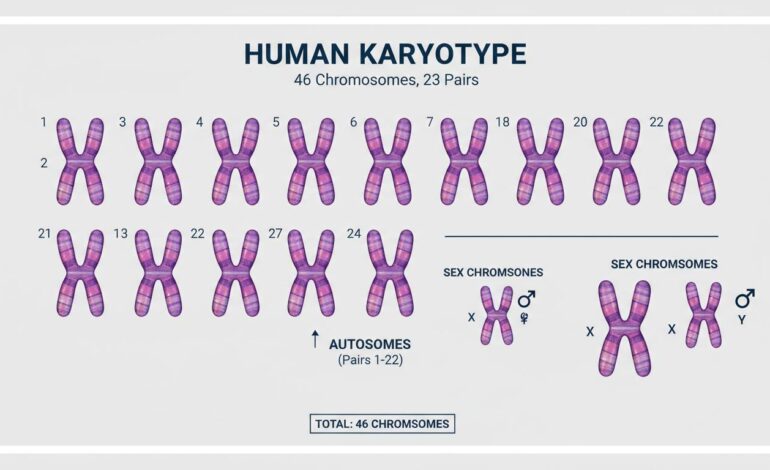
How many chromosomes do humans have? Humans typically have 46 chromosomes in each cell—arranged in 23 pairs. That’s the quick, straight answer. But why that number, what does it mean, and how does it really affect us? Let’s dive in.
What Is the Human Chromosome Count?
Humans carry 23 pairs of chromosomes—totaling 46. One chromosome of each pair comes from your mother, the other from your father. Twenty-two of these pairs are called autosomes, and the 23rd pair are the sex chromosomes—XX in most females and XY in most males .
In reproductive cells—sperm and eggs—only one set of 23 chromosomes is carried. When conception happens, the two sets merge to restore the 46-chromosome count .
Why Exactly 46 Chromosomes?
Every species tends to have a fixed number of chromosomes. Humans have 23 pairs; fruit flies have 4 pairs, rice plants 12, and dogs 39 .
This stable number matters because chromosomes organize DNA tightly. Wrap your DNA differently, or get the wrong number, and your cells might not divide correctly or carry the right info .
“The unique structure of chromosomes keeps DNA tightly wrapped around spool‑like proteins… Without such packaging, DNA molecules would be too long to fit inside cells.”
Breaking Down the 23 Pairs
Autosomes (Pairs 1–22)
These aren’t involved in sex determination. Each autosome pair carries genes influencing traits like height or hair color. Chromosome 1 is the largest; Chromosome 22 is one of the smaller ones .
Sex Chromosomes (Pair 23)
They’re special. Females usually have two X chromosomes (XX); males usually have one X and one Y (XY) . The X has far more genes than the Y . And in females, one X gets silenced in each cell—a process called X-inactivation .
What Happens When Numbers Go Wrong?
Sometimes chromosomes don’t pair up properly—leading to conditions like Down syndrome (three copies of chromosome 21, total 47) or Turner syndrome (only one X, total 45) .
Chromosome errors also link to cancers—like the Philadelphia chromosome in leukemia, where parts of chromosomes 9 and 22 swap places .
Human Chromosome Tips by Section
Understanding Chromosome Structure Simplified
- DNA wraps around proteins (histones).
- That wraps into chromatin, then into distinct chromosomes.
- Each has a centromere (pinch point) and arms labeled “p” (short) and “q” (long) .
How We Inherit Chromosomes
Kids inherit half their chromosomes from each parent. That’s why traits can run in families . For mitochondrial DNA, only the mother’s side passes it on .
Chromosome Functions & DNA Organization
Chromosomes ensure DNA is organized and copied correctly. Unraveled DNA can’t fit into cells—it’d stretch unrealistically long, like six feet per cell! .
Real Stuff: What If Chromosomes Aren’t 46?
- Down syndrome: +1 chromosome 21 = 47 total.
- Turner syndrome: only one X = 45.
- Some people have triple X or XYY syndromes with minimal symptoms .
Real-World Example: Karyotype in Action
Doctors look at karyotypes—pictures of a person’s chromosomes lined up in order. It’s how they spot missing or extra chromosomes. Pretty cool, and very practical.
Why This Matters
- It explains how traits pass down.
- It shows why errors in chromosomes matter—especially for developmental disorders.
- It’s key to genetic testing and diagnosing diseases.
Conclusion
Humans have 23 pairs of chromosomes—46 total—that carry all the genes that make each of us, well, us. That number is super important, because it determines how our DNA is carried, divided, and passed on. Mess with it, and you can get real effects—sometimes serious. But most of the time, it all works perfectly.
Understanding the chromosome count isn’t just biology—it’s about who we are, how we grow, and why tiny changes can matter.
FAQs
Q: Do all cells have 46 chromosomes?
A: Most human cells—like skin or muscle—have 46 chromosomes. But red blood cells lose their nuclei and reproductive cells only have 23.
Q: Can humans have more or fewer than 46 chromosomes?
A: Yes. Conditions like Down syndrome (47 chromosomes) or Turner syndrome (45 chromosomes) arise from having more or fewer chromosomes.
Q: Why is the Y chromosome so small?
A: The Y has fewer genes than the X. It’s mainly responsible for male development, but most of our genetic instructions live elsewhere.
Q: What does “diploid” mean?
A: Diploid means having two sets of chromosomes—like human cells with 46 total (2 × 23). Reproductive cells are haploid—they have one set (23).
Q: What happens in X-inactivation?
A: In individuals with two X chromosomes, one X gets silenced in each cell, so only one is active—a way the body balances gene dosage between sexes.
Let me know if you’d like visuals, deeper gene-level info, or stories about takeaway lessons from chromosome science!