How Many Miles Is 10,000 Steps? Walking Distance Explained

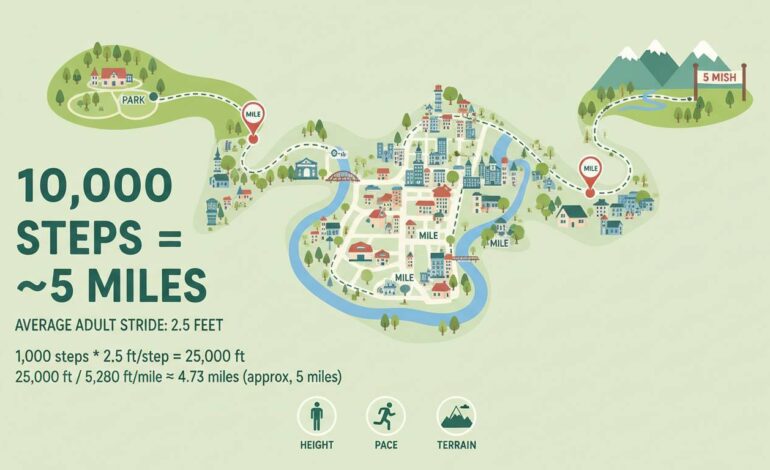
Here’s the straight answer: 10,000 steps generally equals about 4.7 to 5 miles for most adults. That’s based on an average stride length of roughly 2.1 to 2.5 feet, which translates to around 2,000 steps per mile.
Stronger walking or running strides, terrain, and personal height can shift that total a bit higher or lower, but five miles is the reliable ballpark for quick reference.
What Determines Your 10,000-Step Distance?
Stride Length and Personal Variability
Stride length differs from person to person. Most adults walk with a stride between 2.1 to 2.5 feet—so that works out to about 2,112 steps per mile on average. For faster walking or running, stride length stretches, meaning fewer steps make a mile—around 1,950 steps per mile for brisk walking, and only 1,600 per mile for running.
Height Matters
Taller individuals generally take longer strides. For example, someone 6’0″ might walk ~4.77 miles in 10k steps, while a 5’4″ person might only clock 4.25 miles. So tweak your expectations based on your stature.
Pace and Terrain Effects
Walking speed influences stride, too. At 2.5 mph, a 5’9″ individual might only cover about 4.03 miles in 10,000 steps; speed that up to 3.5 mph, and they could walk nearly 4.9 miles. Uneven terrain or hills tend to shorten stride lengths—slow steps add distance without adding miles.
Quick Lookup: Miles per 10,000 Steps by Stride Type
| Step Profile | Steps per Mile | 10,000 Steps = Miles |
|———————-|—————-|————————-|
| Very short stride | 2,800 | ≈ 3.57 miles |
| Short adult stride | 2,400 | ≈ 4.17 miles |
| Average walking | 2,112 | ≈ 4.74 miles |
| Brisk walking | 1,950 | ≈ 5.13 miles |
| Running stride | 1,600 | ≈ 6.25 miles |
These figures give flexibility—choose the row that fits your pace and build best.
Why the “5 Miles” Rule Stuck Around
The “10,000 steps equals 5 miles” figure is a widely used rule of thumb. Most health websites, fitness blogs, and even medical institutions lean into that number—saves time explaining.
Plus, health goals often align: 10,000 steps boosters roughly equal the recommended 30 minutes of brisk walking per day.
Health Context: Step Counts and Well-being
Stepping goals came from 1960s Japan—not from science. Even so, modern studies show real benefit from fewer steps. For instance, 4,400 steps a day significantly lower mortality in older women, while 7,000–9,000 steps seem linked to the most gains.
So the message is: yes, 10,000 steps is nifty—but walking more than even 4,000 steps gives you health wins.
Real-Life Example: Planning Your Day
Imagine breaking up steps through daily life:
- Morning walk: 1.5 miles (~3,000 steps)
- Walking lunch: 1 mile (~2,000 steps)
- Evening stroll: 1.5 miles (~3,000 steps)
- Errands/office movement: ~2,000 steps
Totals out to about 5 miles and 10,000 steps—spread out, it’s manageable.
Expert Insight
“Understanding steps in terms of distance gives folks clearer, more motivating goals—rather than chasing some arbitrary number, they see that a few extra steps can get them half a mile closer to that daily mile target.”
Use devices that allow you to measure your personal stride—and you can make your daily steps even more accurate.
Conclusion
Most people can assume 10,000 steps equals around 4.7 to 5 miles, depending on stride, pace, and body type. Tall, brisk walkers get more mileage for each step; slower or shorter-stride folks get slightly less.
Health benefits pop up even before you hit 10,000—between 4,000 and 9,000 steps daily. So if 10,000 feels daunting, start smaller and build up. The goal is movement that fits your life—even if it’s just around the block.
FAQs
How can I estimate my own stride length?
Walk a measured distance (like 100 feet), count your steps, then divide distance by steps. That gives your real stride length for personalized estimates.
Is 10,000 steps necessary for health?
Not really—studies show significant benefits beginning around 4,400 steps, with even greater impact between 7,000–9,000 steps.
How long does walking 10,000 steps take?
Typically between 1.5 to 2 hours, depending on speed and stride. Brisk walkers do it closer to the lower end.
Can I turn steps into miles using my tracker?
Yes. Devices like Fitbit let you calibrate your stride using your height, or even better, GPS tracking to get more accurate distance measurements.
Why do 10,000 steps often equal 5 miles?
It’s a convenient average based on 2,000 steps per mile. It’s easy to remember and aligns with general walking recommendations—even if not perfectly precise.
Does running affect step-to-mile conversion?
Absolutely. Runners have longer strides—so at running pace, 10,000 steps could equal around 6 miles. That’s quite a leap from walking estimates.